
The Architecture in Use
Closing Chapter 3 — seven moves, one argument, and the toolkit you carry forward

The synthesis that closes Chapter 3. Seven posts that looked like seven topics turn out to be one argument — and they hand you four working instruments for the chapters ahead.
Let me do what I do at the end of every chapter: look back before looking forward. Chapter 3 changed mode. The first two chapters were constructive — building the coordinate system, laying the biological and phenomenological ground. This chapter was cartographic: we took the framework and used it as a locating instrument. The previous section reached the culmination. Now the shape of the whole.
Seven moves, one argument
We opened by placing two schools — behaviorism and constructivism — through two running examples: a child learning “cup,” a child facing two rows of counters. Both turned out to be Agent–World primary, differing in the engine. Phenomena first, placement after.
We added two more lenses — cognitivism and 4E — to the same two children. Cognitivism asked what changed inside (a rule, not a habit; Chomsky’s poverty of the stimulus); 4E asked what the body, the scene, and the tools contributed. Four traditions, one architecture, none complete alone.
We took up Kahneman’s two systems — and showed why science is a System 2 enterprise: every element of method is a countermeasure for a System 1 failure. Beneath “fast and slow” we found the deeper contrast — schematic and stochastic — and the mechanism of expertise, re-habituation.
We watched four sciences converge on that single distinction: associative vs. rule-based, prior vs. prediction error, biologically primary vs. secondary, implicit substrate vs. explicit competence. Independent traditions, one contrast — convergence as evidence.
We traced, in a reflective reconstruction, where the computational picture came from — Gödel, Turing, cybernetics, 1956 — what it enabled, and what its hidden assumption of substrate independence cost. The stream treated as the whole of cognition; the snapshot discarded as detail.
We reframed nature and nurture as two inheritance channels — phyletic and mimetic — and drew out the diagnosis that science, being mimetically inherited, must be taught.
And we reached the inversion thesis: natural intelligence runs habitat → memetat, world to symbol, living snapshot generating the stream; artificial intelligence runs the architecture backward, a frozen map derived from the archive, reaching back toward the world.
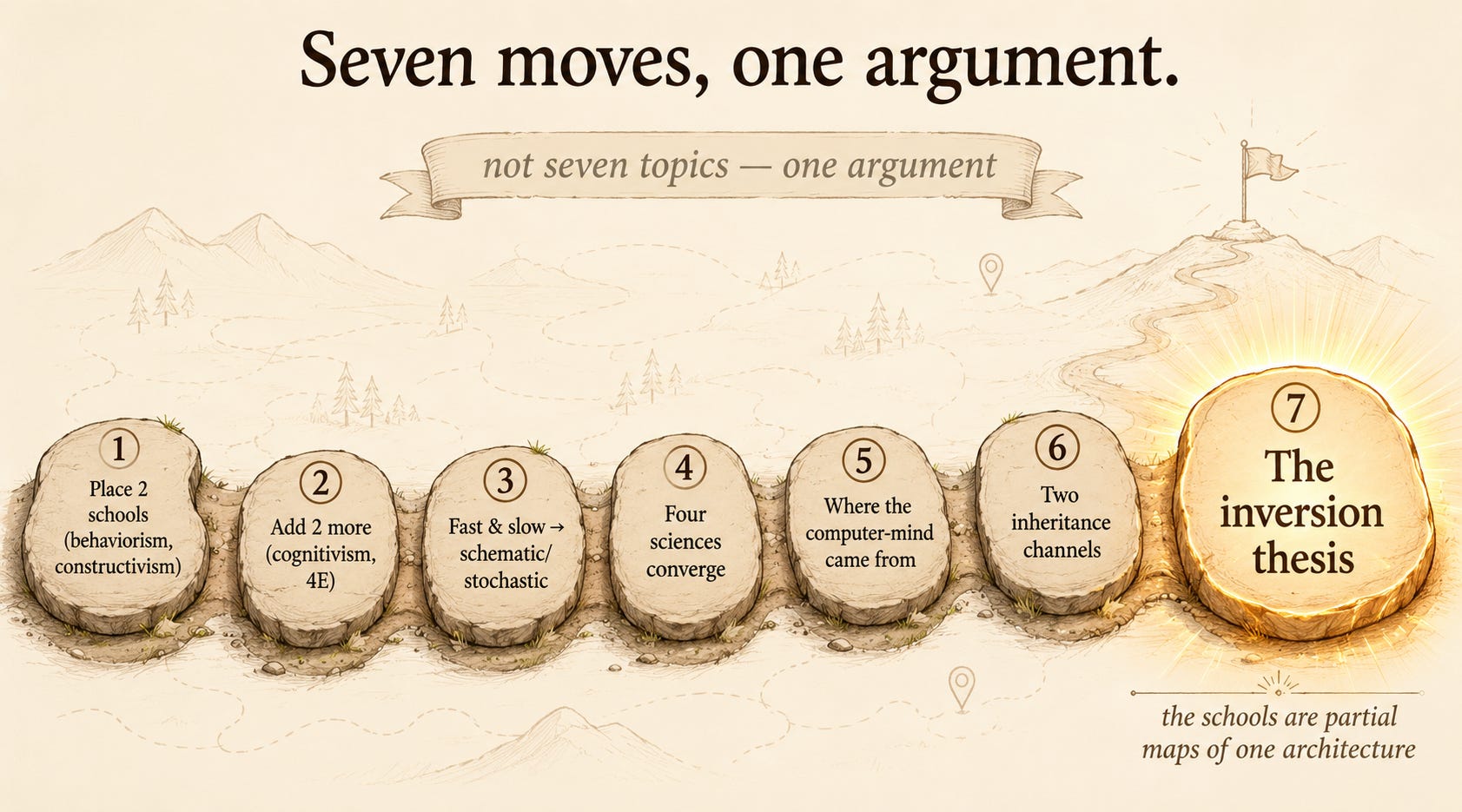
That is not seven topics. It is one argument in seven moves: the schools are partial maps; what they map is the same architecture; that architecture has deep roots in four independent sciences; it is expressed developmentally in the phyletic/mimetic distinction; and it culminates in the inversion thesis — the framework’s sharpest and most timely application.
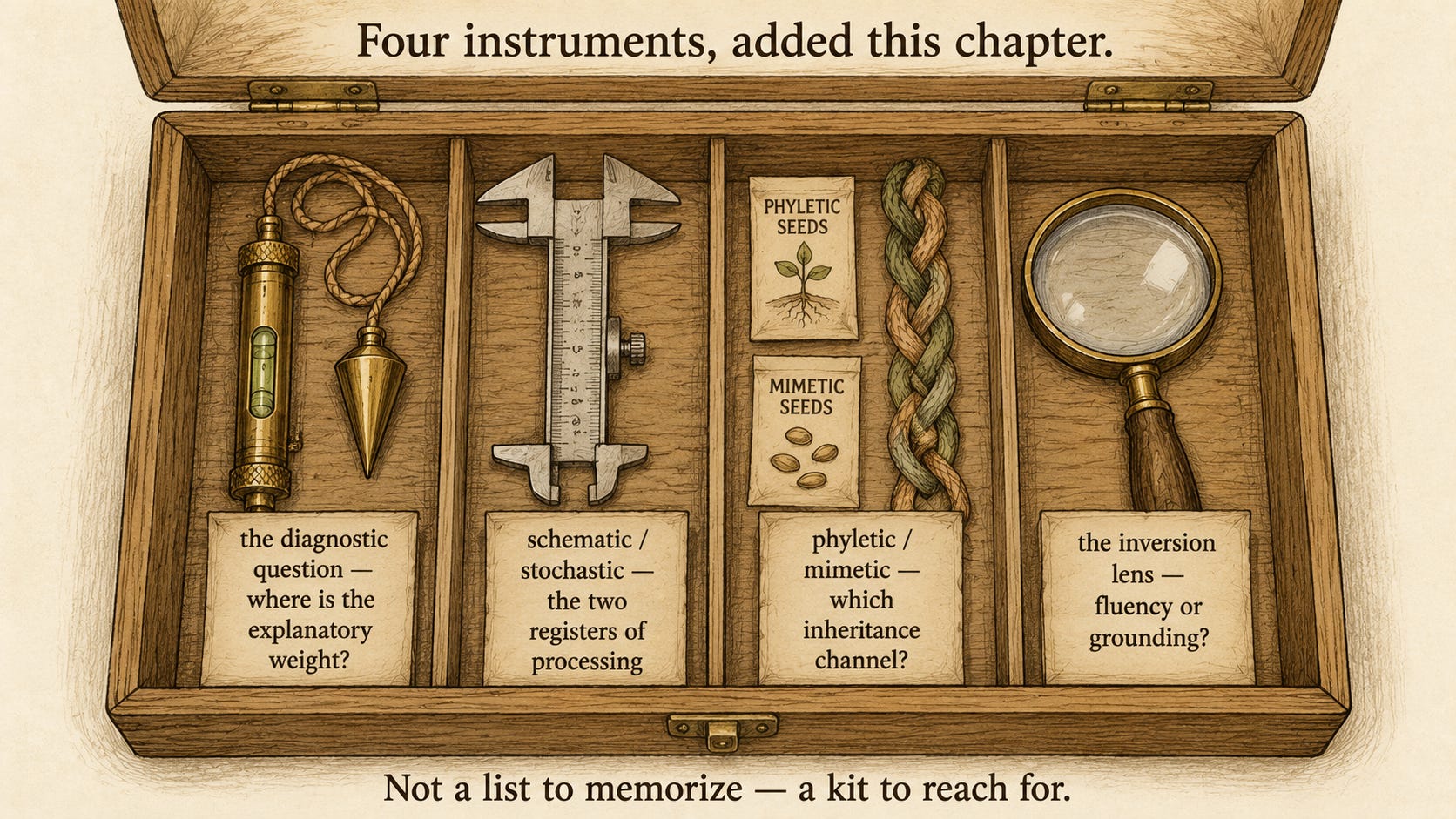
What’s new in your toolkit
Name what you now carry that you did not at the chapter’s start.
The diagnostic question: where is the explanatory weight? You have practiced it on four major traditions. You can pick up any theory, research program, or pedagogy and locate it in the triadic lens before evaluating it — naming the primary vertex, the mechanism, the bet, and what it leaves in the background by design.
The schematic/stochastic contrast as an instrument. Not just two modes of thinking but the epistemic face of the habitat/memetat dialectic, grounded in four sciences. Of any cognitive performance you can now ask: what is the stochastic substrate, what is the schematic overlay, and where is the re-habituation that connects them?
The phyletic/mimetic distinction as a diagnostic. When someone calls a capacity innate, or learned, you can ask the better question: through which channel was it transmitted, and how do the two interact?
The inversion lens for AI. When you meet a claim about what models can or cannot do, you can ask: is this about fluency or grounding? The frozen snapshot or the living one? Pattern completion or re-habituated expertise? These are not just intellectual tools. They are practical instruments — for research, teaching, the design of learning environments, and the evaluation of AI.
What remains open — and what lies ahead
Chapter 3 was cartographic. It gave you tools for locating and comparing theories — not yet the full content of what those theories say about the specific capacities that make science possible. That is the work of the chapters ahead.
We know where language sits in the lens — but not yet what language does in scientific practice: how scientists use it not only to communicate findings but to constitute them, to negotiate meaning across communities. That is Chapter 4: language as a cognitive technology. We know spatial cognition is biologically primary — but not yet how science transforms it into the abstract spaces of diagrams, graphs, and equations. That is Chapter 5. We know model-based reasoning is the distinctive achievement of science — but not yet its cognitive structure. That is Chapter 6. We know affect grounds valuation — but not yet how curiosity, confusion, and insight function as epistemic emotions in learning. That is Chapter 7. And we know cognition is distributed — but not yet how institutions and instruments extend the agent’s reach across generations. That is Chapter 8. The map is sharper. The territory lies ahead.
Three chapters
Three phases of construction. Chapter 1 gave the coordinate system — the cognitive framing, the triadic lens, the five demarcations, the habitat/memetat dialectic, the snapshot/stream architecture. The compass. Chapter 2 gave the biological ground — from behaviorism’s bracket through the lived body, the developmental mechanism, autopoiesis, sensorimotor contingencies, and joint attention, to the snapshot/stream synthesis. The ground. Chapter 3 put the framework to work — placing the schools, explaining the systems, tracing the historical turn, distinguishing the channels, naming the inversion. The architecture in use.
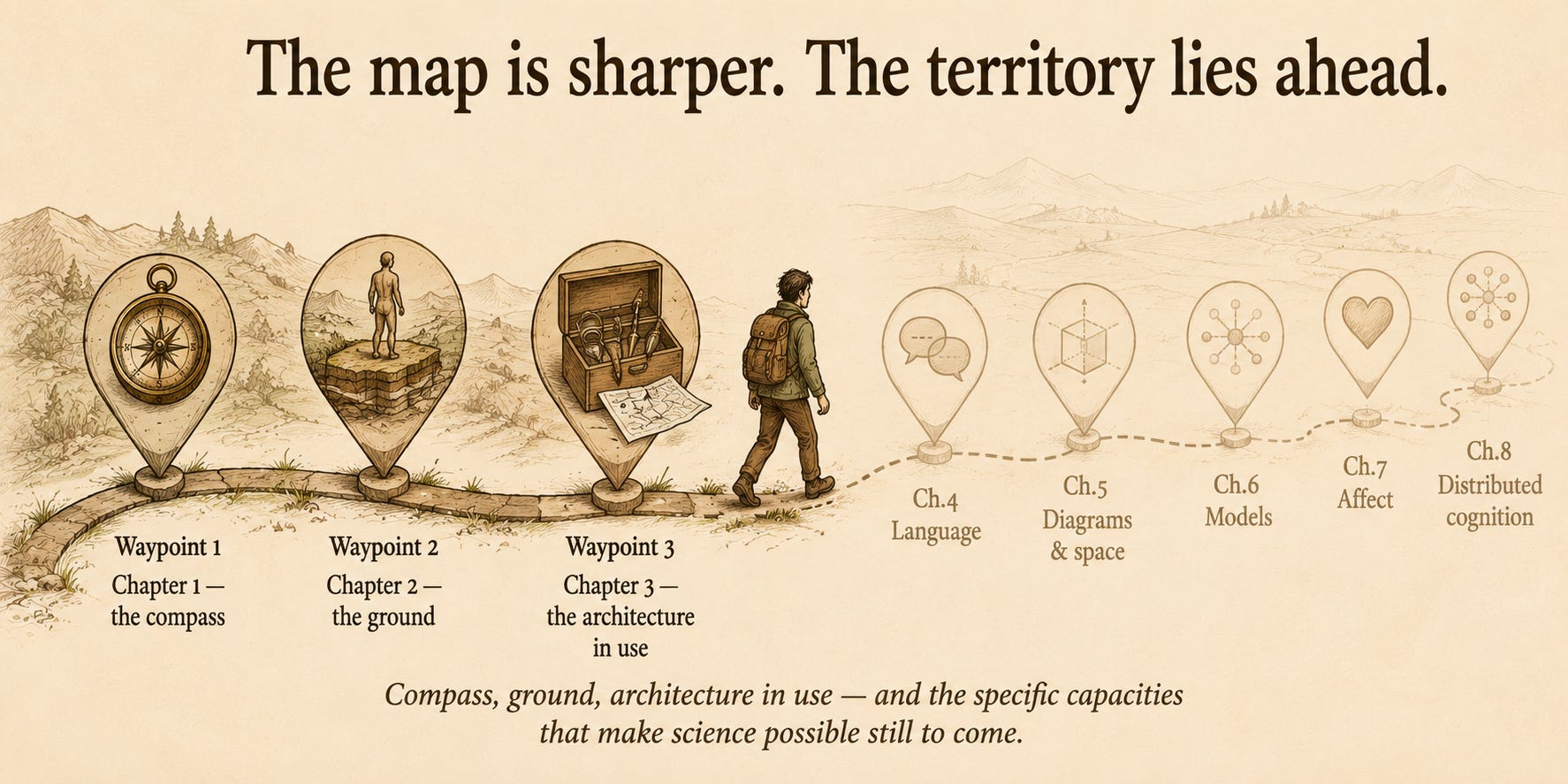
The questions ahead are not easier than the ones behind. But they are better equipped. The compass has not changed. The ground has been laid. The architecture is in use. We carry forward — with the same open mind, the same willingness to sit with hard questions, and the same conviction that understanding what makes science possible is one of the most important things cognitive science can do.
Take-home. Chapter 3 used the framework rather than building it. Its seven posts are one argument: the schools of cognitive science are partial maps of a single architecture; that architecture is confirmed by four independent sciences converging on the schematic/stochastic distinction; it is expressed developmentally through the phyletic/mimetic channels; and it culminates in the inversion thesis distinguishing natural from artificial intelligence. You now carry four working instruments — the diagnostic question (where is the explanatory weight?), the schematic/stochastic contrast, the phyletic/mimetic distinction, and the inversion lens — into the chapters where the framework meets the specific capacities that make science possible.
Next: Chapter 4 opens — “Language as a Cognitive Technology.” We know where language sits in the lens. Now we ask what it actually does in science: not just carrying findings between minds, but constituting them — the first of the specific capacities the rest of the series examines.
Image prompts used for this post. Try them on your own AI model and compare what it produces with our figures.
1. Seven moves, one argument
Output format: PNG. Landscape, 18cm × 10cm. A single winding path made of seven connected stepping-stones, left to right, each labeled with one move of the chapter's argument, the path clearly building toward a destination on the right. Stone 1: "Place 2 schools (behaviorism, constructivism)". Stone 2: "Add 2 more (cognitivism, 4E)". Stone 3: "Fast & slow → schematic/stochastic". Stone 4: "Four sciences converge". Stone 5: "Where the computer-mind came from". Stone 6: "Two inheritance channels". Stone 7 (largest, glowing, the destination): "The inversion thesis". Above the path, a faint banner reading "not seven topics — one argument". Below the destination stone, a small caption: "the schools are partial maps of one architecture". Above the whole figure, large caption: "Seven moves, one argument." Soft warm tones; clean schematic line-art; not photographic; no brain icon.2. The Chapter 3 toolkit
Output format: PNG. Landscape, 16cm × 9cm. An open toolbox, top-down view, with FOUR clearly distinct instruments laid out side by side, each labeled — echoing the "five demarcations toolkit" image from the Chapter 1 close, but now four new tools. (1) A plumb line / level labeled "the diagnostic question — where is the explanatory weight?". (2) A two-sided caliper labeled "schematic / stochastic — the two registers of processing". (3) A pair of distinct seed packets or a two-strand braid labeled "phyletic / mimetic — which inheritance channel?". (4) A lens/loupe labeled "the inversion lens — fluency or grounding?". Small caption above the toolbox: "Four instruments, added this chapter." Small caption below: "Not a list to memorize — a kit to reach for." Warm wood tones; sketched, schematic line-art; not photographic; no brain icon.3. Three chapters — and the road ahead
Output format: PNG. Landscape, 18cm × 9cm. A journey diagram, left to right. Three completed waypoints behind, each with an icon and label: Waypoint 1 "Chapter 1 — the compass" (a small brass compass); Waypoint 2 "Chapter 2 — the ground" (layered bedrock with an embodied figure); Waypoint 3 "Chapter 3 — the architecture in use" (the toolbox + a small map being read). A walking figure stands just past Waypoint 3, facing RIGHT toward five faint, not-yet-reached waypoints fading into the distance, labeled: "Ch.4 Language", "Ch.5 Diagrams & space", "Ch.6 Models", "Ch.7 Affect", "Ch.8 Distributed cognition". The path under the three completed waypoints is solid; the path ahead is dashed. Above, large caption: "The map is sharper. The territory lies ahead." Below, smaller caption: "Compass, ground, architecture in use — and the specific capacities that make science possible still to come." Warm earthy palette; sketched, schematic line-art; not photographic; no brain icon.The same stream (prompts) activates different snapshots (models) in different receivers (agents). Try the prompts above on your own AI model and compare what it produces with our figures.
This is “The Roots of STEM,” a series exploring the cognitive bases of science, technology, engineering, and mathematics. Subscribe to follow the arc from the body to the laboratory.