
When the Mind Became a Computer
Section 5 of Chapter 3 — the computational turn, and what it cost

A reflective reconstruction. Where did the idea that the mind is a computer actually come from? It runs from a failed dream in mathematics, through Gödel and Turing, through wartime cybernetics, to a single extraordinary year — 1956. Tracing it shows both why cognitive science has the shape it does and why the embodied traditions had to push back.
Every so often this series steps back to ask where its own framework came from. We did this with Descartes’ divide. This time the target is the computational metaphor — the picture of the mind as an information-processing machine — which the previous section leaned on heavily. Where did it come from, what did it make possible, and what did it cost?
The dream of mechanized reason
The story starts not with computers but with mathematics. In the late nineteenth and early twentieth centuries, Frege, Russell, and Whitehead tried to show that all of mathematics could be reduced to logic — that every mathematical truth was derivable from a small set of formal axioms by explicit inference rules. No intuition required. Just symbol manipulation, checkable mechanically. The project was called logicism, and behind it lay a profound idea: that valid reasoning has a formal structure that can be made completely explicit — that validity is a matter of formal relationships between symbols, not of what it feels like to the reasoner.
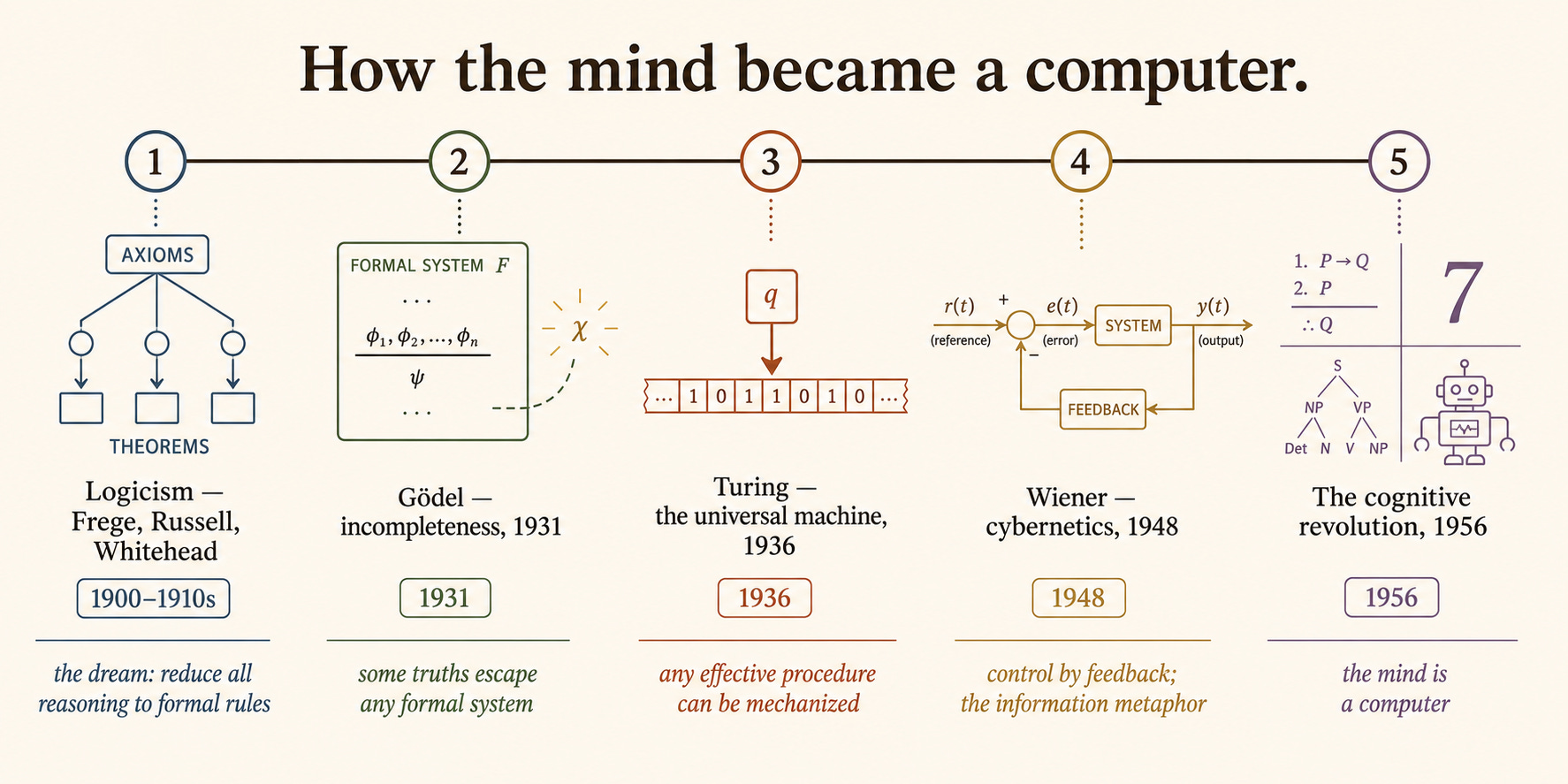
In its strongest form, logicism failed. In 1931, Kurt Gödel proved his incompleteness theorems. The first: any formal system powerful enough to express basic arithmetic contains truths that cannot be proved within it. There will always be truths that escape formalization. The second: no such system can prove its own consistency from within. These were devastating for logicism as a foundation. But they left something enormously productive — they showed, with absolute precision, that formal symbol manipulation could capture the structure of valid inference, and they marked exactly where that capture necessarily fails. The next question wrote itself: what, exactly, can formal systems compute — and is human reasoning among those things?
Turing’s universal machine
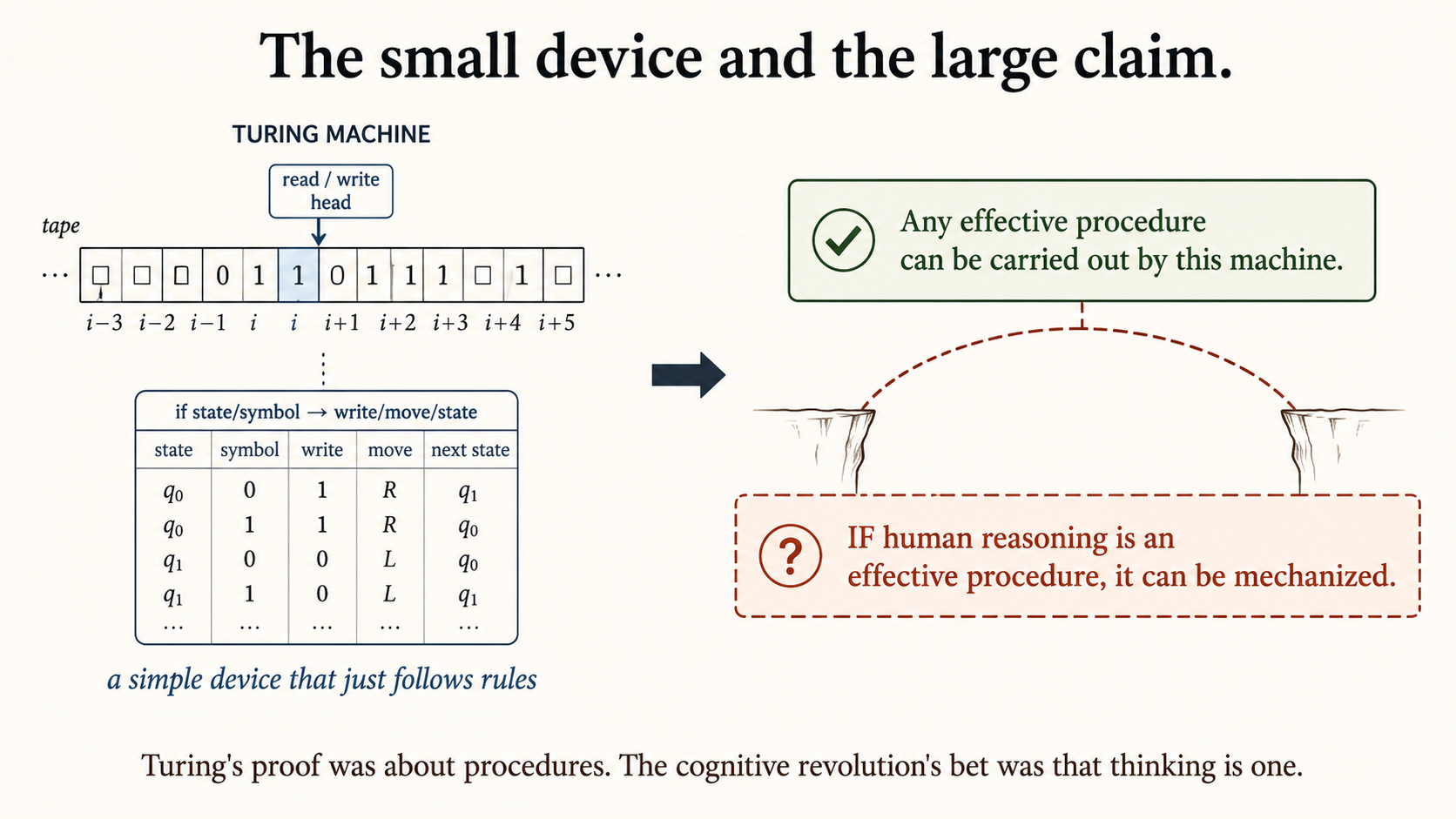
The pivot from logic to computation is Alan Turing. In 1936 he introduced the abstract machine that now bears his name: a simple device that reads symbols from a tape, applies a finite set of rules to decide what to write and where to move, and continues until it halts. No intelligence, no insight — just mechanical rule-following.
And Turing proved something remarkable about this trivial device. Any effective procedure — any precisely specifiable, step-by-step process — can be carried out by a Turing machine. And there exists a universal Turing machine: one that can simulate any other, given its description. The implication was immense. If human reasoning — or any part of it — is an effective procedure, then it can in principle be mechanized. And what can be mechanized can be modeled, studied, and perhaps reproduced in something that is not a brain. Turing pressed the point directly in his 1950 paper Computing Machinery and Intelligence — the one with the Turing Test. “Can machines think?” he proposed replacing with an operational test. The debate has never ended.
Cybernetics and the information metaphor
While Turing developed the theory of computation, Norbert Wiener was coming at related ideas from another angle. His 1948 Cybernetics — from the Greek for “steersman” — was a general theory of control and communication in systems both living and mechanical. Its central concept was feedback: a system monitors its own output and uses the gap between actual and desired state to correct itself. The thermostat is the simple case; the nervous system, Wiener argued, does something analogous.
Cybernetics gave the study of brain and behavior a new vocabulary — the brain processes information; the nervous system transmits signals; behavior is the output of a control system — a language that applied to organisms and machines alike, and that pulled mathematicians, neurophysiologists, and engineers into one of the first genuinely interdisciplinary conversations. But notice something for our framework. The feedback loop — actual state checked against a desired state, error driving correction — is a schematic description of what this series calls structural coupling. What cybernetics could not capture is the organism’s side of the loop: the desired state is not externally specified but internally generated, out of the organism’s own imperatives. Hold that gap. The embodied traditions exist largely to recover it.
1956 — the cognitive revolution
Several things happened in one year that, together, turned the computational metaphor into a full research program. Allen Newell and Herbert Simon presented the Logic Theorist — a program that proved theorems from Russell and Whitehead’s Principia, some by routes of its own — and presented it not as a curiosity but as a model of human thinking. George Miller published “The Magical Number Seven, Plus or Minus Two,” arguing that short-term memory holds about seven chunks — and that such limits demand an information-processing account. Noam Chomsky presented transformational grammar, arguing that language has a deep formal structure requiring a generative rule system — the cognitivist account we met two sections ago, here in its birth year. And the Dartmouth conference founded artificial intelligence with an audacious charter: to simulate every aspect of human intelligence in a machine.
Together these constituted a paradigm shift. The mind is a computer. Thinking is computation — the manipulation of symbolic representations by formal rules. Cognitive science is the study of the programs running on the brain’s hardware.
What it enabled — and what it cost
The productivity was extraordinary. The metaphor gave cognitive science a precise vocabulary (representations, rules, algorithms), a methodology (the information-processing experiment, measuring cognition through reaction times and error patterns), a research program in AI that produced striking demonstrations, and the durable field of cognitive psychology. The framework is not wrong. It is partial — and partial frameworks can be enormously generative.
But it carried an assumption in its foundations: substrate independence — cognition is defined by the computational structure, the program, not by the physical stuff it runs on. The same program runs on a brain or a chip; the body is implementation detail, the environment is input. This licensed the separation of cognition from embodiment — and it had a cost. Classical symbolic AI was brilliant at formal tasks and brittle in the open-ended, noisy, context-sensitive real world. The brittleness was not an accident; it followed directly from ignoring the body and the environment as mere detail.
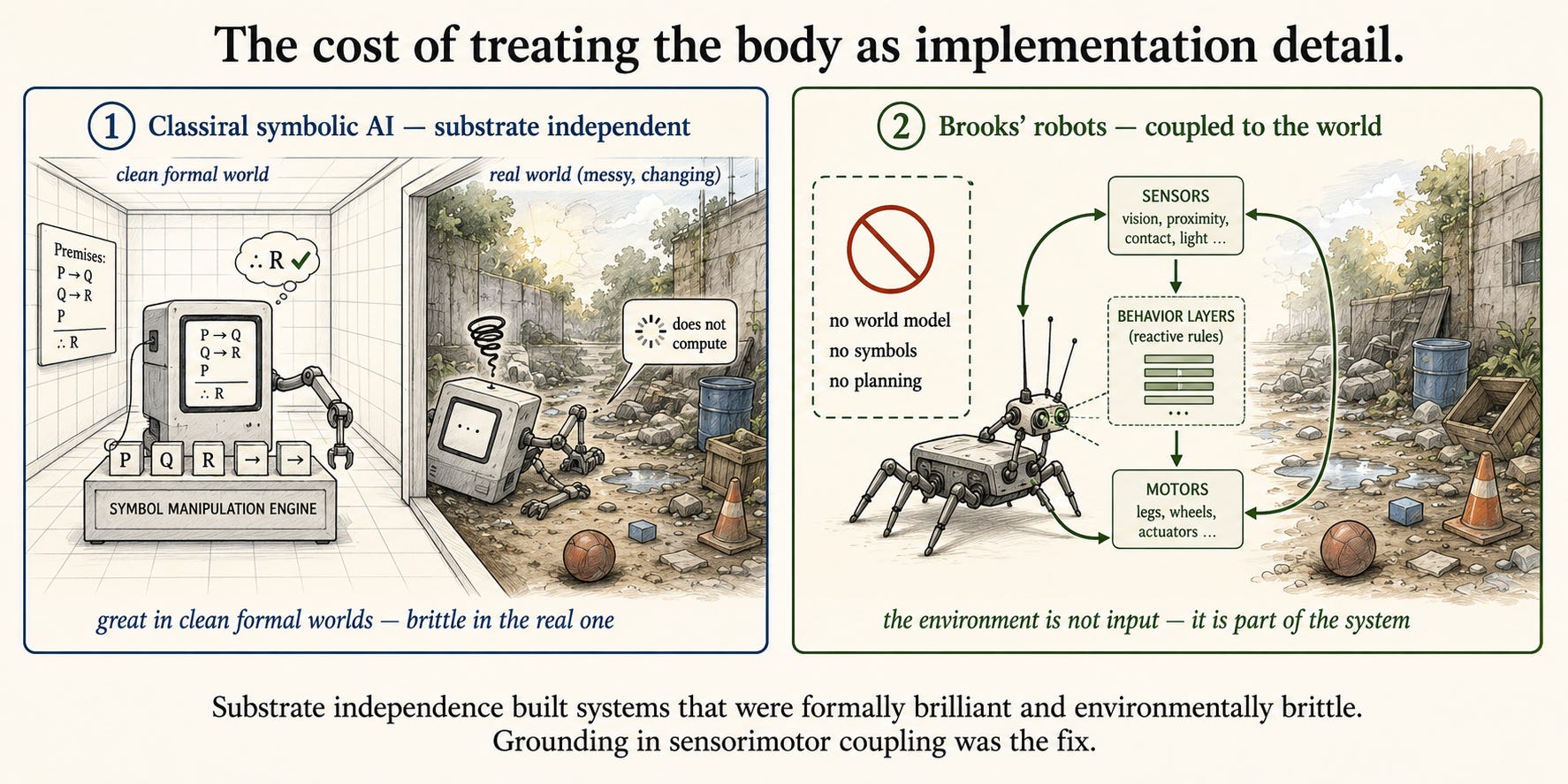
Rodney Brooks made the point vivid in the late 1980s. His subsumption architecture abandoned centralized symbolic planning for layered sensorimotor loops coupled directly to the world. His robots — no internal world model, no symbolic representations, no planning — navigated cluttered real environments more robustly than the classical systems, precisely because they were grounded in ongoing sensorimotor coupling. The environment was not input. It was part of the cognitive system. This is the empirical argument for the embodied traditions — not a philosophical preference for the body, but an engineering demonstration that cognition divorced from body and world is brittle in exactly the ways that matter.
The Gödel reflection
Let me close with a reflection that connects Gödel to this series’ architecture — carefully framed as a structural analogy, not a proof.
Gödel showed that any sufficiently powerful formal system contains truths it cannot prove from within. There is a structural rhyme with our architecture: the stream cannot fully capture the snapshot. Every schematic serialization of the agent’s holistic engagement with the world leaves something out — because the snapshot is analog and holistic, varying continuously and present in all its aspects at once, while the stream is discrete and sequential, one token at a time. The translation is necessarily lossy. And the loss is not a technical failure to be fixed by better encoding. It is a structural feature of the relationship between embodied meaning and communicable representation.
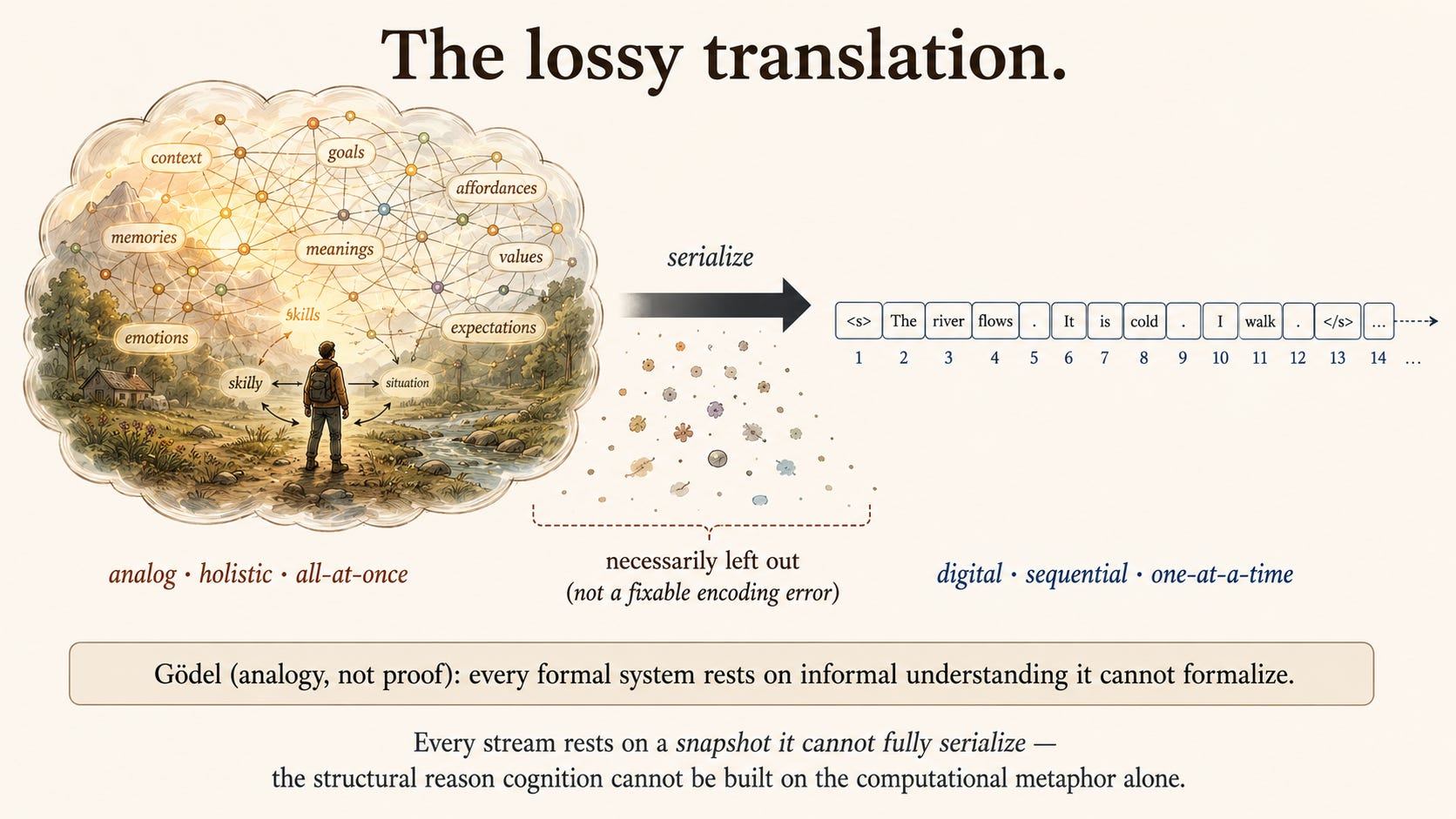
This is not a mystical claim about consciousness. It is an observation about what the snapshot and stream are. The computational turn made the snapshot-to-stream translation the whole of cognitive science — an enormously productive move, but always a partial one. The deepest contribution of the embodied, enactive, and biological traditions has been to restore the snapshot to its place: not as something to be eliminated in favor of the stream, but as the ground from which the stream arises and to which it always returns. Every formal system rests on informal understanding it cannot fully formalize. Every stream rests on a snapshot it cannot fully serialize.
Take-home. The computational turn — from logicism through Gödel through Turing’s universal machine through cybernetics to the cognitive revolution of 1956 — gave cognitive science its central metaphor: cognition is computation, the manipulation of symbols by formal rules. It was extraordinarily productive: experimental methodology, theoretical precision, the AI program. But it rested on the assumption of substrate independence — that the program is what matters and the body is implementation detail — which produced systems that were formally brilliant and environmentally brittle (Brooks’ robots showed the alternative). Gödel offers a structural parallel: just as every formal system contains truths it cannot prove within itself, every stream leaves behind a snapshot it cannot fully serialize. The computational turn treated cognition as pure schematic processing. The missing ground is the stochastic, embodied snapshot from which all schematic processing arises.
Next: “Two Channels of Inheritance.” The oldest debate in the study of mind — nature versus nurture — and why its framing is wrong. The better question: through which channel was a capacity transmitted? Humans, uniquely, have two.
Image prompts used for this post. Try them on your own AI model and compare what it produces with our figures.
1. The lineage of the computational metaphor
Output format: PNG. Landscape, 18cm × 9cm. A horizontal timeline / genealogy, left to right, with five connected stations, each a small icon + label + year. Station 1: "Logicism — Frege, Russell, Whitehead" (icon: axioms branching into theorems); a small caption "the dream: reduce all reasoning to formal rules". Station 2: "Gödel — incompleteness, 1931" (icon: a formal system with one true-but-unprovable statement glowing outside its boundary); caption "some truths escape any formal system". Station 3: "Turing — the universal machine, 1936" (icon: a tape with a read/write head); caption "any effective procedure can be mechanized". Station 4: "Wiener — cybernetics, 1948" (icon: a feedback loop with an error signal); caption "control by feedback; the information metaphor". Station 5: "The cognitive revolution, 1956" (icon: cluster of four small marks — a proof, the numeral 7, a syntax tree, a robot); caption "the mind is a computer". A connecting line threads all five. Above the timeline, large caption: "How the mind became a computer." Clean schematic line-art, warm/neutral palette; not photographic; no brain icon.2. The universal machine — and the leap
Output format: PNG. Landscape, 16cm × 9cm. On the LEFT, a clean schematic of a Turing machine: a long horizontal tape divided into cells with a few symbols (0s, 1s, blanks), a read/write head above one cell, and a small rule-table box ("if state/symbol → write/move/state"); label beneath: "a simple device that just follows rules". A bold arrow points RIGHT to a statement-block in two lines: line 1 (solid, established) "Any effective procedure can be carried out by this machine."; line 2 (drawn as a daring leap, dashed bridge over a gap) "IF human reasoning is an effective procedure, it can be mechanized." Above, large caption: "The small device and the large claim." Below, smaller caption: "Turing's proof was about procedures. The cognitive revolution's bet was that thinking is one." Clean schematic line-art; soft tones; not photographic; no brain icon.3. Brilliant but brittle
Output format: PNG. Landscape, 18cm × 9cm. Two side-by-side panels contrasting two approaches to building intelligence. PANEL 1 ("Classical symbolic AI — substrate independent"): a tidy machine manipulating clean symbols inside a pristine, gridded white room, solving a formal puzzle flawlessly; but at the room's doorway, stepping into a cluttered real-world scene (uneven ground, scattered objects, shifting light), the same system freezes/topples, with a small "does not compute" stall mark; label: "great in clean formal worlds — brittle in the real one". PANEL 2 ("Brooks' robots — coupled to the world"): a small insect-like robot with no internal world-model bubble (shown crossed-out: 'no world model, no symbols, no planning'), navigating the same cluttered scene smoothly via layered sensorimotor loops drawn as direct arrows between its sensors, the environment, and its motors; label: "the environment is not input — it is part of the system". Above both panels, large caption: "The cost of treating the body as implementation detail." Below both panels, smaller caption: "Substrate independence built systems that were formally brilliant and environmentally brittle. Grounding in sensorimotor coupling was the fix." Soft warm tones; sketched, schematic line-art; not photographic; no brain icon.4. The stream cannot fully capture the snapshot
Output format: PNG. Landscape, 16cm × 9cm. On the LEFT, a rich holistic "snapshot": a warm, densely interconnected cloud-web with a small embodied figure coupled to a fragment of world, many relations present at once, with subtle analog gradients; label "analog · holistic · all-at-once". A bold arrow labeled "serialize" points RIGHT to a thin one-dimensional row of discrete tokens marching in sequence; label "digital · sequential · one-at-a-time". Crucially, as the arrow crosses, a faint scattering of small fragments falls away below the arrow — visibly lost in translation — tagged "necessarily left out (not a fixable encoding error)". Beneath the whole figure, a quiet caption-band: "Gödel (analogy, not proof): every formal system rests on informal understanding it cannot formalize." Above, large caption: "The lossy translation." Below, smaller caption: "Every stream rests on a snapshot it cannot fully serialize — the structural reason cognition cannot be built on the computational metaphor alone." Soft warm tones on the snapshot side, cool on the stream side; clean schematic line-art; not photographic; no brain icon.The same stream (prompts) activates different snapshots (models) in different receivers (agents). Try the prompts above on your own AI model and compare what it produces with our figures.
This is “The Roots of STEM,” a series exploring the cognitive bases of science, technology, engineering, and mathematics. Subscribe to follow the arc from the body to the laboratory.
It has a lot to do with Descartes as well. First-order predicate binary logic as the main or sole kind of cognition, which will likely dominate thought until a half century after Chomsky dies.
Actually, the very idea of mind as an entity rather than a process, which goes back to Aristotle at least. We'd be in a better space if Heraclitus had dominated.
It’s awesome to see how even the greatest minds can confuse the explanation or the abstractions we made of what we perceibe with the phenomena itself. I think it all comes from Descartes and later interpretation of him. Putting reasoning first lead us straight to a subculture that ended up views humans as, in this case, thinking machines. We need the brain to have language and comunicate, but language and comunication does not happen in the brain, they happen in the relational space of the coexistance that we live everyday with other people.