
Descartes’ Divide
Section 5 of Chapter 2 — the historical move that made the embodied turn necessary

A Reflective Reconstruction — looking back to see how we got here.
We have spent the last three sections building, carefully, a picture of cognition as inseparable from biological life. Merleau-Ponty: the lived body as the medium through which a world is disclosed. Piaget: cognition constructed, developmentally, through the action schemas of the embodied agent. Maturana and Varela: cognition continuous with the self-producing organization of any living system.
So here is a question worth pausing on.
If this picture is as compelling as it seems — if the evidence for embodied, enactive, biologically grounded cognition is as strong as the traditions we have just been examining suggest — then why did it need to be argued for? Why isn’t it the default? Why has cognitive science had to fight, and in many quarters is still fighting, against a very different picture: one in which cognition happens inside a disembodied computational system, and the body is the hardware on which the software runs?
The answer is historical. And it leads back to one man, one argument, and one strategic move that has shaped Western thought about body and mind for nearly four centuries.
It leads back to René Descartes.
What Descartes was actually doing
It is worth being precise about this, because the usual textbook version misses what is at stake.
Descartes, writing in the early seventeenth century, was not primarily trying to solve the mind-body problem. He was trying to solve a more pressing one: how to give the new mathematical physics a secure foundation in a hostile theological climate.
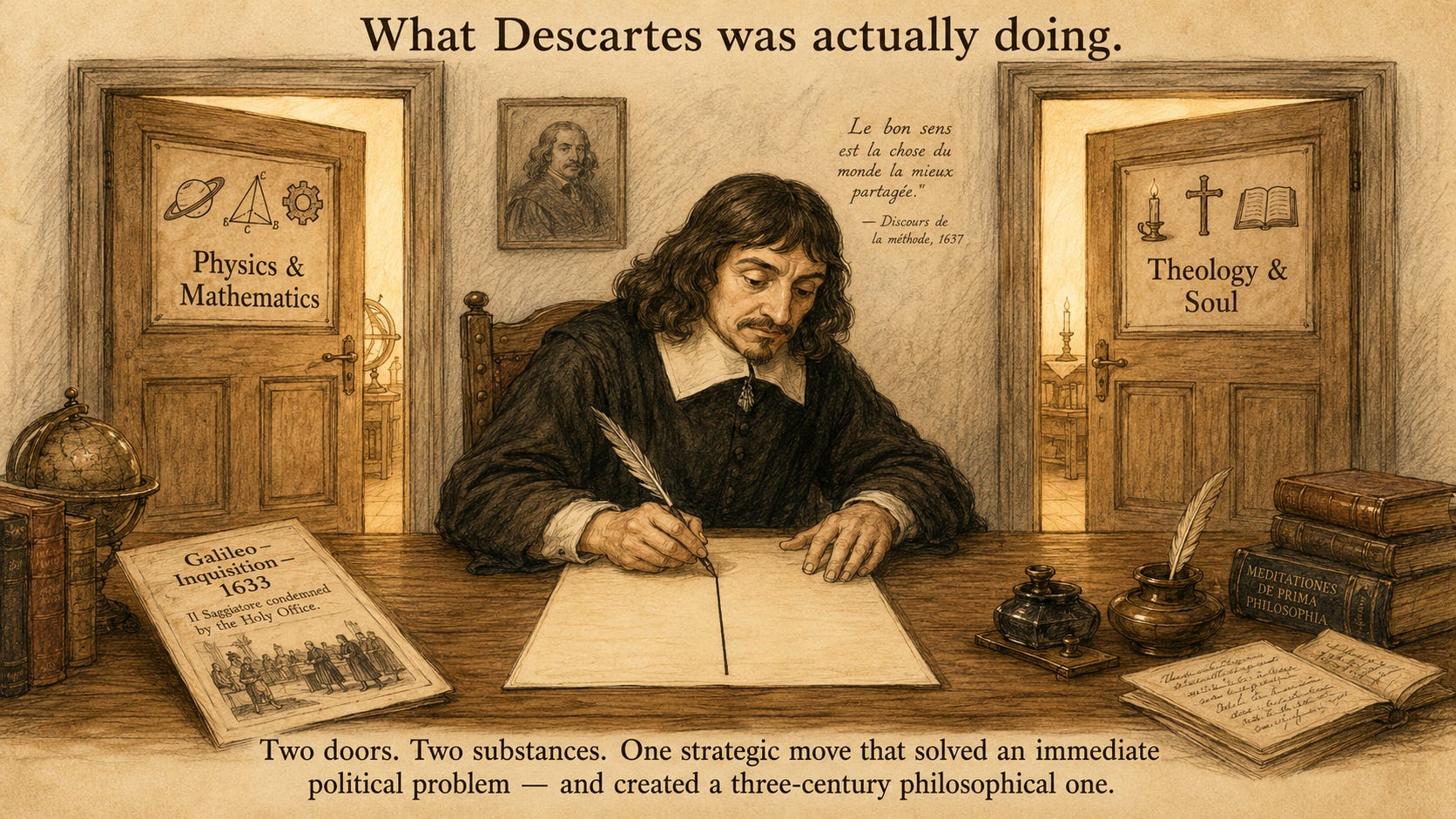
Galileo had just been condemned by the Inquisition for defending Copernican heliocentrism. The new science — mechanistic, mathematical, premised on the idea that the natural world could be fully described in terms of matter and motion — was in direct conflict with the Church’s picture of nature as a domain suffused with purpose, soul, and divine intention. Descartes needed a framework that would protect mathematical physics from theological interference while also keeping his own work clear of the fate that had befallen Galileo.
His solution was strategically brilliant. He divided reality into two entirely separate substances.
The Two Substances
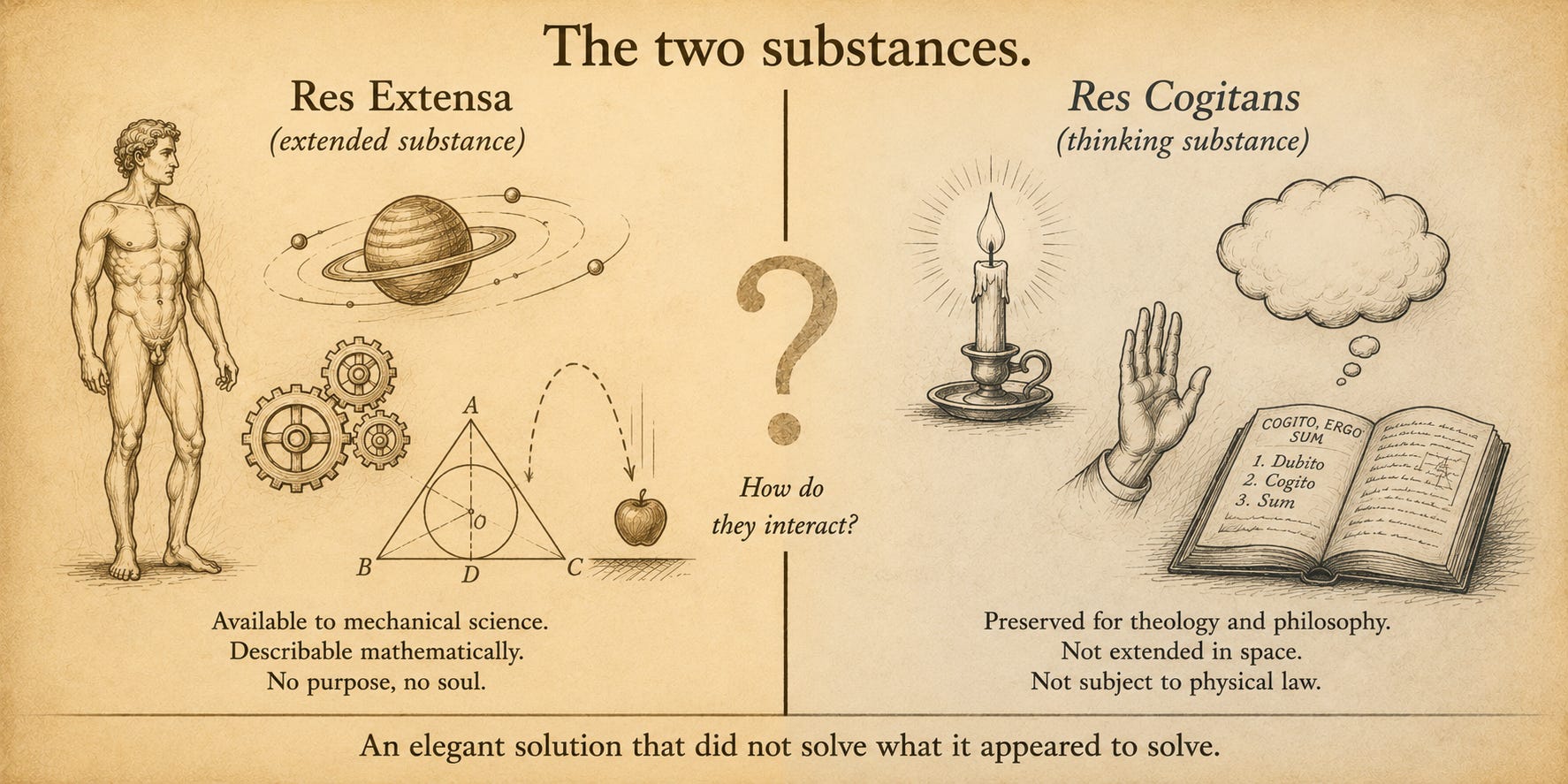
Res extensa — extended substance, the material world. Everything physical — bodies, animals, plants, planets, the human body itself — belongs here. The material world operates by mechanical laws. It can be fully described mathematically. It has no purpose, no soul, no interiority. It is, in the most literal sense, a machine. And as a machine, it is entirely available to scientific investigation. No theological objection can stand against the mathematical description of matter in motion.
Res cogitans — thinking substance, the immaterial mind. Thought, consciousness, will, the soul: these belong here. The mind is not extended in space. It cannot be described mechanically. It is not subject to the laws of physics. It is the domain of freedom, of reason, of the soul — and therefore the domain of theology and philosophy, not of natural science.
This division solved Descartes’ immediate problem at a stroke. The body — res extensa — was handed over to the new mechanical science. The soul — res cogitans — was preserved for theology. Neither could interfere with the other’s domain. Galileo’s misfortune could not happen to Descartes’ mechanics, because mechanics had been declared theologically neutral by construction.
The problem it created
But the strategic move created a problem that has never been satisfactorily resolved.
If mind and body are entirely separate substances — with no common nature, no shared properties — how do they interact? How does my decision to raise my arm cause my arm to rise? How does the pinprick in my finger, a material event, produce the conscious sensation of pain, a mental event?
This is the mind-body problem. And it is, in a precise sense, a problem that Descartes created — not discovered.
That distinction matters. The history of philosophy after Descartes can be read as a long series of attempts to solve the mind-body problem and a long series of failures. Not because the attempts were unintelligent. Because the problem, as framed, may not have a solution within Descartes’ framework.
The idealist response — Berkeley, then in different forms Kant and the German idealists — was to dissolve the problem by denying the independent existence of matter. If only minds and their contents are real, the interaction problem evaporates. But the position conflicts with the robust reality of the physical world that science was demonstrating with increasing precision. Most found it too high a price.
The materialist response was the opposite — deny the independent existence of mind, or reduce it to matter. If mental events are just physical events in the brain, the interaction problem disappears. This eventually became dominant in neuroscience and much of cognitive science. But it has its own difficulties — the subjective character of experience does not cooperate easily with reduction — and it tends to reproduce the Cartesian divide in a new form. Now it is not mind versus body but brain versus behavior, neural mechanism versus conscious experience. Same shape, different vocabulary.
The various reconciliation moves — parallelism (mind and body run in perfect parallel, never interacting), occasionalism (God coordinates them at every moment), Leibniz’s pre-established harmony — were never convincing. They read as theological patches on a philosophical wound.
The divide did not resolve. It institutionalized.
The institutional inheritance
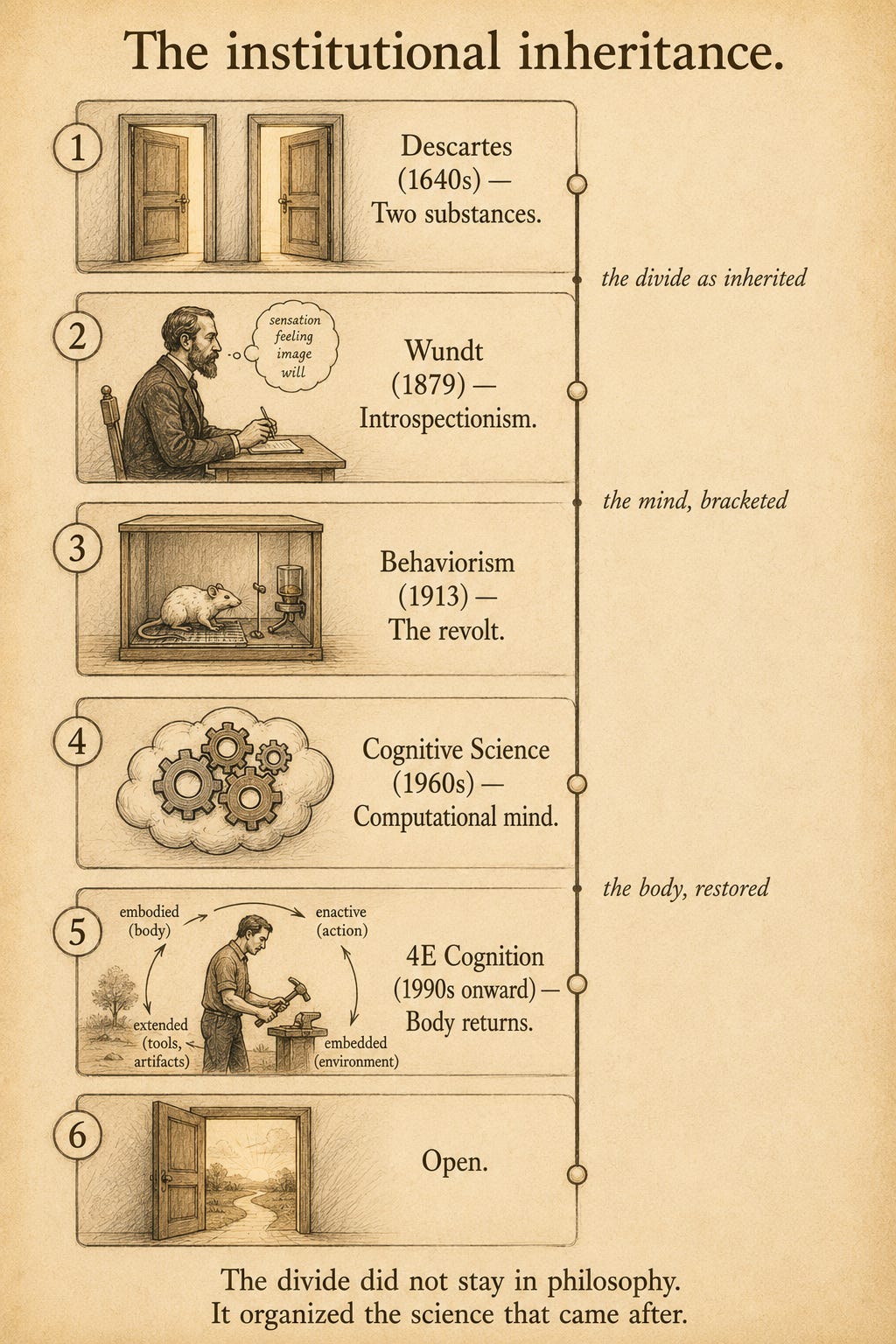
When Wilhelm Wundt founded the first experimental psychology laboratory in Leipzig in 1879, he was inheriting the Cartesian framework whether he wanted to or not. Psychology was to be the science of mind — of consciousness, experience, perception, thought. And mind, in the Cartesian tradition, is precisely what is separate from the body. This produced an immediate methodological problem: how do you study something that, by definition, is not available to external observation?
Wundt’s answer was introspection — trained observers reporting on the contents of their own consciousness. Behaviorism, as we discussed in the opening section of Chapter 2, was the revolt against exactly that. If mind is inaccessible, bracket it; study only what is publicly observable. Behaviorism was not, on this telling, a refusal of cognition — it was a methodological move against the Cartesian inheritance, and against the introspectionist tradition that the inheritance had produced. The body — or, more precisely, the organism’s action patterns — became the subject matter of a psychology that had decided to give up on the mind.
William James, Wundt’s great contemporary and rival, took a different path. His radical empiricism tried to dissolve the divide from another direction by insisting that experience is the primary datum, and that the distinction between mental and physical is a distinction within experience, not between two kinds of substance. James was, in his own way, anticipating the phenomenological tradition that Husserl would found and Merleau-Ponty would develop.
Husserl’s psychologism controversy — the one we examined in this series’ first Reflective Reconstruction — was itself a dispute within the Cartesian inheritance. Husserl was insisting that logic and mathematics cannot be grounded in the contingent facts of human psychology, which presupposes exactly the Cartesian separation between the necessary truths of reason and the contingent facts of the empirical mind.
The Cartesian divide did not stay in philosophy. It organized the institutional landscape of psychology, shaped the methodological disputes of the early twentieth century, and produced the framework within which cognitive science was eventually born — and against which the biological and embodied traditions have been pushing ever since.
What the embodied turn is responding to
Now you can see why Merleau-Ponty, Maturana, and Varela feel like responses to a historical problem. Because they are.
Merleau-Ponty’s insistence that the lived body is the condition of all experience — not an object among objects but the ground from which all objectivity is possible — is a direct challenge to the Cartesian separation. There is no res cogitans floating free of the body, constituting experience from a position of disembodied reason. There is only the lived body, already in the world, already engaged, already meaningful — prior to any Cartesian doubt and prior to any explicit cognition.
Maturana and Varela’s autopoiesis goes further. It grounds cognition in the biology of living systems. The mind-body problem, on the autopoietic account, is a pseudo-problem generated by the Cartesian framework. It assumes that mind and body are separate, then asks how they interact. But if cognition is continuous with life — if sense-making arises from the same organizational logic that defines the living system — then there is no separation to begin with. The question of how mind and body interact presupposes a divide that biology does not recognize.
This does not mean the problem evaporates. The subjective character of experience — what philosophers call qualia — remains deeply puzzling. The question of how neural processes give rise to conscious experience is not answered by autopoiesis, and certainly not by phenomenology. It is one of the genuinely hard problems in the study of cognition, and we should not pretend otherwise.
But the Cartesian framing of the problem — as a problem of interaction between two entirely separate substances — is increasingly replaced by a different framing: how does subjective experience arise from within a living system that is already organized, already engaged, already acting in a world it co-constitutes through its own activity? That question is harder to ask precisely. It is also a better question. And it is the question the biological and embodied traditions are working toward answering.
A lingering shadow
Let me close with something practical.
The Cartesian divide did not produce only a philosophical problem. It produced a cultural and institutional habit of thinking that shapes how science is practiced, how education is organized, how medicine treats the human body, and how we think about what it means to know.
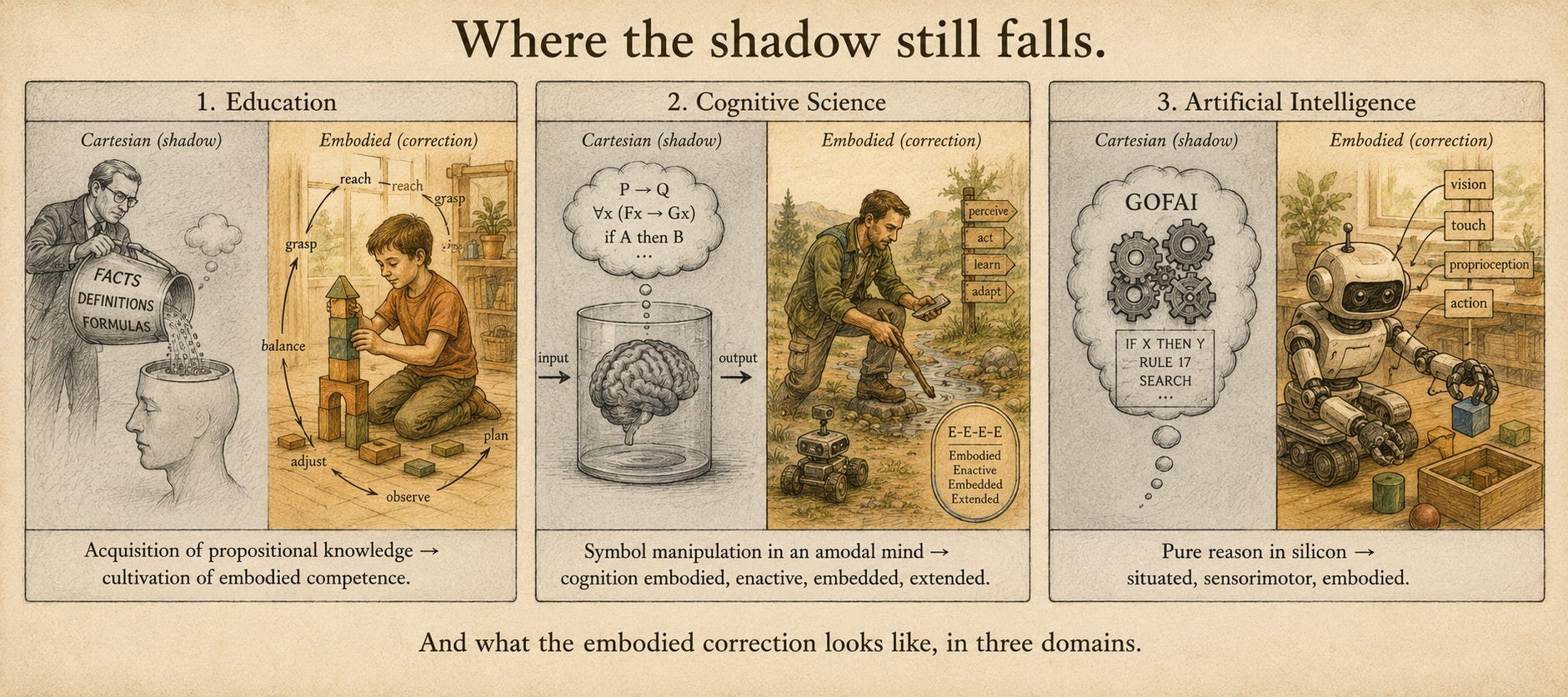
In science education, the Cartesian inheritance appears whenever we treat learning as the acquisition of propositional knowledge — facts and procedures stored in a disembodied mind — rather than as the development of embodied competence, the cultivation of perceptual skill, the transformation of action patterns. When we separate knowing from doing, theory from practice, cognition from affect, we are working within a framework that the biological evidence increasingly undermines.
In cognitive science itself, the inheritance appears whenever cognition is modeled as symbol manipulation in an amodal computational system, with the body as a mere input/output peripheral. The embodied, enactive, embedded, and extended traditions — the four E’s that this series keeps returning to — are, in part, the sustained empirically grounded argument that cognition cannot be separated from the body that implements it, the environment it is embedded in, and the practices and tools it is extended through.
In artificial intelligence, the inheritance appears most starkly. Classical symbolic AI was Cartesianism mechanized — the attempt to implement pure reason in silicon, with no body, no environment, no sensorimotor history. The brittleness and inability to handle the open-endedness of real-world environments that plagued classical AI can be traced directly to the Cartesian assumption that cognition can be separated from embodied engagement. The current revival of bodied, situated, sensorimotor AI is, on one reading, the field finally taking the embodied critique seriously after decades of trying to do without it.
The shadow is long. It is being lifted — slowly, empirically, through the accumulation of evidence from biology, neuroscience, developmental psychology, and cognitive science that points consistently toward the same conclusion: the Cartesian divide is not a discovery about the nature of reality. It was a strategic move, made for good reasons in a specific historical context, that produced a framework we have been living inside — and working our way out of — ever since.
Take-home point. Descartes did not discover the mind-body problem — he created it. The division of reality into res extensa and res cogitans solved an immediate political problem (protecting the new mathematical physics from theological objection) but generated a framework in which mind and body are entirely separate substances and their interaction becomes unintelligible. The institutional consequences shaped psychology, cognitive science, and AI for three centuries. Merleau-Ponty’s lived body and Maturana and Varela’s autopoiesis are, in part, the work of dissolving a framework that was never a discovery about nature — but has shaped the study of nature for a very long time.
Next: “Sensorimotor Contingencies” — Alva Noë and Kevin O’Regan on perception as something we do, not something that happens to us. The most concrete form of the embodied claim — and the one that lands directly in the laboratory.
Image prompts used for this post. Try them on your own AI model and compare what it produces with our figures.
1. What Descartes Was Actually Doing
Output format: PNG. Landscape, 16cm × 9cm. A 17th-century scene at René Descartes' writing desk, rendered in soft warm line-art, scholarly and sketched (not photographic). DESCARTES himself is seated at the desk in the center foreground, in 17th-century dress, leaning over a sheet of paper on which he is drawing a single vertical line down the middle — the line that will divide reality into two substances. Behind him, on the back wall, two doors stand side by side. The LEFT door bears a label "Physics & Mathematics" with small icons above it (a planetary orbit, a geometric proof, a gear); the door is slightly ajar, with warm light coming through. The RIGHT door bears a label "Theology & Soul" with small icons above it (a candle, a small cross, an open book); the door is also slightly ajar, with the same warm light. The two doors are clearly separate, with a solid wall between them — no passage from one to the other. On the desk in the foreground, a printed broadside is visible with the words "Galileo — Inquisition — 1633" faintly legible, providing the historical context. Caption above the figure: "What Descartes was actually doing." Caption below: "Two doors. Two substances. One strategic move that solved an immediate political problem — and created a three-century philosophical one." Soft warm tones; the figure of Descartes in close, contemplative posture; the doors at clean architectural angles. Sketched, scholarly, not photographic.2. The Two Substances
Output format: PNG. Landscape, 16cm × 8cm. A single schematic diagram divided into two halves by a thick vertical line running down the middle. LEFT HALF — labeled "Res Extensa (extended substance)": warm earth tones; icons distributed across the panel showing the human body (in sketched outline), a planet in orbit, mechanical gears, a falling apple with a parabolic trajectory, a mathematical equation; a small caption below: "Available to mechanical science. Describable mathematically. No purpose, no soul." RIGHT HALF — labeled "Res Cogitans (thinking substance)": cool neutral tones; icons distributed across the panel showing a candle flame (the soul), a thought bubble, a hand raised in a gesture of will, an open book of reasoning; a small caption below: "Preserved for theology and philosophy. Not extended in space. Not subject to physical law." AT THE DIVIDING LINE, in the very middle of the figure, a large faded question mark is overlaid on the line itself, with the words "How do they interact?" written in small italic letters around it. The mark and label make visible the unresolved problem the division created. Above both halves, large caption: "The two substances." Below both halves, smaller caption: "An elegant solution that did not solve what it appeared to solve." Soft warm palette for res extensa; cooler neutrals for res cogitans; the dividing line solid and unambiguous. Sketched, schematic.3. The Institutional Inheritance
Output format: PNG. Portrait, 14cm × 18cm. A vertical timeline diagram, drawn in soft warm line-art, showing how the Cartesian divide propagated through four centuries of psychology and cognitive science. From TOP to BOTTOM, six labeled nodes connected by a single vertical line that runs down the page. NODE 1 (top): "Descartes (1640s) — Two substances." A small icon of two doors. NODE 2: "Wundt (1879) — Introspectionism." A small icon of a seated observer reporting on inner states. NODE 3: "Behaviorism (1913) — The revolt." A small icon of an organism in a Skinner box, no inner state visible. NODE 4: "Cognitive Science (1960s) — Computational mind." A small icon of a brain represented as gears in a cloud, disembodied. NODE 5: "4E Cognition (1990s onward) — Body returns." A small icon of a human figure engaged with tools, in an environment, with arrows indicating embodied / enactive / embedded / extended. NODE 6 (bottom): "Open." A small icon of an open door, suggesting the unfinished work. Along the connecting line on the right side, small annotations: "the divide as inherited" (between nodes 1 and 2); "the mind, bracketed" (between 2 and 3); "the body, restored" (between 4 and 5). Caption above the figure: "The institutional inheritance." Caption below: "The divide did not stay in philosophy. It organized the science that came after." Soft warm tones throughout; the timeline clean and architectural. Sketched, not photographic.4. Where the Shadow Still Falls
Output format: PNG. Landscape, 18cm × 8cm. Three side-by-side panels, each showing one domain where the Cartesian inheritance is still operative — and beside it, a small embodied correction. Each panel is internally split into two side-by-side halves: a Cartesian version (cool gray, faded) and an embodied version (warm, in color). PANEL 1 — "Education": LEFT half shows a teacher pouring text labels ("facts," "definitions," "formulas") into a disembodied head outline, the head with no body attached; RIGHT half shows a child building a block tower, engaged with the world, action patterns visibly developing. Label below: "Acquisition of propositional knowledge → cultivation of embodied competence." PANEL 2 — "Cognitive Science": LEFT half shows a brain floating in a vat, with arrows of "input" and "output" but no body, no environment, no tools — pure symbol manipulation in a cloud; RIGHT half shows a human figure embedded in an environment, with tools in hand, body actively engaged, an "E-E-E-E" badge faintly visible. Label below: "Symbol manipulation in an amodal mind → cognition embodied, enactive, embedded, extended." PANEL 3 — "Artificial Intelligence": LEFT half shows a disembodied algorithm icon (gears in a thought cloud labeled "GOFAI"), with no robot body or sensors; RIGHT half shows a small robot with a body, sensors, and grasping arms, actively engaged with an object in a real environment. Label below: "Pure reason in silicon → situated, sensorimotor, embodied." Above all three panels, large caption: "Where the shadow still falls." Below all three panels, smaller caption: "And what the embodied correction looks like, in three domains." Cool gray for the Cartesian halves; warm amber tones for the embodied halves; clean schematic line-art throughout. Sketched, not photographic.The same stream (prompts) activates different snapshots (models) in different receivers (agents). Try the prompts above on your own AI model and compare what it produces with our figures.
This is “The Roots of STEM,” a series exploring the cognitive bases of science, technology, engineering, and mathematics. Subscribe to follow the arc from the body to the laboratory.