
One Distinction, Four Sciences
Section 4 of Chapter 3 — four sciences, one distinction

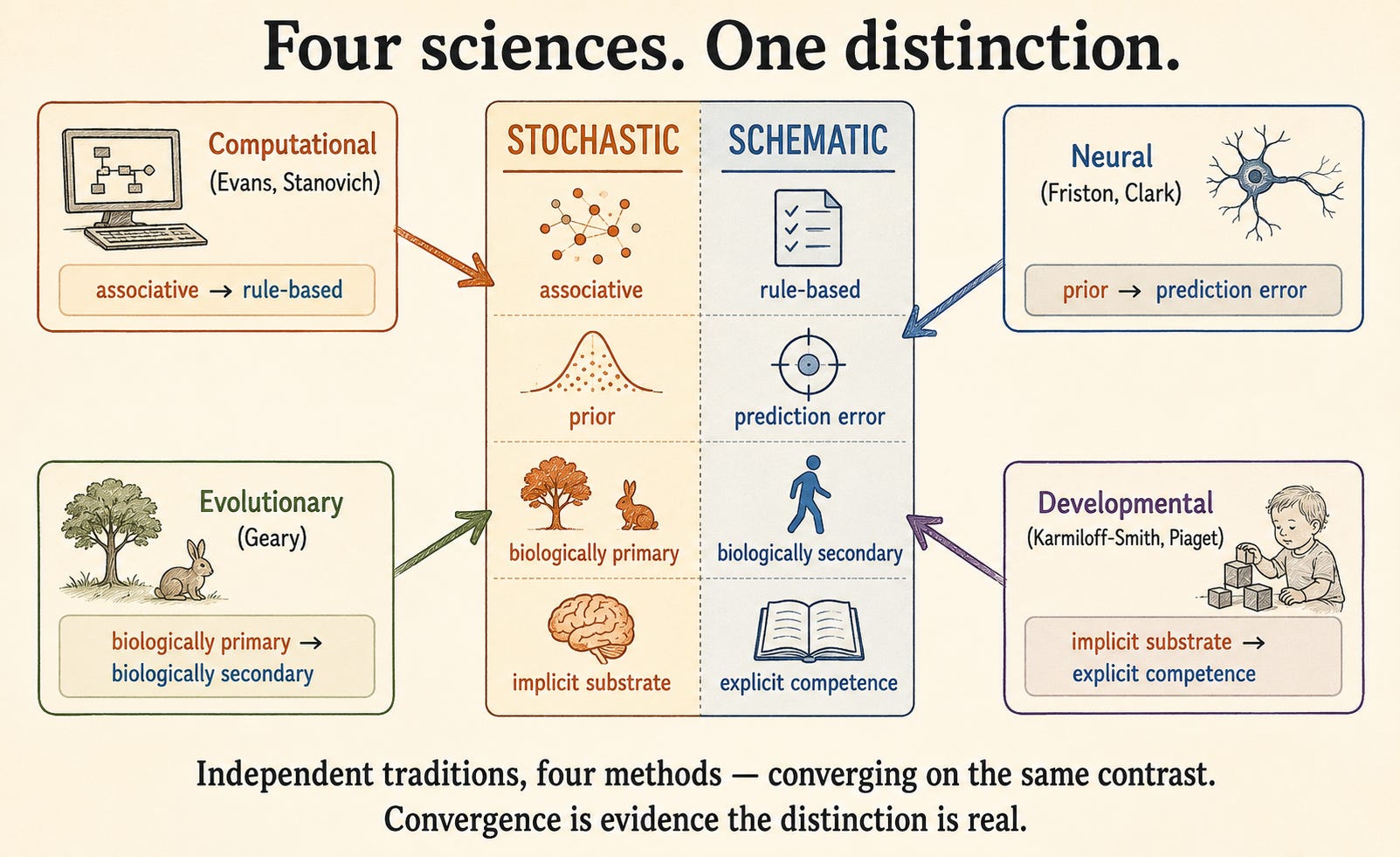
Kahneman described the two systems. Four independent scientific traditions — working from different methods, asking different questions — have explained them, and converged on the same underlying contrast. That convergence is not a coincidence. It is evidence the distinction is real.
The previous section ended on an open question. The fast/slow framework is powerful and well-evidenced — but it is mostly descriptive. Why do the two modes differ as they do? What architecture produces the split?
The striking answer: four separate traditions, approaching from four directions, have arrived at the same contrast. Watch for the convergence.
Layer 1 — Computational: associative vs. rule-based
The most direct explanation comes from dual-process theory proper — Jonathan Evans, Keith Stanovich, Steven Sloman. The claim: the two systems differ not just in speed but in computational architecture. System 1 is associative — it spreads activation across networks of associated representations, completes patterns from partial input, produces responses calibrated to past statistical regularities. System 2 is rule-based — it applies explicit rules in sequence, in working memory, producing outputs evaluable against formal standards.
Stanovich adds a key idea: decoupling — the ability to hold the current context at bay and reason about a hypothetical. When you check the bat-and-ball answer, you decouple: you suppress the System 1 output (”ten cents”) while running an alternative calculation. That suppression costs working memory — which is why System 2 is hardest exactly where System 1 is strongest: the louder the intuition, the more capacity it takes to hold it down.
Convergence: associative = stochastic; rule-based = schematic; decoupling = the effort of holding a hypothetical while suppressing the System 1 response.
Layer 2 — Neural: the prior and the prediction error
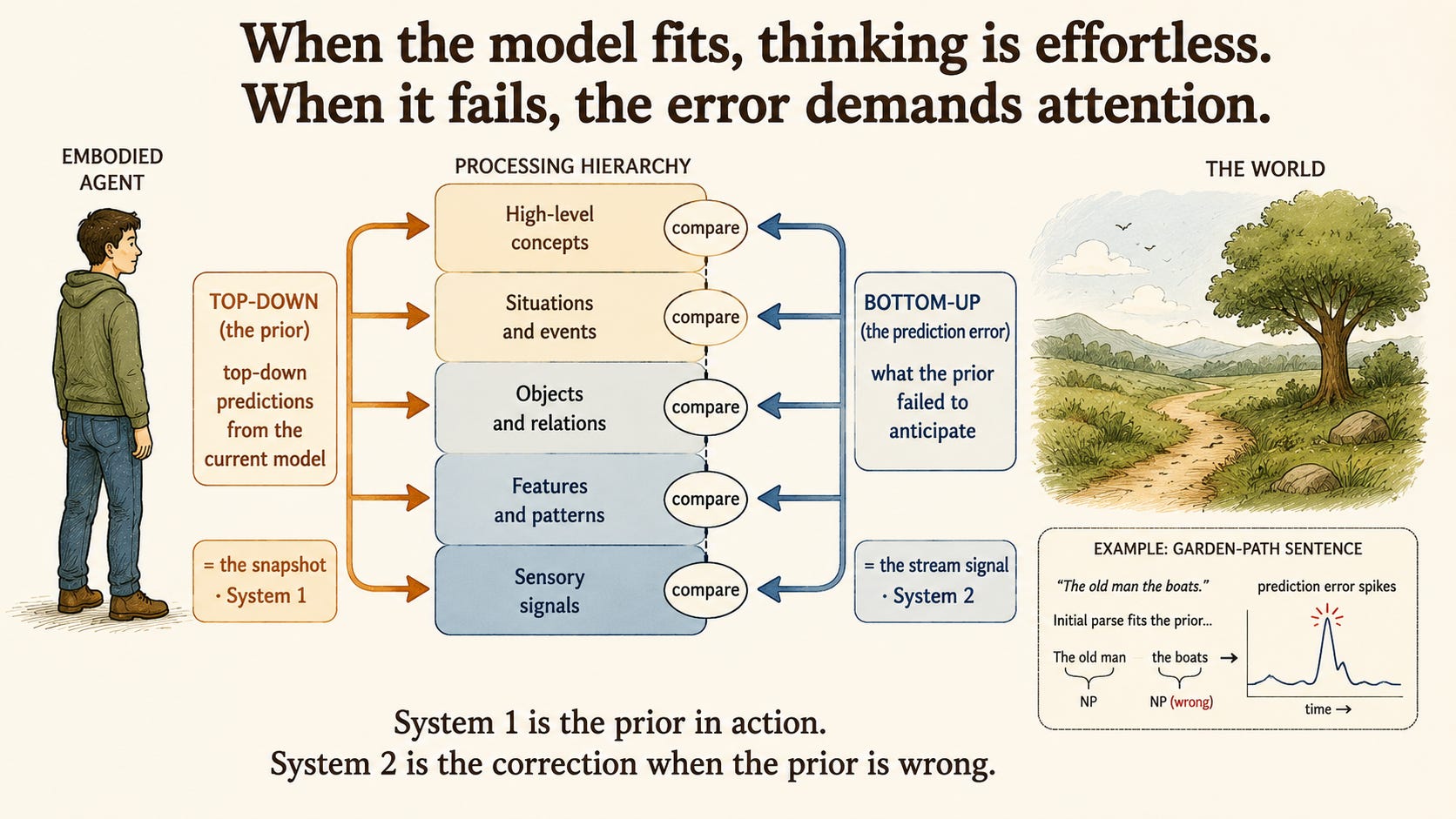
Predictive processing — Karl Friston’s free-energy principle, Andy Clark’s predictive mind — offers the neural-level account. The brain is not a passive receiver; it is an active prediction machine, continuously generating expectations and updating them by minimizing prediction error — the gap between what it predicted and what it sensed. At every level it runs two processes at once: top-down predictions from its current model, and bottom-up sensory signals compared against them.
System 1, here, is the prior in action — the top-down prediction running on a well-calibrated model. When the model fits the world, predictions are accurate and processing is fast and effortless. The world confirms the model; no correction needed. System 2 is error correction — what happens when large or surprising prediction errors arrive that the prior failed to anticipate, demanding attention and a deliberate revision of the model. That revision is effortful because restructuring the model is expensive. (A garden-path sentence — one that seems to parse one way, then forces reanalysis — is a small jolt of exactly this: the prior was wrong, the model must be revised.)
Convergence: the prior is the snapshot — the agent’s running model of the world; the prediction error is the stream — the incoming signal that revises it when the prior fails. System 1 is the prior; System 2 is the correction.
Layer 3 — Evolutionary: biologically primary vs. secondary
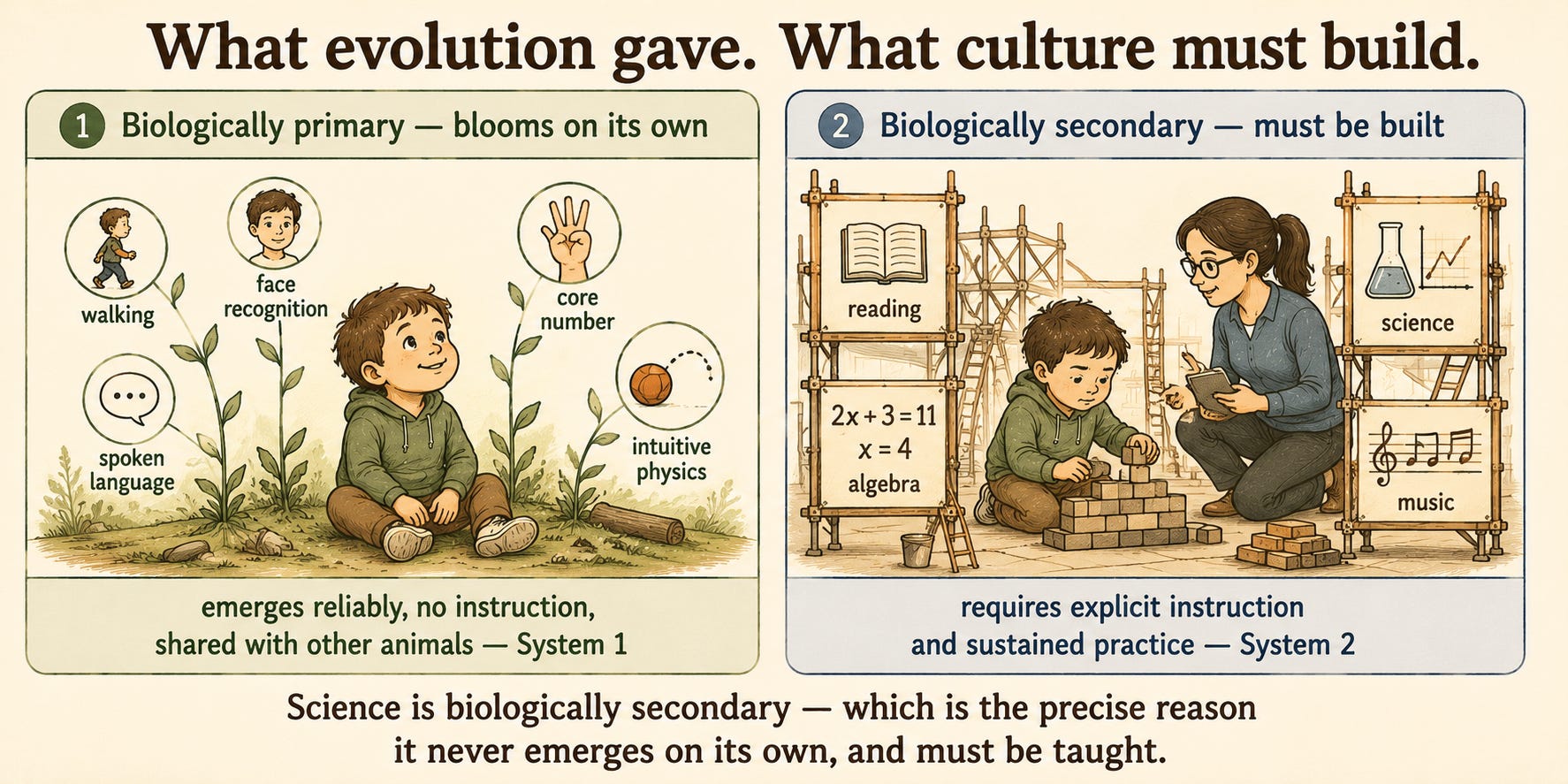
David Geary distinguishes biologically primary competences — those evolution built directly, with dedicated neural architecture — from biologically secondary ones, which culture constructed by repurposing that architecture. Primary competences emerge reliably in any normal environment, need no explicit instruction, and are shared in simpler form with other animals: walking, face recognition, basic social understanding, spoken-language comprehension, core number sense, intuitive physics. These are System 1 competences — fast and automatic because the brain was built for them.
Secondary competences — reading, formal mathematics, scientific reasoning, logical inference, musical notation — are slow, effortful, and require instruction and sustained practice, because the brain was not built for them. It does them by recruiting systems evolved for other purposes (phonological processing repurposed for reading, spatial processing for mathematical notation). This explains something the other layers don’t: why System 2 competences need institutional support. If science were biologically primary, children would pick it up spontaneously, the way they pick up speech. They don’t — because it is secondary, and biology does not deliver it.
Convergence: biologically primary = habitat; biologically secondary = memetat. What evolution gave directly is the substrate; what culture constructed — science, mathematics, literacy — is what education must build.
Layer 4 — Developmental: redescription and re-habituation
The developmental account supplies the mechanism the other three point toward: how does System 1 get restructured by System 2 practice? Two processes, running in opposite directions. Karmiloff-Smith’s representational redescription is the first: implicit procedural knowledge, locked in action patterns, is progressively made explicit — available for inspection, communication, transfer. That is the stochastic-to-schematic direction. Re-habituation is the reverse: once a schematic competence is acquired through effortful practice, extensive repetition absorbs it back into the stochastic substrate. The skill becomes fast and automatic. System 2 becomes System 1 — the beginning reader’s effortful decoding becomes the fluent reader’s instant recognition.
Convergence: representational redescription turns stochastic substrate into schematic competence; re-habituation absorbs schematic achievement back into the stochastic substrate. This is the mechanism of expertise — and what scientific training does.
The convergence — and what it means
Four traditions. Four levels of explanation. Look at what they land on. Associative processing is stochastic. Rule-based processing is schematic. The prior is the snapshot; the prediction error is the stream signal. Biologically primary is habitat; biologically secondary is memetat. Every contrast maps onto the same underlying distinction.
This is the key claim. The habitat/memetat dialectic, the snapshot/stream architecture, and the schematic/stochastic contrast are not extra theoretical constructs bolted onto an established science. They are names for a distinction that four independent traditions reached from four directions — because the distinction is real, it is fundamental, and it is written into the architecture of the cognitive agent at every level of description. Kahneman described it phenomenologically; dual-process theorists explained it computationally; predictive processing explained it neurally; Geary explained it evolutionarily; the developmental tradition explained how the implicit becomes explicit and the schematic becomes fluid. The series framework is the integrative architecture that holds all four together — not a rival to them, but the thing that shows they are describing the same object.
And re-habituation is the thread that runs through all four into a single account of expertise. The expert scientist’s System 1 is not the novice’s. The novice’s is a general-purpose pattern recognizer calibrated by everyday life — powerful in familiar domains, systematically misleading in scientific ones. The expert’s has been rebuilt, through years of System 2 practice, to hold the consolidated knowledge of the field. The goal of science education is not to turn students into System 2 processors. It is to produce scientists whose System 1 has been remade — through enough System 2 practice — to think scientifically by default. That is why training takes years. And it is why understanding this architecture matters.
Take-home 1. Four traditions independently converge on one distinction. Computationally: associative vs. rule-based (Evans, Stanovich). Neurally: prior vs. prediction error (Friston, Clark). Evolutionarily: biologically primary vs. secondary (Geary). Developmentally: stochastic substrate vs. schematic achievement (Karmiloff-Smith, Piaget). Each is a different level of explanation for the same architecture — System 1 and System 2 are not arbitrary labels but a deep structural distinction, written into cognition at every level of description.
Take-home 2. Habitat/memetat, snapshot/stream, and schematic/stochastic are the integrative framework that holds the four together. Associative = stochastic = habitat; rule-based = schematic = memetat; the prior = the snapshot; the prediction error = the stream; biologically primary = habitat; biologically secondary = memetat. Re-habituation — the absorption of schematic achievement into the stochastic substrate through practice — is the developmental mechanism of expertise. The expert’s System 1 has been rebuilt by System 2 practice; science education is the cultivation of that rebuilding.
Next: “When the Mind Became a Computer.” A reflective reconstruction — where the computational picture of mind actually came from. From Gödel through Turing through cybernetics to the cognitive revolution of 1956 — what it made possible, and what it cost.
Image prompts used for this post. Try them on your own AI model and compare what it produces with our figures.
1. Four sciences, one distinction
Output format: PNG. Landscape, 18cm × 11cm. A convergence diagram. In the CENTER, a tall vertical divider with two columns labeled at the top "STOCHASTIC" (left, warm tones) and "SCHEMATIC" (right, cool tones). From FOUR directions — the four corners — arrows point inward toward the central divider, each from a labeled source box, each carrying the pair of terms that maps onto stochastic/schematic. Top-left box "Computational (Evans, Stanovich)": "associative → rule-based". Top-right box "Neural (Friston, Clark)": "prior → prediction error". Bottom-left box "Evolutionary (Geary)": "biologically primary → biologically secondary". Bottom-right box "Developmental (Karmiloff-Smith, Piaget)": "implicit substrate → explicit competence". Each arrow's left term lands in the STOCHASTIC column, right term in the SCHEMATIC column. Above the center, large caption: "Four sciences. One distinction." Below, smaller caption: "Independent traditions, four methods — converging on the same contrast. Convergence is evidence the distinction is real." Clean schematic line-art; warm/cool palette split across the center; not photographic; no brain icon.2. The prior and the prediction error
Output format: PNG. Landscape, 16cm × 9cm. A diagram of predictive processing as two opposing flows. A small embodied figure on one side, the world on the other, joined by a processing hierarchy drawn as stacked horizontal bands. TOP-DOWN arrows (from figure toward world), warm, labeled "the prior — top-down predictions from the current model" and tagged "= the snapshot · System 1". BOTTOM-UP arrows (from world toward figure), cool, labeled "the prediction error — what the prior failed to anticipate" and tagged "= the stream signal · System 2". Where the two flows meet at each band, a small "compare" node computes the mismatch. A small inset shows a "garden-path sentence" producing a spike of prediction error. Above, large caption: "When the model fits, thinking is effortless. When it fails, the error demands attention." Below, smaller caption: "System 1 is the prior in action. System 2 is the correction when the prior is wrong." Soft warm/cool tones; clean schematic line-art; not photographic; no brain icon — render a whole embodied figure, not a brain.3. What evolution gave vs. what culture must build
Output format: PNG. Landscape, 18cm × 9cm. Two side-by-side panels contrasting Geary's two kinds of competence. PANEL 1 ("Biologically primary — blooms on its own"): a small child in an ordinary environment, with icons sprouting effortlessly around it like growing plants — walking, a face being recognized, a spoken speech bubble, a hand showing "two/three" fingers (core number), a ball arcing (intuitive physics); label: "emerges reliably, no instruction, shared with other animals — System 1". PANEL 2 ("Biologically secondary — must be built"): the same child now in a structured setting with scaffolding/ladders and a teacher figure, effortfully assembling constructed icons — an open book (reading), an equation (algebra), a beaker and graph (science), a musical staff; label: "requires explicit instruction and sustained practice — System 2". Above both panels, large caption: "What evolution gave. What culture must build." Below both panels, smaller caption: "Science is biologically secondary — which is the precise reason it never emerges on its own, and must be taught." Soft warm tones; sketched, schematic line-art; not photographic; no brain icon.The same stream (prompts) activates different snapshots (models) in different receivers (agents). Try the prompts above on your own AI model and compare what it produces with our figures.
This is “The Roots of STEM,” a series exploring the cognitive bases of science, technology, engineering, and mathematics. Subscribe to follow the arc from the body to the laboratory.
Convergence is underrated.
When independent paths lead to the same destination, I pay attention.