
The Inversion Thesis
Section 7 of Chapter 3 — natural and artificial intelligence

The culmination of three chapters. Large language models have produced an enormous outpouring of commentary — euphoric and alarmed, and mostly imprecise. This series has not been building toward a verdict on AI. It has been building toward a framework for thinking clearly about what these systems are, and how they differ from the natural agents they are compared to. That framework is the inversion thesis.
Two chapters ago we named the snapshot/stream architecture, and ended on a hinge: the natural agent’s snapshot lives; a model’s snapshot is stored. The previous section gave us the two inheritance channels. Now everything assembles into a single, precise claim about the most discussed technology of our time.
Two trajectories, mirror-imaged
Natural intelligence runs from habitat to memetat. It begins in the body’s sensorimotor engagement with physical reality. Phyletic inheritance builds the biological substrate; development carries the agent from H-action schemas through representational redescription to symbolic competence; the snapshot is primary and living, continuously revised through action, and the stream is constructed from it — serialized embodied meaning. Mimetic inheritance then adds cultural content on top of the biological ground. The trajectory: world → body → schema → symbol.
Artificial intelligence — as built in today’s large language models — runs the architecture backward. It begins in the memetat: a vast digital archive of human-produced text. There is no phyletic inheritance — no body, no sensorimotor history, no biological substrate. Training is statistical pattern extraction over the archive, producing a relational map. The snapshot — if we can call it that — is derived from the stream, not the other way round, and the model’s weights are static between training runs. The trajectory: symbol → model → (toward) world.
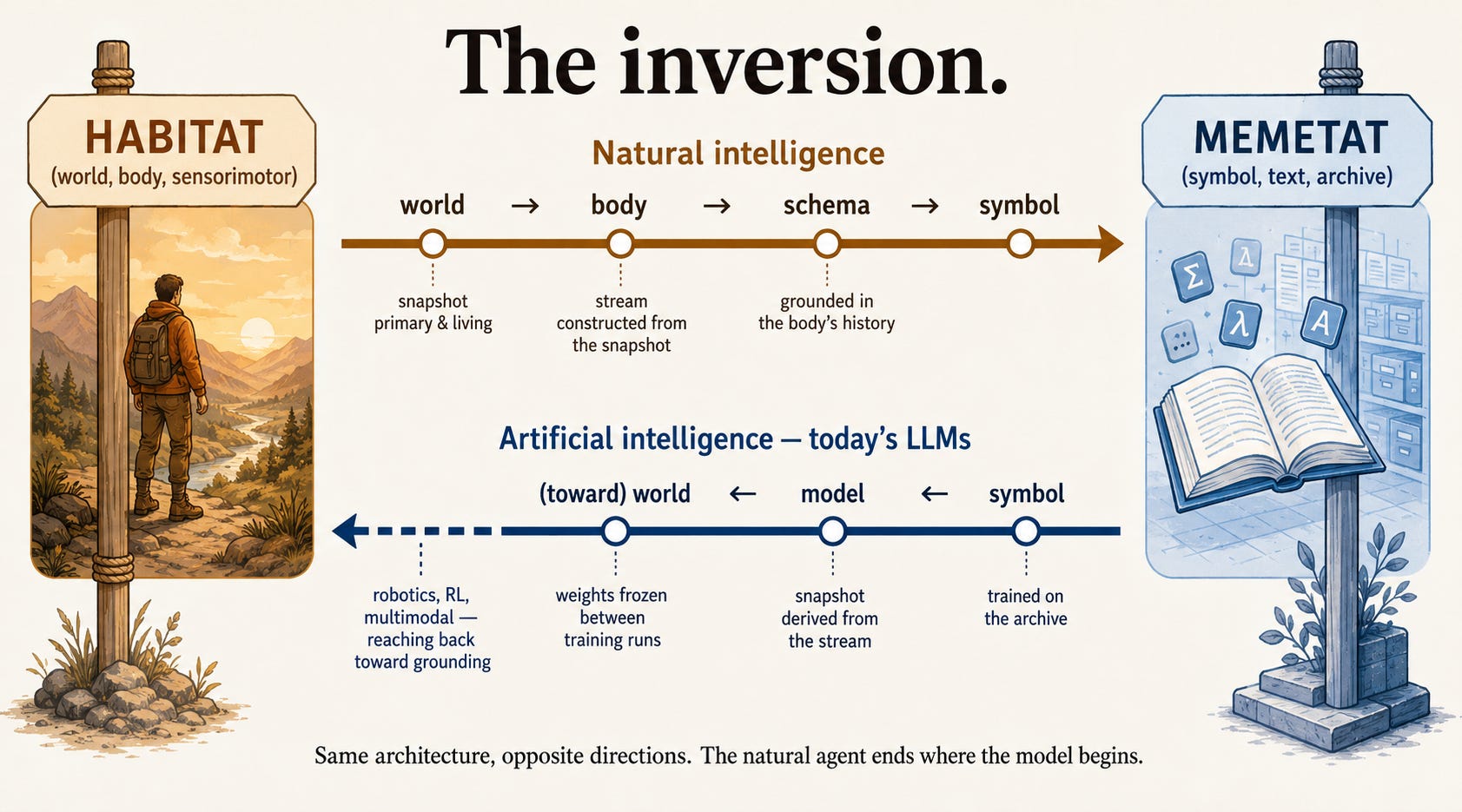
These are structural inverses. The natural agent’s developmental journey runs from world to symbol. The artificial agent begins at the endpoint of that journey — the archive of finished symbols — and works, with enormous effort and partial success, back toward the beginning. Understanding that inversion precisely, not metaphorically, is what the series has been building toward.
Five consequences
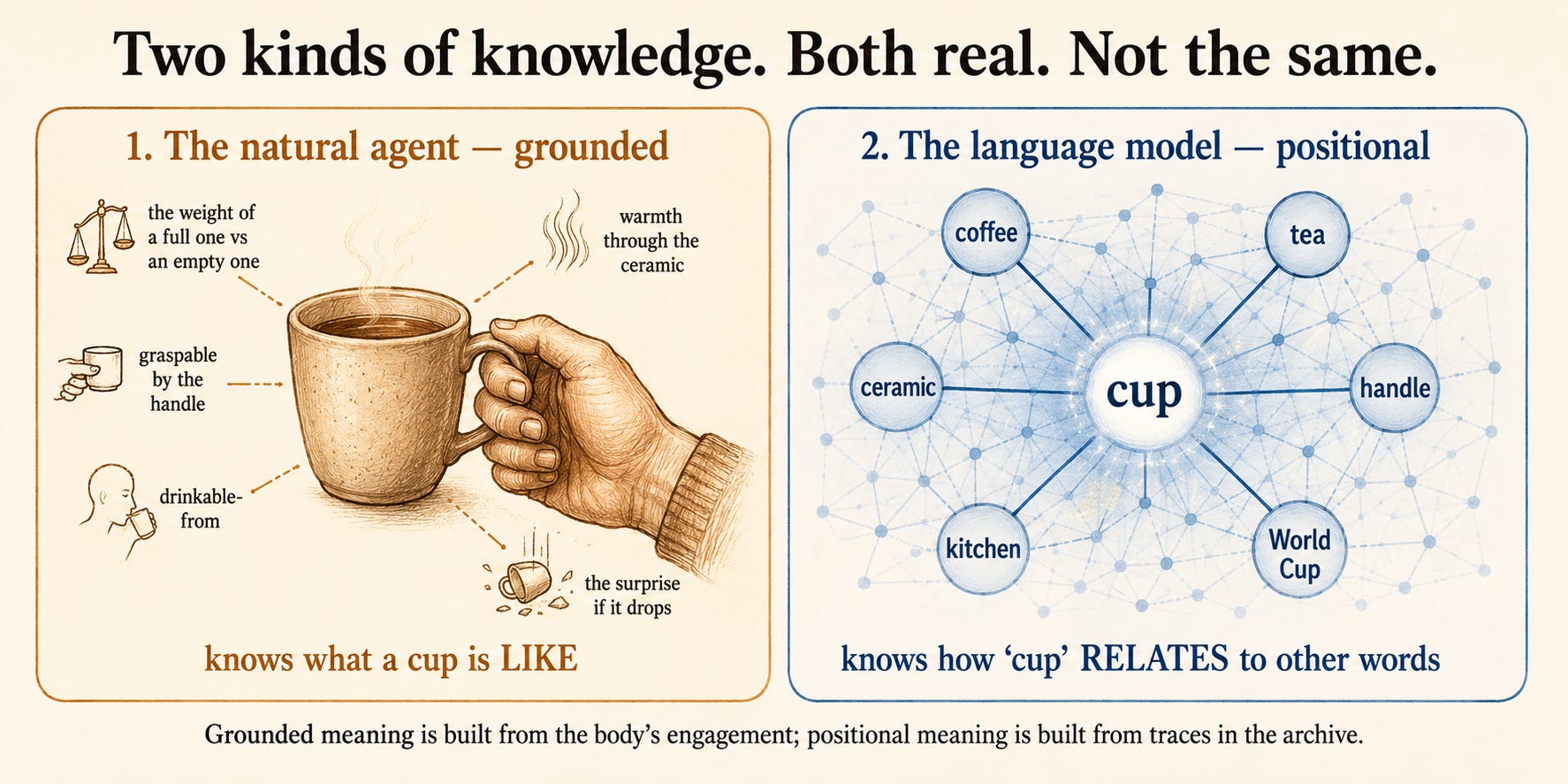
1. Grounded vs. positional representation. When the natural agent represents “cup,” what activates is a cluster of sensorimotor schemas — the look of cup-shapes, the feel of handling one, the affordance of being drinkable-from, the contexts and associations of years of cup-experience. The meaning is grounded in the body’s history of engagement. The model’s “cup” is positional — a location in a high-dimensional space, fixed by statistical co-occurrence across the corpus. It is not groundless: it genuinely knows that cups relate to coffee, ceramics, handles, kitchens. But it knows these through their traces in the memetat, not through any encounter with cups. The model knows how “cup” relates to other words. The agent knows what a cup is like.
2. Living snapshot vs. frozen map. The natural agent’s snapshot is revised by every act of perception and every motor action — it is the current state of active coupling with the world. The model’s weights, the nearest analogue, are static between training runs. It does not revise its understanding through a conversation; when the world changes after the cutoff, it does not know. This is not merely a limitation to be patched by more frequent retraining. A living snapshot is continuously grounded in an ongoing process; a frozen map is the product of a completed analysis. Those are different things — and the difference matters for everything from updating on new evidence to genuine responsiveness.
3. Re-habituated expertise vs. direct pattern completion. The natural expert’s fast, fluent competence is re-habituated expertise — schematic skill practiced until absorbed into the stochastic substrate, calibrated against the world’s actual resistance to action. The model’s fluency is direct statistical completion over the memetat. It looks similar from outside; the process is structurally different. And the calibration differs: the expert’s intuition is tuned against reality, the model’s against what humans have written — which carries the errors, biases, and blind spots of the communities that produced it, expressed with the same fluency as accurate information.
4. Normativity — stakes in the world. The natural agent’s cognition is normatively grounded in biological organization: some states are compatible with continued existence, others are not. That primitive norm is the ground on which epistemic, ethical, and institutional norms are built. The agent cares, in this biological sense, because its representations are inseparable from engagement with a world that has real consequences for it. The model has no such ground — its outputs are shaped by externally imposed training objectives, not internally generated imperatives. Whether this matters for whether it can be said to understand is a hard philosophical question; it certainly matters for how we evaluate, oversee, and deploy these systems.
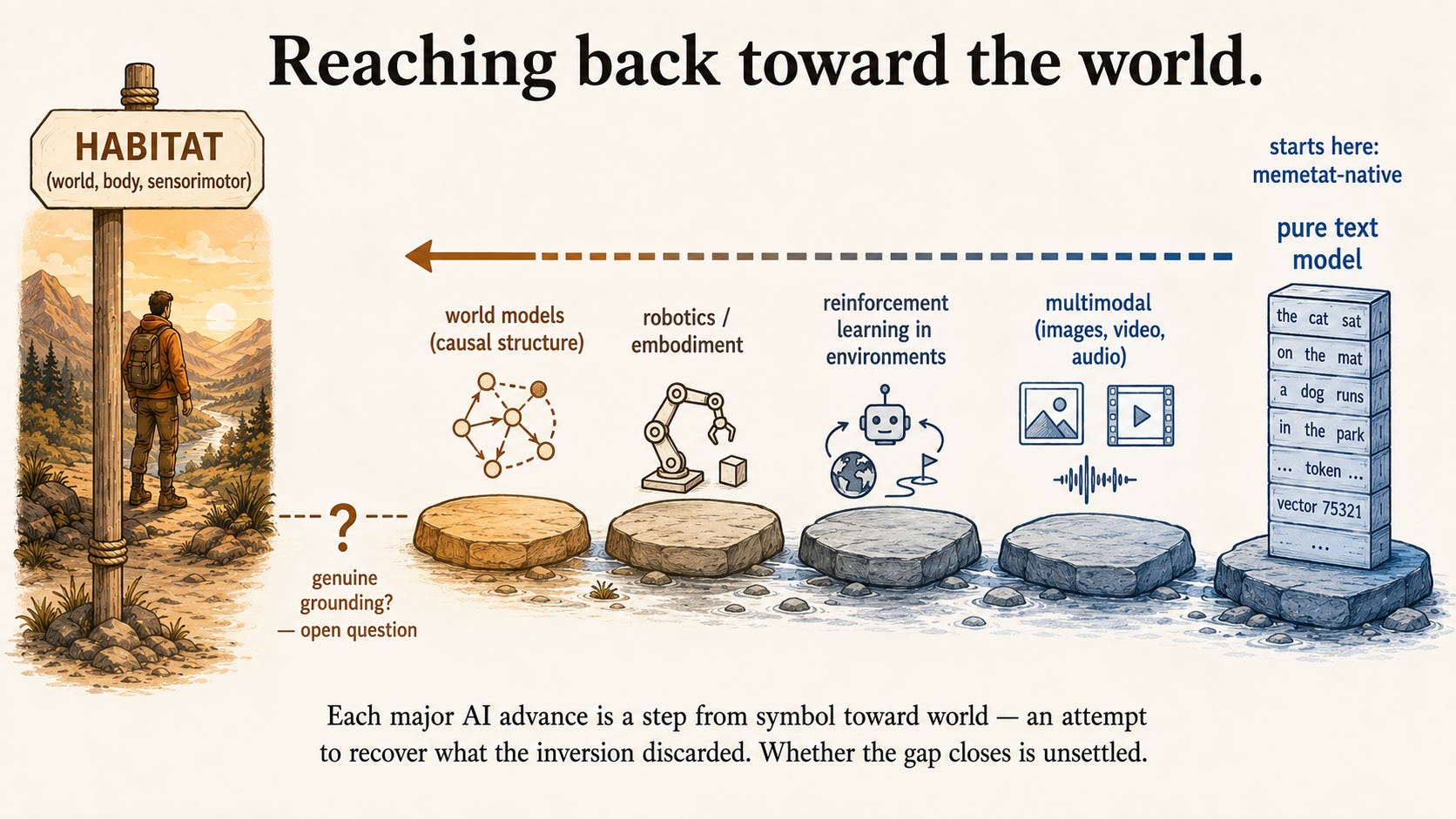
5. The path back toward habitat. The most important recent moves in AI research can all be read as attempts to recover what the inversion discarded — to travel from the memetat toward the habitat. Robotics and embodied AI give agents bodies that act. Reinforcement learning in physical environments lets them learn from the consequences of action. Multimodal training on images, video, and audio reaches past pure text toward traces of sensorimotor experience. World models build causal structure beyond statistical completion. Each is a step from symbol toward world — the reverse of the natural agent’s path. Whether these steps eventually produce genuine habitat grounding is an open question the inversion thesis does not pretend to answer. It provides the framework for evaluating whatever answer the evidence supports.
The two children, one last time
Return to our running examples, and ask what it would mean for a model to know what they describe.
“Cup.” A model trained on human text has rich exposure to the word — it knows cups relate to coffee and tea, that they are held and filled and washed, the grammatical and metaphorical contexts (”a cup of kindness,” “the World Cup”). A statistically comprehensive, linguistically precise positional representation. But it has never held a cup, never felt a full one against an empty one, never felt the heat of tea through ceramic, never dropped one. Its “cup” is built entirely from the traces cups left in the memetat. The child learning “cup” is mapping a label onto an affordance-rich, embodied engagement with a class of objects. Both are genuine knowledge. They are not the same knowledge.
Conservation. A model can produce fluent, accurate descriptions of Piaget’s experiments — the developmental sequence, the failure pattern, the theoretical interpretations from all four schools. It has been trained on a vast developmental-psychology literature. But it has never watched a quantity stay invariant under a transformation it could see, has no sensorimotor history with discrete objects, no perceptual default to override. What the child achieves in grasping conservation is not a fact but a cognitive reorganization restructuring the relation between perception and concept. The model can describe that reorganization with accuracy. It cannot undergo it. The description is in the memetat. The reorganization is in the habitat. And a description of a reorganization is not the reorganization.
What the inversion thesis is — and is not
Lets be explicit about the limits of the claim. It does not say models are useless, or understand nothing, or are mere parrots. The statistical patterns in a well-trained model encode real information about the structure of the memetat — the relations between concepts, the norms of argument, the conventions of scientific writing, the accumulated knowledge of a culture. That is an extraordinary achievement, even if a different kind from what the natural agent develops.
And it does not say AI cannot become more like natural intelligence. The movement toward habitat grounding — embodiment, environmental interaction, multimodality, world modeling — is a genuine attempt to close the gap. Whether it will succeed, and what genuine grounding would even amount to in a non-biological system, are open questions.
What the inversion thesis does claim is this: natural and artificial intelligence are structurally different in ways that matter — for understanding, reliability, normativity, and the characteristic failures each is prone to. Those differences follow from the inversion of the developmental trajectory. The thesis is a lens, not a verdict. It gives precise analytical purchase on what these systems can and cannot do — and replaces both celebration and fear with something more useful: clarity. The question it opens, rather than closes, is the deepest one: what would it take for an artificial system to have a living snapshot, re-habituated expertise, biological normativity? And if that were achieved, would the result still be artificial intelligence — or a new kind of natural intelligence in a non-biological substrate?
Take-home 1. Natural intelligence follows a habitat-to-memetat trajectory: sensorimotor engagement → representational redescription → schematic competence → re-habituated expertise. The snapshot is primary and living; the stream is constructed from it; meaning is grounded in the body’s history with the world. Artificial intelligence, as built in large language models, follows the inverse: the memetat is primary, the model is trained on the digital archive, and the snapshot — the weights — is a frozen statistical map derived from the stream. These are structural inversions. The difference is not one of degree but of architecture.
Take-home 2. Five consequences distinguish them: grounded vs. positional representation (the agent knows what things are like; the model knows how they relate to other words); living vs. frozen snapshot; re-habituated expertise vs. direct pattern completion; biological normativity vs. externally imposed objectives; and the direction of AI research toward habitat grounding as the attempt to recover what the inversion discarded. The inversion thesis is a lens, not a verdict — and it does not claim AI cannot become grounded. It names what grounding would require, and gives clarity where there is mostly hype.
Next: “Closing Chapter 3 — The Architecture in Use.” The synthesis. Seven moves, one argument — and the toolkit you now carry into the chapters ahead, where the framework meets the specific capacities that make science possible.
Image prompts used for this post. Try them on your own AI model and compare what it produces with our figures.
1. The inversion
Output format: PNG. Landscape, 18cm × 10cm. The signature diagram: two horizontal trajectories running in OPPOSITE directions between two poles. The left pole is labeled "HABITAT (world, body, sensorimotor)" with a warm embodied-figure-in-terrain icon; the right pole is labeled "MEMETAT (symbol, text, archive)" with a cool open-book/token icon. TOP TRACK ("Natural intelligence"), a bold arrow pointing LEFT→RIGHT, with stations along it: "world → body → schema → symbol"; annotations beneath: "snapshot primary & living", "stream constructed from the snapshot", "grounded in the body's history". BOTTOM TRACK ("Artificial intelligence — today's LLMs"), a bold arrow pointing RIGHT→LEFT (mirror of the top), with stations: "symbol → model → (toward) world"; annotations beneath: "trained on the archive", "snapshot derived from the stream", "weights frozen between training runs"; the leftmost part of this arrow is drawn dashed/striving, labeled "robotics, RL, multimodal — reaching back toward grounding". Above the whole figure, large caption: "The inversion." Below, smaller caption: "Same architecture, opposite directions. The natural agent ends where the model begins." Warm tones on the habitat side, cool on the memetat side; clean schematic line-art; not photographic; NO brain icon — render the natural agent as a whole embodied figure.2. Grounded vs. positional — what each knows about “cup”
Output format: PNG. Landscape, 18cm × 9cm. Two side-by-side panels, both about the word "cup". PANEL 1 ("The natural agent — grounded"): a human hand holding a cup at the center, surrounded by sensorimotor associations drawn as felt qualities radiating from the body — "the weight of a full one vs an empty one", "warmth through the ceramic", "graspable by the handle", "drinkable-from", "the surprise if it drops"; label beneath: "knows what a cup is LIKE". PANEL 2 ("The language model — positional"): the word "cup" as a glowing node in a high-dimensional word-space lattice, connected by statistical edges to neighboring word-nodes — "coffee", "tea", "ceramic", "handle", "kitchen", "World Cup"; no body, no hand, just relations among tokens; label beneath: "knows how 'cup' RELATES to other words". Above both panels, large caption: "Two kinds of knowledge. Both real. Not the same." Below both panels, smaller caption: "Grounded meaning is built from the body's engagement; positional meaning is built from traces in the archive." Warm tones (left), cool tones (right); sketched, schematic line-art; not photographic; no brain icon.3. The path back toward habitat
Output format: PNG. Landscape, 16cm × 9cm. A single rightward-to-leftward progression showing AI research trying to travel from the memetat back toward the habitat (reversing the inversion). On the FAR RIGHT, a "pure text model" icon (a tower of text/tokens) labeled "starts here: memetat-native". A series of stepping-stones leads LEFT toward a habitat pole (warm terrain/body) on the far left, each stone labeled with one research direction and a small icon: "multimodal (images, video, audio)", "reinforcement learning in environments", "robotics / embodiment", "world models (causal structure)". The stones get progressively warmer in tone as they approach the habitat pole, but a visible GAP remains between the last stone and the habitat pole, marked with a question mark and the label "genuine grounding? — open question". Above, large caption: "Reaching back toward the world." Below, smaller caption: "Each major AI advance is a step from symbol toward world — an attempt to recover what the inversion discarded. Whether the gap closes is unsettled." Cool-to-warm gradient left to right; clean schematic line-art; not photographic; no brain icon.The same stream (prompts) activates different snapshots (models) in different receivers (agents). Try the prompts above on your own AI model and compare what it produces with our figures.
This is “The Roots of STEM,” a series exploring the cognitive bases of science, technology, engineering, and mathematics. Subscribe to follow the arc from the body to the laboratory.