
Habits Are Not Rules
Section 2 of Chapter 3 — cognitivism, 4E, and the difference between a habit and a rule

The same two children, two more lenses. Classical cognitivism asks what changed inside the child. The 4E family asks what the body, the social scene, and the tools contributed. By the end, four traditions are in view at once — not as rivals, but as partial maps of one architecture.
In the previous section we ran two scenes — a toddler learning the word “cup,” a four-year-old who thinks the spread-out row of counters has “more” — through behaviorism and constructivism. Both turned out to be Agent–World primary, differing in the engine: the world’s contingencies versus the agent’s own construction.
Now the same two children meet two more traditions. And the first thing to do is name the gap the previous pair left open.
The gap both leave
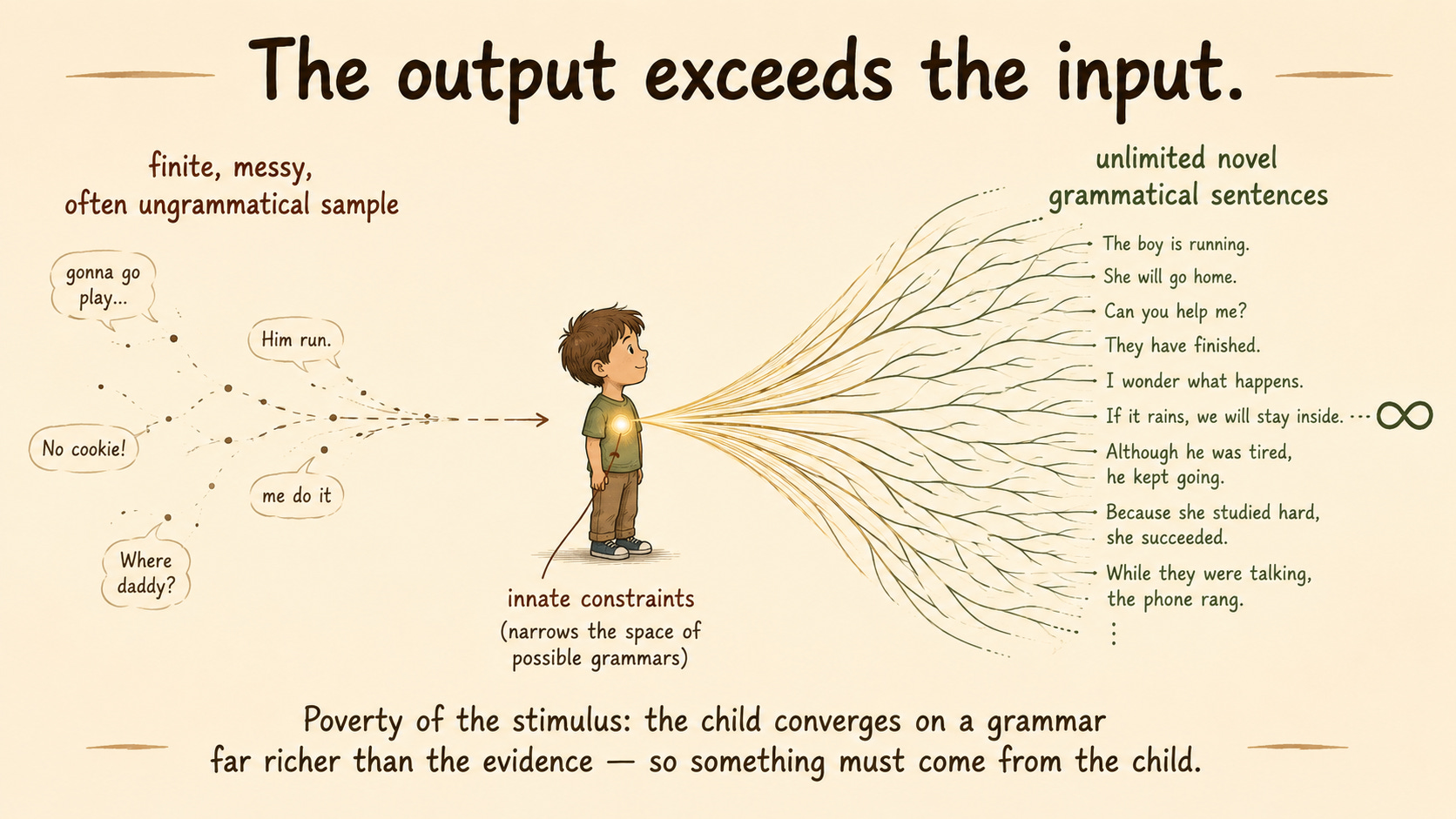
Behaviorism explains how action patterns get shaped by environmental contingencies. But it cannot explain how a child who has heard a finite, messy sample of sentences goes on to produce and understand an unlimited number of sentences it has never encountered before. That is not retrieval of trained responses. That is generation. And generation requires internal structure.
Constructivism explains how cognitive structures develop through active engagement — but tends to describe the developmental sequence without fully specifying the machinery that implements each stage. What does the child who passes conservation actually have that the younger child lacks?
Both gaps point the same way: toward the agent’s internal organization. Which is exactly where classical cognitivism turns.
Cognitivism: a rule is not a habit
First, be precise about what’s being explained. A single word — “cup,” “dog,” “run” — needs no grammar. Chomsky’s argument is not about words. It is about language: grammatically structured sentences, the rules by which words combine and nest into endlessly many expressions. A child who has acquired language hasn’t memorized a list of sentences. The child has internalized a generative system — a grammar — that produces and parses sentences it has never heard.
In 1959, Noam Chomsky reviewed Skinner’s Verbal Behavior, and the review became a founding document of the cognitive revolution. The argument: no reinforcement account can, even in principle, explain the productivity of language. The child meets a finite, imperfect, often ungrammatical sample — and reliably converges on a grammar that correctly generates sentences far beyond that sample. This is the poverty of the stimulus: the input is too thin to explain the output by any mechanism that works only on that input. Something must come from the child’s own architecture — something innate, narrowing the space of possible grammars enough that the child can converge from limited evidence.
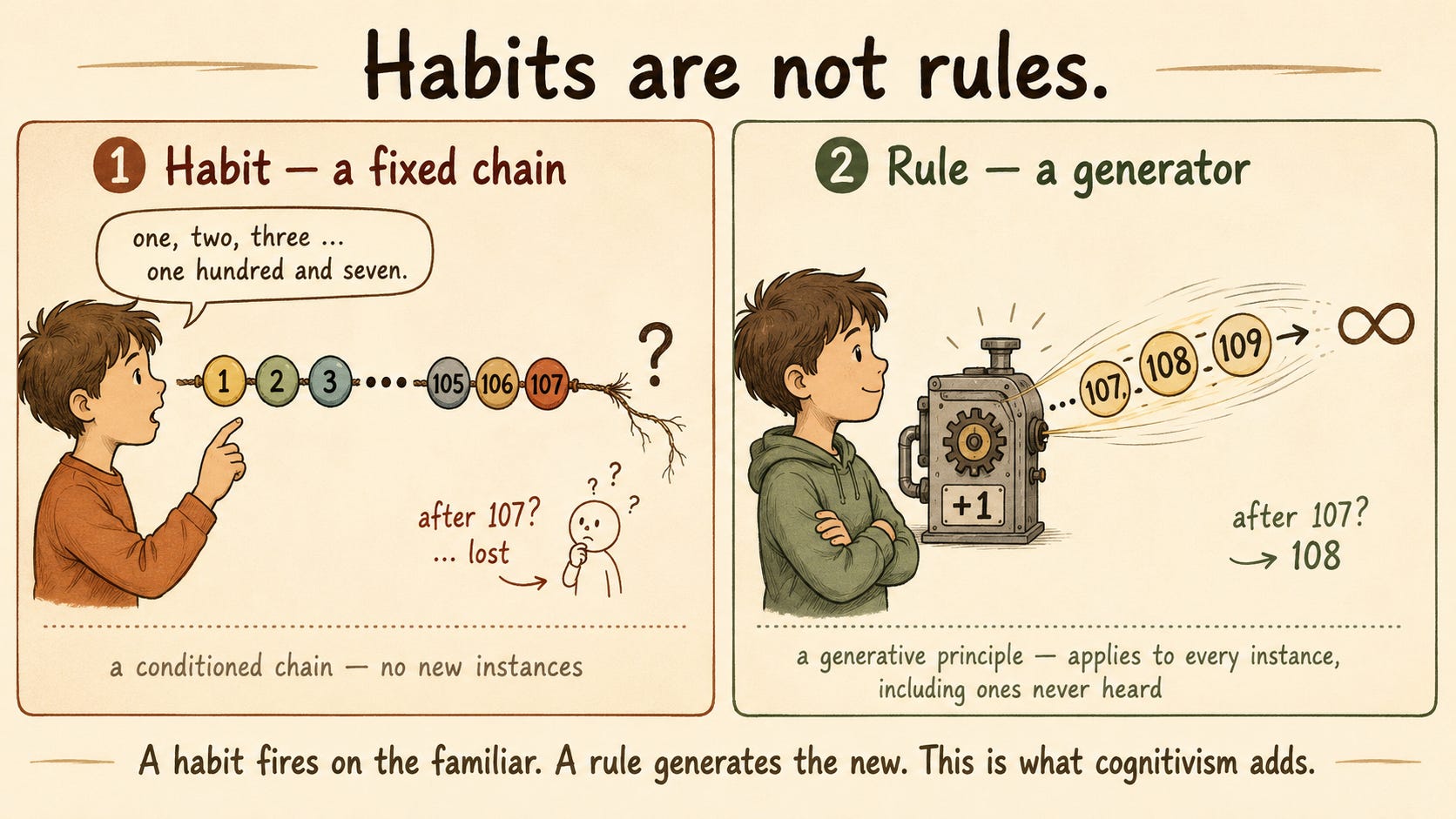
The deepest cognitivist point is the contrast between a habit and a rule. A habit is a conditioned response: it fires in the presence of familiar stimuli and does not generalize systematically to new cases. A rule is generative: it applies to every instance that meets its conditions, including instances never encountered.
Counting makes the difference vivid. A child who has merely been trained to recite “one, two, three, four, five” has a verbal habit — a fixed response chain. A child who has grasped the rule of number succession — each number followed by exactly one next, the sequence extending without limit, the same operation at every step — can generate numbers it has never heard. Ask what comes after one hundred and seven. The child with the rule says one hundred and eight. The child with only the trained sequence is lost. The rule generates new instances; the habit does not.
The same logic lands on conservation. A child trained to say “the same” to spread-out rows has a habit. A child who has genuinely grasped conservation has a rule — quantity is invariant under transformation — that applies to new quantities, new materials, new arrangements. This is what cognitivism adds over both behaviorism and pure developmental description: a specification of what has changed internally when understanding appears. The child has a rule where it had only a perceptual habit.
4E cognition: the body, the scene, the tools
Behaviorism and cognitivism, for all their differences, share an assumption the 4E family rejects. Both treat the body as implementation detail — behaviorism reduces the agent to an input–output function, cognitivism to an information-processing device with internal representations. Both bracket the body, the social practice, and the material environment as secondary to the cognitive process.
The 4E family — embodied, enactive, embedded, extended — insists that abstraction costs something real. You cannot say what the agent knows without attending to the world it is coupled with, the body it acts through, the practices it participates in, and the tools it uses.
On language, the 4E account starts not with grammar or reinforcement but with the social-cognitive substrate that makes communication possible at all — the joint attention and shared intentionality we met in Chapter 2. The child acquiring language is not primarily testing grammatical hypotheses, nor being shaped by reinforcement. It is participating in a shared practice in which words direct attention, share intentions, and coordinate action inside a shared frame. And meaning stays anchored in the body: when a child learns “give,” “throw,” “push,” the meaning isn’t an abstract token — it is grounded in the sensorimotor schemas of giving, throwing, pushing. Tellingly, children acquire words for things they can do earlier and more securely than words for things they can only watch.
On conservation, the 4E account asks: what is the embodied ground from which numerical invariance is built? Long before the formal concept, the child has rich bodily experience with quantity — reaching into containers, pouring water and watching the level change, stacking and unstacking. Out of this it builds a deep coupling between spatial spread and quantity — because in everyday life more stuff usually does take up more space. The child’s failure isn’t an abstract limitation; it is an expression of that well-grounded embodied history. The conservation task asks the child to override a coupling it built through years of acting in the world. And 4E points to something the others miss: tools and structured practices scaffold the override. Children embedded in practices where quantity is measured, counted, and made explicit show more robust conservation, earlier. The concept is not only in the child’s head — it is distributed across the child, its sensorimotor history, and the material practices that make quantity visible. This is the Agent–Institution dimension, and it is exactly what science education tries to exploit.
Now — the placement
Four traditions, two examples. The placement arrives after the evidence.
Classical cognitivism is agent-internal primary. The explanatory weight falls on the agent’s internal representations and processes — the structure or mechanism that enables systematic generalization across novel cases. Habits are not rules; what differentiates understanding from trained behavior is the generative structure that produces correct outputs for all instances, not just the trained ones.
The 4E family is Agent–World primary via embodied coupling — but extended toward Agent–Agent (joint attention as constitutive of meaning) and Agent–Institution (tools and practices as components, not background). The body, the social interaction, and the material infrastructure are not the setting in which cognition happens; on this view they are part of the cognitive system.
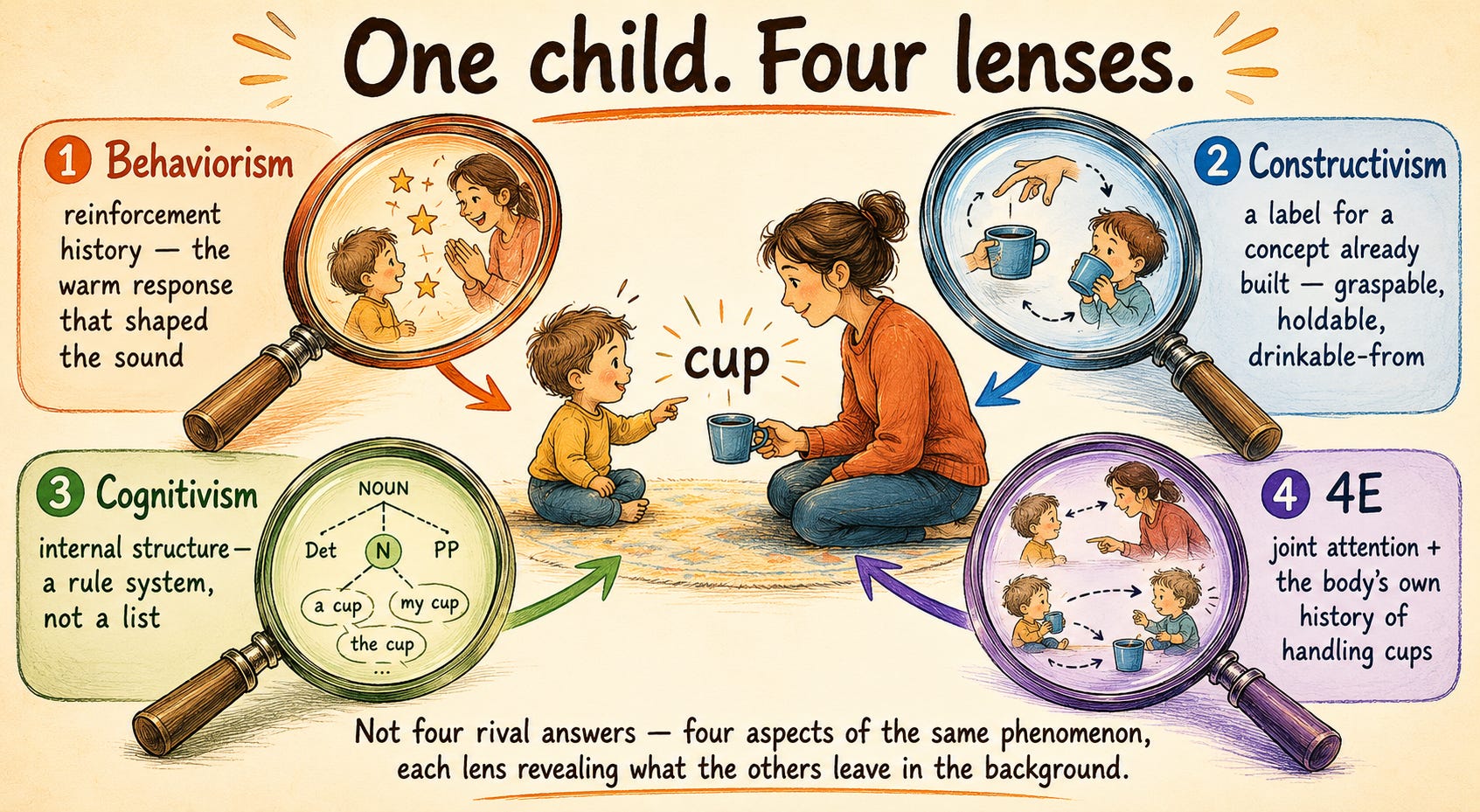
Now look at all four at once. On language: behaviorism maps the role of social reinforcement; constructivism maps how language is staged by prior conceptual development; cognitivism maps the internal generative structure — grammar as a rule system — that makes productivity possible; 4E maps the social-cognitive substrate that makes language a joint action and grounds word meaning in the body. On conservation: behaviorism establishes the facts and shows the limits of conditioning; constructivism explains why reorganization, not training, is required; cognitivism specifies what changes internally — a rule, not a habit; 4E maps the embodied history that grounds and initially misleads, and the practices that scaffold the way out.
No single tradition gives the whole picture. Each maps a different aspect of the same phenomena — and the triadic lens shows why: each assigns primary weight to a different vertex, or a different mechanism within a vertex. That is not a failure of the field. It is the natural consequence of the complexity of the phenomena, and the reason this series holds the traditions together rather than choosing between them.
Take-home. Classical cognitivism puts the explanatory weight on the agent’s internal representations and processes. On language, Chomsky’s poverty-of-the-stimulus argument shows that grammatical productivity needs innate constraints no reinforcement account can supply; on conservation, the child who genuinely understands has a rule (quantity is invariant under transformation), not a habit — a generative principle that fires correctly on novel instances. The 4E family adds the constitutive role of the body, sensorimotor history, joint attention, and material practice. Together the four traditions map different vertices of one triadic architecture. No single one is complete. The diagnostic question — where is the explanatory weight? — locates each before you evaluate it.
Next: “Thinking Fast and Slow — and Why Science Is Hard.” A bat and a ball, a capital city, and Kahneman’s two systems. Why science is, by its very nature, a System 2 enterprise — and what the deeper schematic/stochastic distinction explains that “fast and slow” only describes.
Image prompts used for this post. Try them on your own AI model and compare what it produces with our figures.
1. A habit ends; a rule goes on forever
Output format: PNG. Landscape, 18cm × 9cm. Two side-by-side panels contrasting a trained sequence with a generative rule, using counting. PANEL 1 ("Habit — a fixed chain"): a child reciting a chain of number-beads on a string — "one, two, three … one hundred and seven" — and then the string simply ENDS, frayed, with a question mark and a small puzzled figure; annotation: "after 107? … lost". A faint label: "a conditioned chain — no new instances". PANEL 2 ("Rule — a generator"): the same child, but instead of a finite string there is a small gear/engine labeled "+1" from which numbers stream outward without end — "…107, 108, 109 →" trailing into an infinity symbol; the figure is calm and confident; annotation: "after 107? → 108". A faint label: "a generative principle — applies to every instance, including ones never heard". Above both panels, large caption: "Habits are not rules." Below both panels, smaller caption: "A habit fires on the familiar. A rule generates the new. This is what cognitivism adds." Soft warm tones; clean schematic line-art; not photographic; no brain icon.2. The poverty of the stimulus
Output format: PNG. Landscape, 16cm × 9cm. A single diagram of an asymmetry. On the LEFT, a thin, broken trickle of input flowing toward a small child figure — the trickle is labeled "finite, messy, often ungrammatical sample" and visibly sparse, with a few fragmentary speech scraps. On the RIGHT of the child, an enormous fan-out of neat, well-formed sentence-structures branching outward without end, labeled "unlimited novel grammatical sentences", trailing into an infinity symbol. Between the thin input and the vast output, a small glowing node inside the child labeled "innate constraints (narrows the space of possible grammars)". Above the diagram, large caption: "The output exceeds the input." Below, smaller caption: "Poverty of the stimulus: the child converges on a grammar far richer than the evidence — so something must come from the child." Soft warm tones; clean schematic line-art; not photographic; no brain icon — render the child as a whole small figure, not a head/brain.3. One scene, four lenses
Output format: PNG. Landscape, 18cm × 9cm. In the center, a single small scene: a toddler and an adult with a cup, the word "cup" between them. Around the scene, FOUR labeled magnifying lenses, each angled toward the scene and each tinted a different color, with a short note of what that lens makes salient. Lens 1 "Behaviorism": note reads "reinforcement history — the warm response that shaped the sound". Lens 2 "Constructivism": note reads "a label for a concept already built — graspable, holdable, drinkable-from". Lens 3 "Cognitivism": note reads "internal structure — a rule system, not a list". Lens 4 "4E": note reads "joint attention + the body's own history of handling cups". Above the scene, large caption: "One child. Four lenses." Below, smaller caption: "Not four rival answers — four aspects of the same phenomenon, each lens revealing what the others leave in the background." Soft warm tones; sketched, schematic line-art; not photographic; no brain icon.The same stream (prompts) activates different snapshots (models) in different receivers (agents). Try the prompts above on your own AI model and compare what it produces with our figures.
This is “The Roots of STEM,” a series exploring the cognitive bases of science, technology, engineering, and mathematics. Subscribe to follow the arc from the body to the laboratory.