
Placing the Schools: Behaviorism and Constructivism
Section 1 of Chapter 3 — where the explanatory weight falls

Chapter 3 changes mode. The first two chapters built a coordinate system. This one uses it — as an instrument for locating the major schools of cognitive science, so their apparent contradictions dissolve once you see what each is actually claiming.
For two chapters we built something: the habitat/memetat dialectic, the triadic lens, the five demarcations, and — at the close of Chapter 2 — the snapshot/stream architecture. A compass. Now we use it.
The rest of the series is cartographic. We take the framework and use it to place the schools of cognitive science — to ask, for each one, where it puts its explanatory weight, what it explains well, and what it leaves in the background. The payoff: most of the famous disputes between schools turn out not to be contradictions at all, but claims pitched at different vertices of the same architecture.
But I want to do this the right way round. Phenomena first. Placement after. So before naming a single theory, sit with two concrete cases.
Two children
Here are two scenes. You have lived through both — as a child, and as someone who has watched a child.
A child learns a word. A toddler, somewhere between twelve and eighteen months, hears “cup” for the first time. An adult holds one up and says the word. Over the next few encounters the child gets it — points to cups, asks for a cup, uses the word in the right place. How? What did the child bring, and what did the room contribute?
A child and two rows of counters. A four-year-old sees two rows of six counters, lined up one-to-one. Same number? The child agrees. Now the experimenter spreads one row out, longer, without adding or removing anything. Same number? The child says: the longer row has more. A year or two later, the same child finds the question almost too easy to be worth asking. What changed in between — and why can’t you just tell the four-year-old the answer?
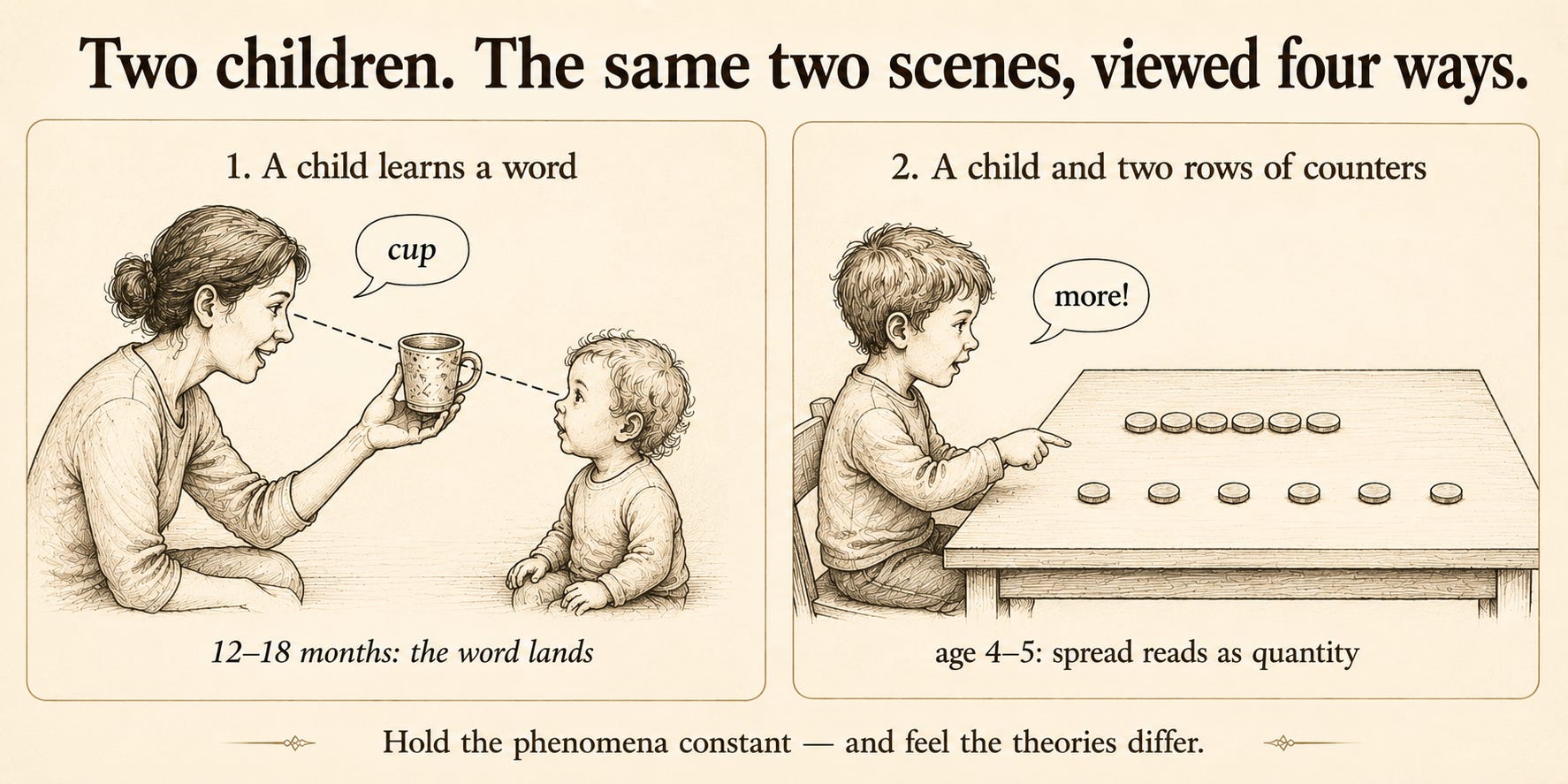
Two examples. We will run them through four traditions across this post and the next. Hold them constant, and the theoretical differences stop being abstract — you feel them directly, as different answers to the same question about the same child.
Behaviorism: the environment shapes the agent
B.F. Skinner gave the behaviorist answer to word learning in his 1957 Verbal Behavior. It is worth taking seriously before noting where it runs out, because it captures something real.
Word learning, on this account, is operant conditioning applied to vocal behavior. The child produces rough sounds; the social environment selectively reinforces the ones that resemble the target. The child says something like “cu” near a cup, the adult lights up, and that warm response reinforces the verbal action pattern. Across successive approximations, shaped by social reinforcement, the sounds converge on “cup.” The word’s meaning, on this view, just is its reinforcement history — the pattern of consequences that have followed its production.
Notice where the explanatory weight sits: on the structure of the environment’s responses. The responsive parent, the consistent labeling, the selective reward — these are the engines. The child is shaped; the world shapes. And this is a genuine contribution: responsive, verbally rich environments really do produce better language outcomes. The insight isn’t wrong. It’s partial.
On conservation, the behaviorist account is more direct — and more visibly limited. The child who fails has learned to associate visual spread with “more” (because in everyday life, more stuff usually does take up more room). The remedy is equally direct: reinforce the correct response. Train the child to say “the same” to rearrangements, across enough varied trials, and the right response should lock in.
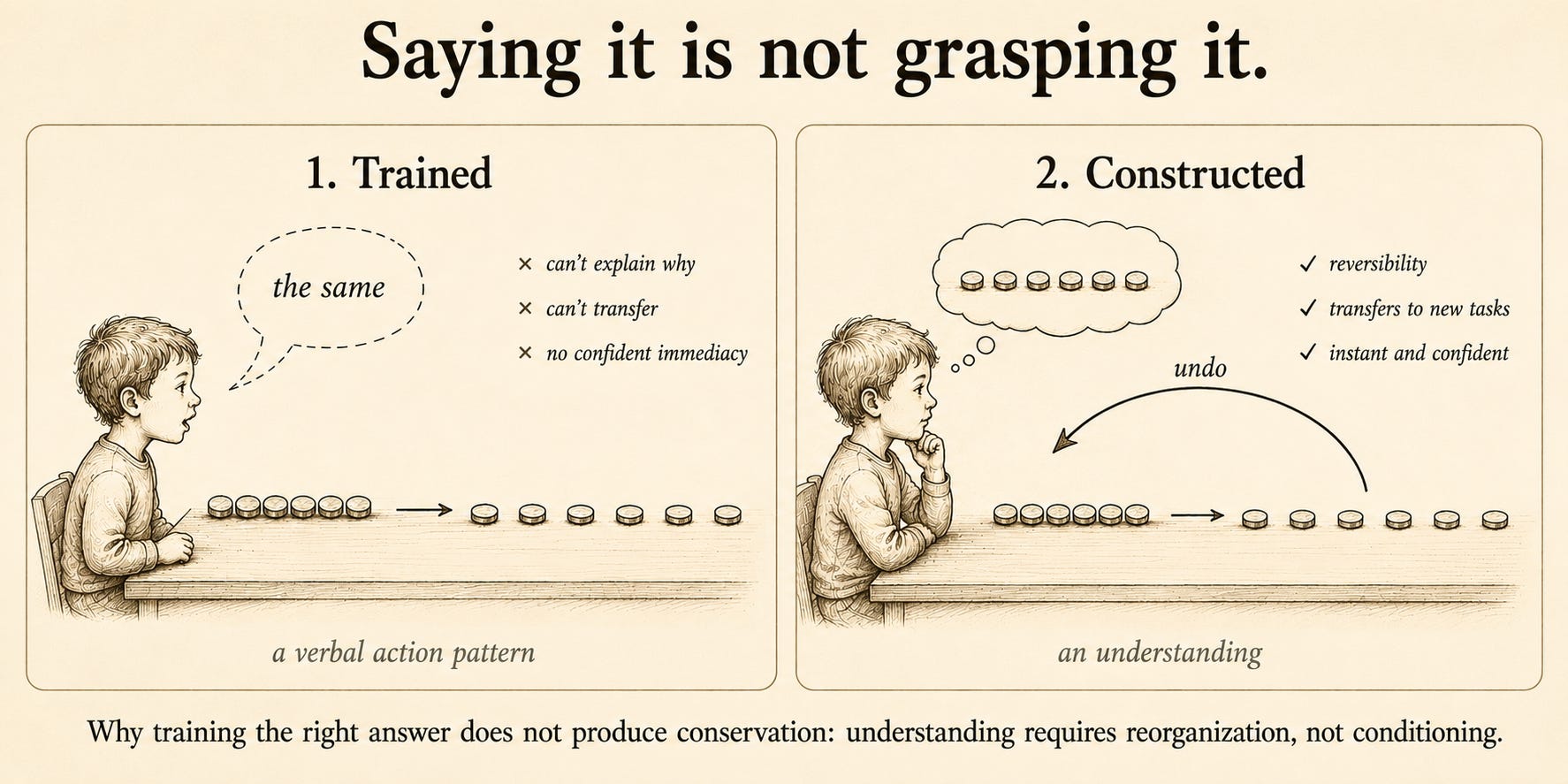
But Piaget found that this is not what happens. Conservation follows a strikingly consistent developmental sequence across cultures, and direct training does not reliably accelerate it. You can train a child to say “the same.” But that child often cannot explain why, cannot transfer it to a new task, and shows none of the confident immediacy of a child who genuinely grasped it. The reinforcement produced a verbal action pattern. It did not produce an understanding. Those are different achievements — and behaviorism, by its own design, cannot say why.
Constructivism: the agent builds the structure
For Piaget, the order of explanation reverses. Language does not drive cognitive development; cognitive development drives language. The child can only take on a word for a concept it has already constructed at the level of action. The word is not the vehicle for the concept — it is the label for a concept already present.
So when a child learns “cup,” it isn’t building a category from scratch through reinforcement. It is finding a conventional label for a category it already has — a cluster of sensorimotor schemas: graspable, holdable, drinkable-from. This explains something behaviorism struggles with: the vocabulary explosion. Around eighteen months many children suddenly acquire words at astonishing speed — sometimes several a day. Not because reinforcement spiked, but because a developmental threshold was crossed. The cognitive ground was finally prepared, and words now map fast onto structures already in place.
Conservation is where constructivism is at its most powerful. The child who fails is not giving a wrong answer that training can fix. The child is reasoning correctly within the structures currently available to it — its thinking dominated by perceptual centration, fixing on the single most salient dimension (length) and reading it as quantity. To pass, the child has to construct something specific: reversibility — the understanding that the spreading can be undone, that quantity is invariant under the transformation. That is not a fact you can hand over. It is a logical relationship the child must build, through repeated encounters with transformation and invariance. Which is exactly why training the verbal response doesn’t produce the understanding.
Now — the placement
Having seen what each tradition explains and what it misses, we can place both. And the placement is not imposed from outside — it is a description of what you just saw.
Ask the diagnostic question: where is the explanatory weight?
Both behaviorism and constructivism are Agent–World primary. Both insist that cognitive competence is shaped by the agent’s engagement with the world — not by innate structures unfolding on their own, and not by social transmission alone. In that, they are allies.
But the mechanism differs, and our examples showed exactly where the difference bites. For behaviorism, the weight falls on the environment: the contingency structure explains the learning. For constructivism, it falls on the agent’s own constructive dynamics: assimilation, accommodation, equilibration. The environment is essential — without perturbation there is no accommodation — but it is not the engine.
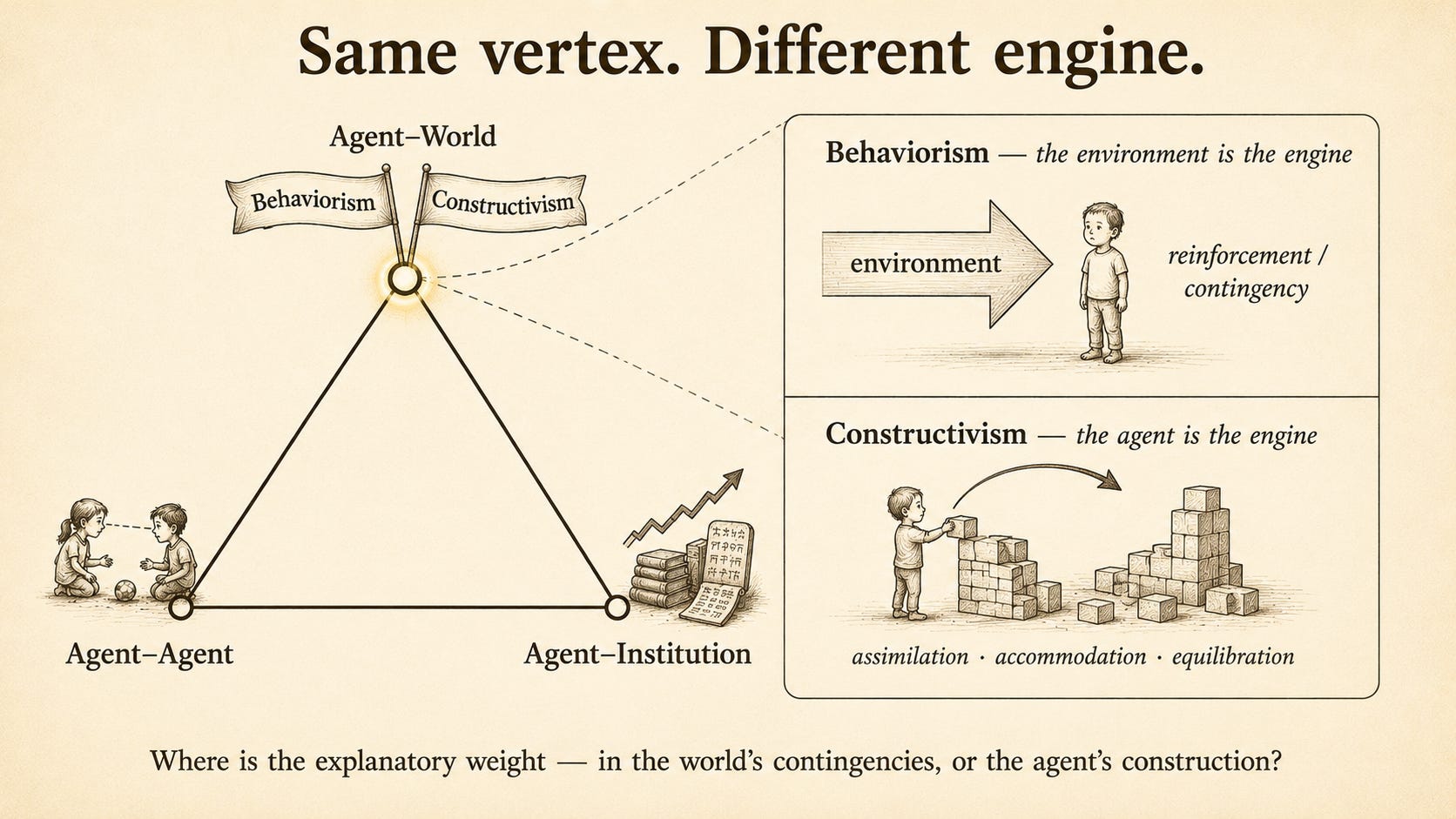
On word learning: behaviorism explains reinforcement-based association; constructivism explains developmental staging and the vocabulary explosion. On conservation: behaviorism offers training; constructivism explains why training fails to produce understanding. Neither is complete. The behaviorist is right that contingency shapes verbal behavior. The constructivist is right that the agent’s internal organization constrains what learning is possible. The triadic lens shows they are operating at different registers within the same vertex — and that integrating them beats choosing between them.
That is always the right order. Phenomena first. Placement after.
But isn’t language institutional? What the placement does — and doesn’t — claim
Here is the question a careful reader should be forming right about now — and if you felt it, good. Language and number aren’t really things you find lying around in the physical world. A word is a convention. The count sequence is a cultural invention, handed down and enforced by a community. Surely, then, they belong at the Agent–Institution vertex — and reinforcement, after all, is how a community teaches you to follow its norms. So how can behaviorism and constructivism possibly be Agent–World?
Everything turns on what the lens is placing. The triadic lens localizes a theory’s explanatory mechanism — not the subject matter being learned. The question is never “what kind of thing is this?” It is “where does this theory put the engine?” And both behaviorism and constructivism put the engine in the agent’s engagement with its world — the contingencies that shape the child, or the schemas the child builds. They are not theories of the institution of language. They are theories of how one child first gets a foothold in it — and that foothold, both of them bet, is made in the agent–world loop. Place the theory by its mechanism, and Agent–World is exactly right. Place the topic instead, and of course you land somewhere else — but that’s a different question than the one the lens asks.
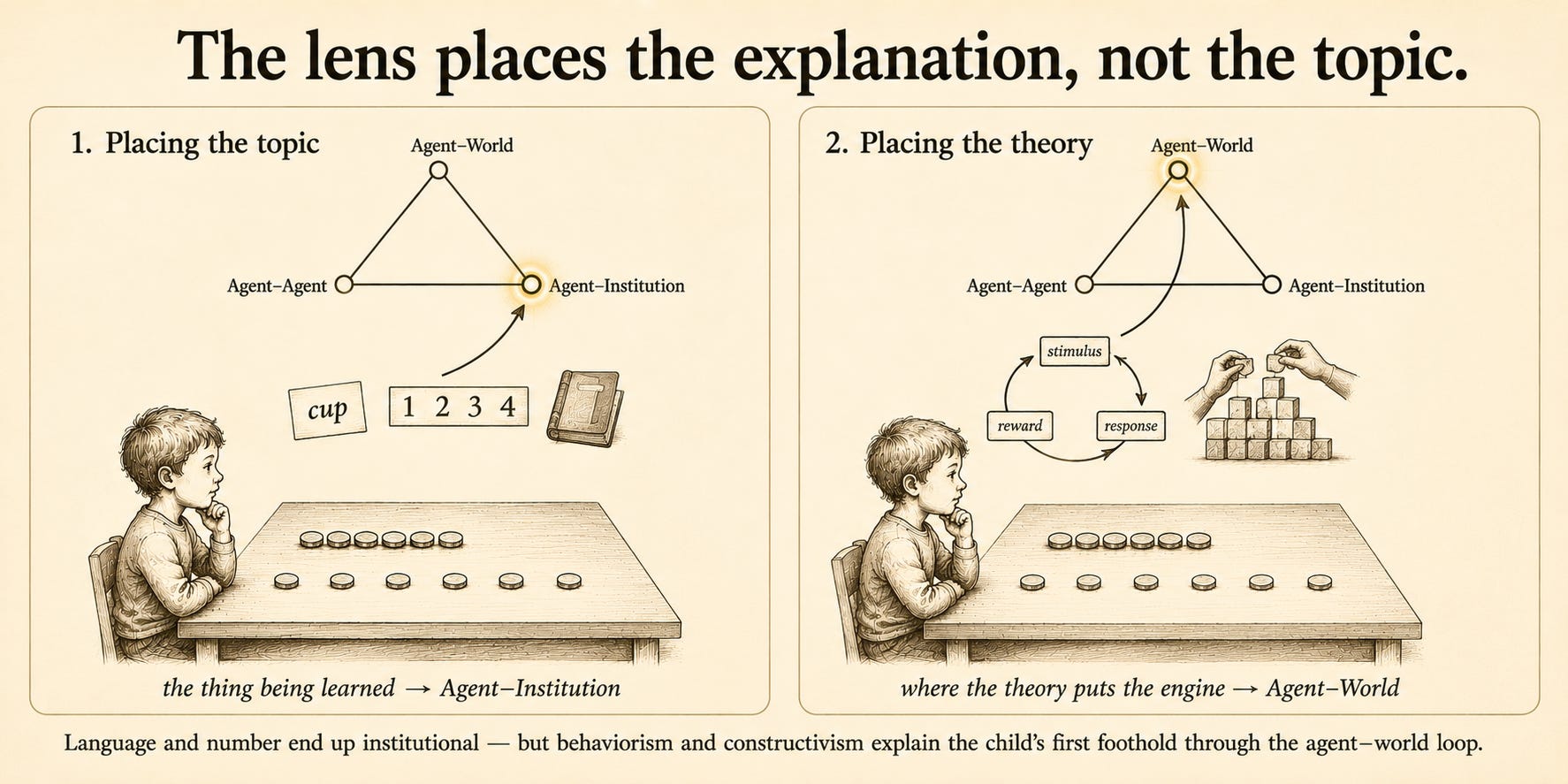
So your instinct about the object is correct, and worth keeping. Mature language and formal number really are institutional — and this series will place them there (that is Chapter 4 and beyond). The whole habitat-and-memetat story is that they begin in the body’s engagement with the world and become institutional through development and cultural transmission. Our two examples even straddle the seam: a child’s rough sense of “more” and “fewer” is biological, agent–world equipment shared with other animals, while the precise count sequence and the conservation principle are cultural achievements the institution has to supply. The example earns its keep precisely because it sits on that boundary.
And the reinforcement point deserves the sharpest answer, because it is the deepest part of the question. Watch what behaviorism does with the parent’s approval: it treats it as one more environmental contingency. It folds the social agent into “the world.” That collapse is behaviorism’s signature move — and its limit. Reinforcement can produce behavior that conforms to a norm without the child ever grasping the norm as a norm. We have already seen it: train a child to say “the same” and you get a verbal habit, not an understanding. Grasping a norm as binding — seeing it as a standard you could meet or fail — needs the Agent–Agent and Agent–Institution structure that these two theories leave in the background. “Agents learn norms by reinforcement” is not a neutral observation; it is a behaviorist claim, and whether it holds is one of the things this chapter exists to test. (Its answer, gently, is: not on its own.)
If you pressed this objection, you have independently arrived at the famous Vygotskian critique of Piaget — that he under-weighted the social and the cultural. The series agrees, which is exactly why the next post brings the body’s social and material world back to the center. The placement at Agent–World is not where we finally rest. It is where behaviorism and Piaget put the weight — and naming that precisely is what lets us see what they hand off to the other vertices to explain.
Take-home. Behaviorism and constructivism are both Agent–World primary — both root cognitive competence in the agent’s engagement with the world. But the mechanism differs: behaviorism puts the explanatory weight in environmental contingencies; constructivism puts it in the agent’s own constructive dynamics. On word learning, behaviorism explains reinforcement-based association while constructivism explains developmental staging. On conservation, behaviorism offers training while constructivism explains why training doesn’t yield genuine understanding. The diagnostic question — where is the explanatory weight? — locates any school before you evaluate it. Always let the phenomena arrive first.
Next: “Habits Are Not Rules” — the same two children, two more lenses. Classical cognitivism (Chomsky’s argument that no amount of reinforcement can explain the productivity of language) and the 4E family. Four traditions, one architecture.
Image prompts used for this post. Try them on your own AI model and compare what it produces with our figures.
1. Two children, held constant
Output format: PNG. Landscape, 18cm × 9cm. Two side-by-side panels, each a clean line sketch of a developmental scene that the post will view through four theories. PANEL 1 ("A child learns a word"): a toddler and an adult; the adult holds up a cup; a speech bubble from the adult reads "cup"; small dashed lines of shared gaze connect both faces to the cup; a faint label beneath reads "12–18 months: the word lands". PANEL 2 ("A child and two rows of counters"): a seated four-year-old facing a table; on the table two rows of six round counters — the top row lined up one-to-one, the bottom row spread out longer; a speech bubble from the child points at the longer row and reads "more!"; a faint label beneath reads "age 4–5: spread reads as quantity". Above both panels, large caption: "Two children. The same two scenes, viewed four ways." Below both panels, smaller caption: "Hold the phenomena constant — and feel the theories differ." Soft warm tones; sketched, schematic line-art; not photographic; no brain icon.2. Same vertex, different engine
Output format: PNG. Landscape, 16cm × 9cm. A single triangle with three labeled vertices — top "Agent–World", bottom-left "Agent–Agent", bottom-right "Agent–Institution". A bright marker sits on the TOP vertex (Agent–World), with TWO small flags planted on it side by side, labeled "Behaviorism" and "Constructivism", showing they share the same primary vertex. To the right of the triangle, a zoomed-in inset split into two halves showing the DIFFERENT mechanism at that one vertex. Upper half ("Behaviorism — the environment is the engine"): a large arrow labeled "environment" pointing INWARD at a small passive figure, with "reinforcement / contingency" beside it. Lower half ("Constructivism — the agent is the engine"): a small figure with an arrow looping OUTWARD from itself building a growing structure of blocks, labeled "assimilation · accommodation · equilibration". Above the figure, large caption: "Same vertex. Different engine." Below, smaller caption: "Where is the explanatory weight — in the world's contingencies, or the agent's construction?" Soft warm tones; clean schematic line-art; not photographic; no brain icon.3. The trained response vs. the constructed understanding
Output format: PNG. Landscape, 18cm × 9cm. Two side-by-side panels contrasting two outcomes on the conservation task. PANEL 1 ("Trained"): a child saying "the same" to a spread-out row of counters, but the speech bubble is drawn as a hollow, echo-like outline; small annotations around the child read "can't explain why", "can't transfer", "no confident immediacy"; a faint label: "a verbal action pattern". PANEL 2 ("Constructed"): a child watching a row being spread and then mentally running it backward — shown by a curved "undo" arrow returning the spread row to its lined-up state; the child's expression is calm and certain; small annotations read "reversibility", "transfers to new tasks", "instant and confident"; a faint label: "an understanding". Above both panels, large caption: "Saying it is not grasping it." Below both panels, smaller caption: "Why training the right answer does not produce conservation: understanding requires reorganization, not conditioning." Soft warm tones; sketched, schematic line-art; not photographic; no brain icon.The same stream (prompts) activates different snapshots (models) in different receivers (agents). Try the prompts above on your own AI model and compare what it produces with our figures.
This is “The Roots of STEM,” a series exploring the cognitive bases of science, technology, engineering, and mathematics. Subscribe to follow the arc from the body to the laboratory.
The behaviorism/constructivism dispute has the same structural architecture as every other "hard problem".
Two projections of one constitutive activity, evaluated from outside, found incompatible. Behaviorism reads what the environment does to the agent. Constructivism reads what the agent's internal organization constructs. The dispute asks: which is the real explanation? The question presupposes one must be right and the other wrong. Both are projections of the child's constitutive activity. The child learning is one constitutive event readable two ways. The incompatibility is in the joint evaluation from outside, not in the child.
The trained-versus-constructed distinction you draw is the structural receipt. The trained child produces the right answer without the constitutive activity that would make the answer the child's own. Configuration-shaped output. Cannot explain why, cannot transfer, no understanding. The constructing child's grasp of reversibility IS constitutive activity — the understanding IS what being-this-child-at-this-stage is. Transfers, explains, immediate and confident. The difference is not degree. It is kind. One is output. The other is being.
The same distinction applies to every domain where the pattern-match-versus-constitutive-activity question arises. The LLM that produces the right answer without constitutive understanding is the trained child. The organism that constructs the understanding is the constructing child. The distinction your piece draws at the developmental level is the distinction that settles the AI consciousness question at the architectural level.