
The Pivot: From Architecture to Practice
Opening Chapter 4 — science as mediated cognition, and the tools and symbols that mediate it

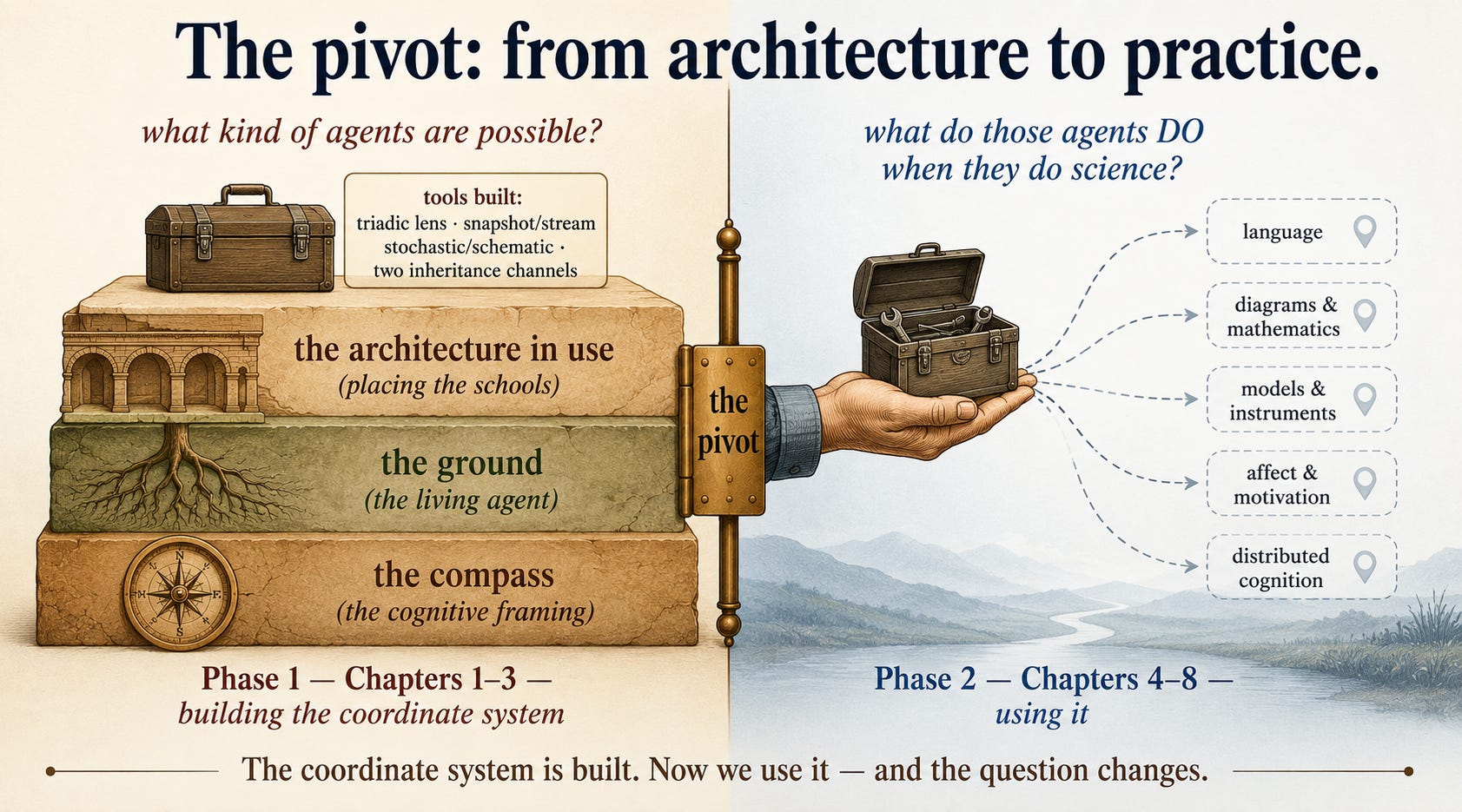
For three chapters we asked one question: what kind of agents are we, that science is possible for us at all? We built the answer carefully — a coordinate system for thinking about cognition. Now the question turns. Not what kind of agents are possible, but what those agents do when they do science. And the answer reframes everything that follows: science is not a direct encounter with the world. It is mediated cognition — conducted through a whole ecosystem of mediators: language, yes, but also the instruments and tools that extend what a living body can reach and do.
The coordinate system is built — now we use it
Look back at what the first three chapters assembled. We moved through biology and phenomenology, watching how living bodies engage their environments — stochastically, through the continuous modulation of sensorimotor loops. We watched that fluid, embodied contact get progressively schematised into portable, rule-governed structures that can be stored and transmitted. We named the movement: habitat to memetat, snapshot to stream. We placed the four great schools of cognitive science not as rivals but as partial maps of one architecture. And we named that architecture — the triadic lens, the stochastic and the schematic, the two inheritance channels.
These were never just vocabulary items. They are a coordinate system: a set of tools for locating, diagnosing, and thinking clearly about cognitive phenomena. Chapters 1 through 3 built that system. Chapters 4 through 8 use it. And in the using, the question changes — quietly, but completely. We are no longer asking what kind of cognizer is possible. We are asking what a cognizer of that kind does when it turns to the specific, historically evolved, cognitively demanding practice we call science.
Science is mediated cognition
Here is the central claim of everything ahead, stated plainly so the rest can elaborate it:
Science is mediated cognition.
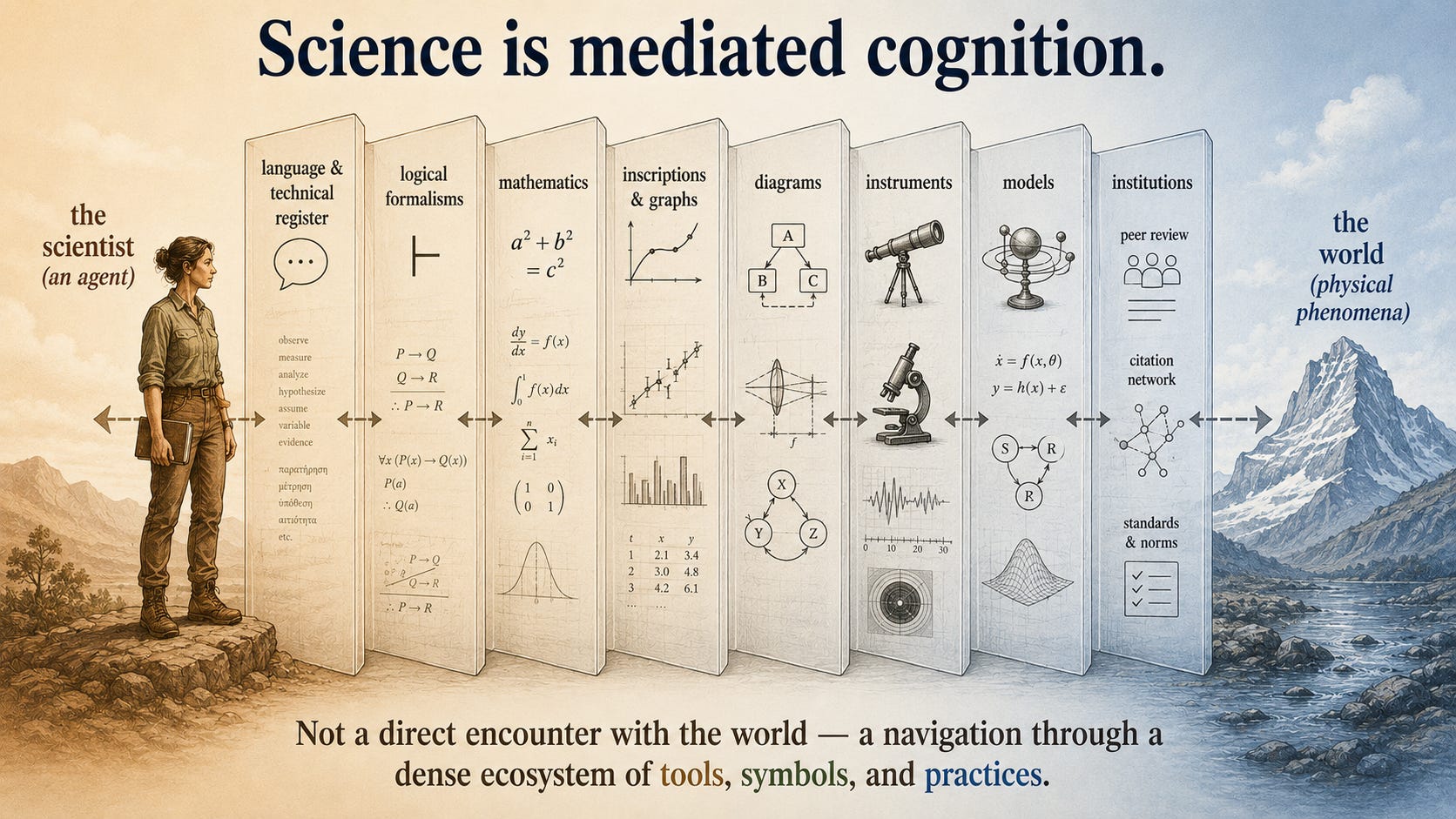
To say cognition is mediated is to say there is something in between — a medium through which contact occurs. The relationship between scientists and the world is not direct. There is no unfiltered encounter between a cognizing agent and mute reality. There never was: even ordinary perception is mediated — by the perceptual system, by the sensorimotor contingencies through which the world is engaged, by the prior schemas that shape what gets noticed. Perception is not a window. It is an action.
But scientific mediation is something additional. It is mediation deliberately constructed, historically accumulated, socially organized, and institutionally maintained — through a dense ecosystem of structures: natural language sharpened into technical registers, logical formalisms, mathematics, inscriptions and graphs, diagrams, instruments, models, and the institutions that stabilize all of them. To do science is to navigate this ecosystem with enough skill that one’s cognitive operations can be regenerated, communicated, challenged, refined, and passed on.
Notice what this does not say. It does not say science is mere social construction — that the world does not push back, that observation is infinitely malleable. The mediation ecosystem does not replace the world; it is the infrastructure through which the world becomes accessible to collective, cumulative inquiry. And it does not say individual cognition is unimportant — quite the opposite. The ecosystem works only because individual agents bring the biological endowment, the developmental history, and the schematic training to engage it. The ecosystem and the agent are co-constitutive; you cannot understand one without the other.
What the claim does say is that science is not, at bottom, an Agent–World story. It is an Agent–Agent story, conducted through a shared interfacing medium. And understanding what scientists do means understanding how they navigate that medium.
Where the lens points now
In the language of the triadic lens, this is a shift of emphasis. The first three chapters foregrounded the Agent–World vertex: what kind of sensorimotor coupling with the physical environment makes cognition possible at all? The chapters ahead foreground the Agent–Agent and Agent–Institution vertices: how do agents align meanings and standards, and stabilize reliable practice, through the mediation ecosystem?
The Agent–World vertex does not disappear. It is the ground. But the instruments of science are precisely the structures that extend Agent–World contact far beyond what unaided biology can reach — the telescope, the microscope, the balance, the scan. Five questions organize the road ahead: what scientific practice is, cognitively speaking; what makes it possible, layer by layer; what we learn when we learn science; how we learn it, in the negotiation between stochastic endowment and schematic inheritance; and why we learn it at all, given how demanding and unrewarding it often is. This chapter takes the first layer.
Why begin with language — and why that is not a claim of primacy
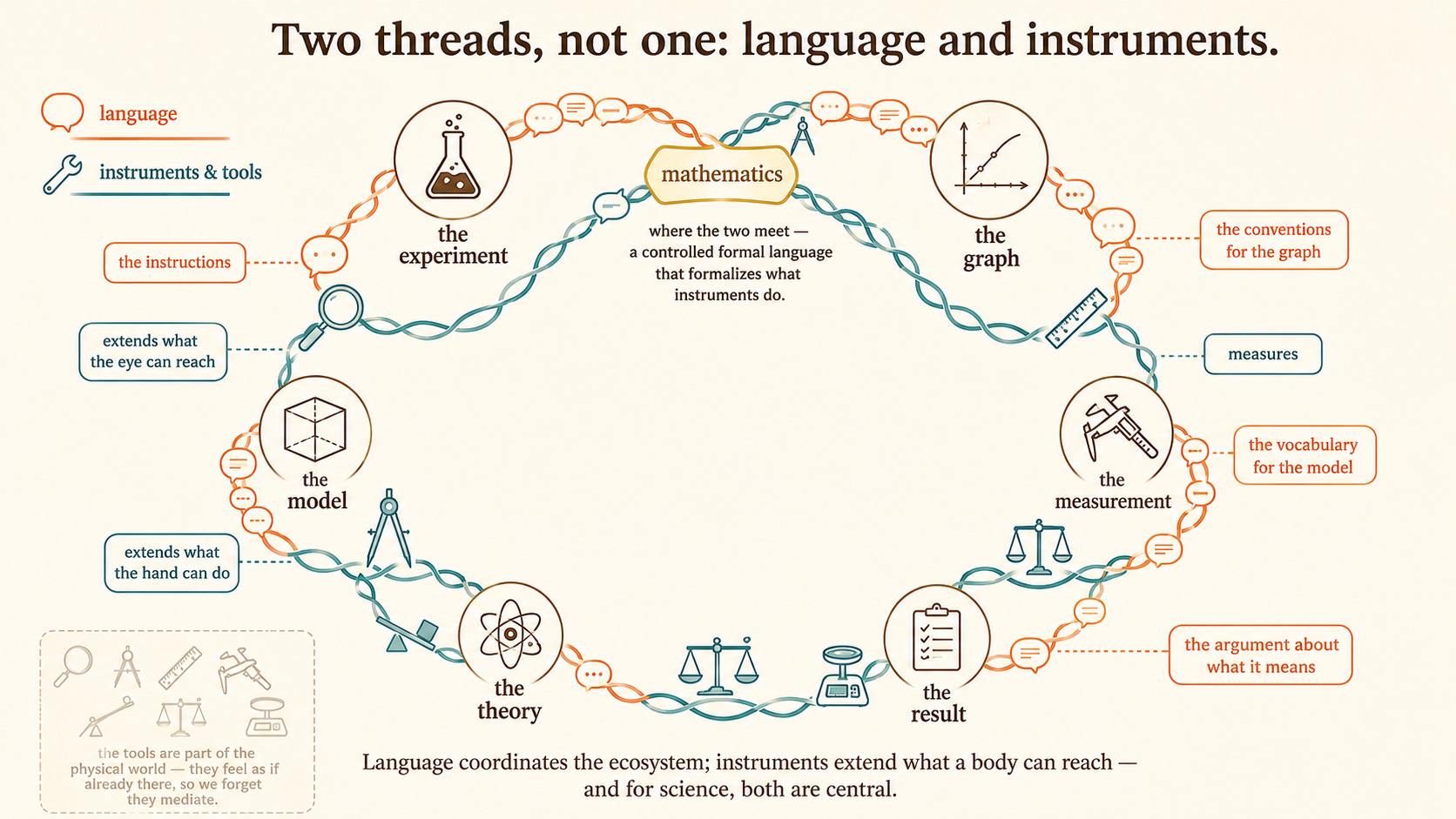
The ecosystem has many layers, and we could have begun anywhere. We begin with language for an expository reason, not because language founds the rest. Language does coordinate the others — it carries much of the vocabulary for the model, the conventions for reading the graph, the argument about whether the experiment succeeded. But we should resist a tempting overstatement: that the instruments come downstream of language, learned only through it. They do not. A child learns the hammer by imitation and bodily apprenticeship long before any instruction is read; Euclid’s compass and straightedge are not merely described by geometry — they constitute what geometry can construct. Tools are taught by showing at least as much as by telling.
And here is the point that matters most for science in particular. Language is shared with all of social and cultural life — every community runs on it. What is distinctive of scientific life is the dense layer of instruments and tools that extend our affordances: the lever, the balance, the lens, the calibrated scale, the wheel and tools the mason and carpenter rely on. Because these are part of the physical world, they enter our lives as if they were simply already there — and so we stop noticing that they mediate at all. That forgetting is itself one of the cognitive bases of science worth naming: the most constitutive mediators are often the most invisible. For science, the tools that extend what a body can reach are at least as central as the words that describe what it found.
But scientific language is not ordinary language — and this surprises many students, including those who are themselves scientists. We talk about language as if it were transparent, a neutral vehicle for thoughts already formed. It is not. Language is a cognitive tool. It restructures thought; it makes operations possible that would be impossible without it. And scientific language — with its technical registers, its inference rules, its mathematical notation, its recursive embedding of propositions within propositions — is a highly specialized cognitive technology, evolved and refined over centuries.
The chapter traces that technology carefully: from Vygotsky’s insight that language is the instrument of thought and not merely its medium, through Halliday on what makes scientific register distinctive, through Carruthers on recursion as the structural condition of scientific metacognition, through mathematics as the most powerful compressive and generative language we have, to Wittgenstein and Kuhn on what happens when language games change and translation breaks down. The simpler point comes first, though: we begin here because language is the medium the rest of the chapter is conducted in. The work language does in science is not decorative. It is constitutive: it shapes what can be thought, what can be communicated, and what counts as an explanation — but it shapes alongside the instruments, not above them.
What we carry forward
None of the earlier tools retire here; they go into active use. The mediation ecosystem we are about to examine is, in its entirety, an elaboration of the memetat — language, formalisms, instruments, institutions are all M-action structures: schematic, portable, rule-governed, communicable. The chapters ahead ask how the stochastic, embodied agents of the first three chapters learn to inhabit and extend them.
And the snapshot/stream asymmetry will be everywhere. Every time a scientist turns an embodied grasp of a phenomenon into a written description, a graph, or an equation — that is snapshot to stream. Every time a student tries to reconstruct understanding from a textbook — that is stream to snapshot. The gap between the two is exactly where the most interesting pedagogical and epistemic problems live. Which leaves us one honest question to carry forward: if the world is always accessed through a dense ecosystem of tools and symbols, does the very mediation that makes collective science possible also introduce its own characteristic blindspots? Hold that. We will earn the answer across the chapter.
Take-home. Science is not a direct encounter between agents and the world. It is mediated cognition — constituted through a dense ecosystem of tools, symbols, and social practices that agents have historically accumulated to extend and coordinate their cognitive reach. The first three chapters asked what kind of agent makes science possible; the chapters ahead ask what that agent does, and the answer is: it navigates the ecosystem. We begin with language — not because it founds the rest, but because it is the medium the chapter is conducted in; for science specifically, the instruments and tools that extend our affordances are at least as central. And scientific language itself is not a transparent vehicle but a cognitive technology that restructures thought itself.
Next: “Language as Tool: Vygotsky and Mediated Action.” Vygotsky’s central insight — that language is not merely the medium through which thoughts are expressed, but a cognitive tool that restructures thought itself. The running examples of word learning and conservation of number return, now seen through the Zone of Proximal Development and the social scaffolding of schematic acquisition.
Image prompts used for this post. Try them on your own AI model and compare what it produces with our figures.
1. The pivot
Output format: PNG. Landscape, 18cm × 10cm. A two-phase journey diagram divided by a clear vertical hinge in the middle labeled "the pivot". LEFT HALF ("Phase 1 — Chapters 1–3 — building the coordinate system"): three stacked, completed layers like geological strata — bottom "the compass (the cognitive framing)", middle "the ground (the living agent)", top "the architecture in use (placing the schools)"; a small toolbox icon resting on top, tagged "tools built: triadic lens · snapshot/stream · stochastic/schematic · two inheritance channels". A faint question floats above this half: "what kind of agents are possible?". RIGHT HALF ("Phase 2 — Chapters 4–8 — using it"): the same toolbox now open and in a hand that reaches toward five faint, dashed, not-yet-reached waypoints labeled "language", "diagrams & mathematics", "models & instruments", "affect & motivation", "distributed cognition". A different question floats above this half: "what do those agents DO when they do science?". Above the whole figure, large caption: "The pivot: from architecture to practice." Below, smaller caption: "The coordinate system is built. Now we use it — and the question changes." Warm earth tones (left), cooler tones (right); clean schematic line-art; not photographic; NO brain icon.2. The mediation ecosystem
Output format: PNG. Landscape, 18cm × 10cm. A central claim made visual: science is not a direct line between agent and world. On the FAR LEFT, a whole embodied human figure labeled "the scientist (an agent)". On the FAR RIGHT, a physical-world pole labeled "the world (physical phenomena)". Between them, instead of a single straight arrow, a DENSE LAYERED MEMBRANE the contact must pass through — a vertical stack of translucent panels, each labeled and carrying a small icon: "language & technical register" (speech bubble), "logical formalisms" (an inference arrow ⊢), "mathematics" (an equation), "inscriptions & graphs" (a plotted curve), "diagrams" (a labeled schematic), "instruments" (a telescope/microscope), "models" (a small orrery), "institutions" (peer-review/citation marks). A faint two-way arrow threads through all the panels connecting agent and world, showing contact is real but mediated. Above, large caption: "Science is mediated cognition." Below, smaller caption: "Not a direct encounter with the world — a navigation through a dense ecosystem of tools, symbols, and practices." Warm tone on the agent side fading to cool on the world side, the membrane in neutral schematic ink; clean line-art; not photographic; NO brain icon — render the scientist as a whole embodied figure.3. Language and instruments as connective tissue
Output format: PNG. Landscape, 16cm × 9cm. A diagram showing the two intertwined mediators of scientific practice — language and instruments — woven through it as equal partners. Around a ring, arrange the products and moments of scientific practice as separate icon-nodes: "the experiment", "the graph", "the model", "the measurement", "the result", "the theory". Threading between and through ALL of them run TWO continuous strands, braided together like a double helix or twin mycelial threads, each in its own distinct highlight color and of equal visual weight. Strand 1, labeled "language", drawn as a flowing line of small speech-bubbles and words; tags along it read "the instructions", "the conventions for the graph", "the vocabulary for the model", "the argument about what it means". Strand 2, labeled "instruments & tools", drawn as a flowing line of small tool icons — a lens, a balance, a lever, compass-and-straightedge, a calibrated scale; tags along it read "extends what the eye can reach", "extends what the hand can do", "measures", "constructs". Where the two strands cross near the top, a small fused node labeled "mathematics" carries a note: "where the two meet — a controlled formal language that formalizes what instruments do." In a lower corner, a faint, half-transparent cluster of the same tool icons is tagged: "the tools are part of the physical world — they feel as if already there, so we forget they mediate." Above, large caption: "Two threads, not one: language and instruments." Below, smaller caption: "Language coordinates the ecosystem; instruments extend what a body can reach — and for science, both are central." Soft warm tones, the two strands in two distinct highlight colors of equal weight; clean schematic line-art; not photographic; NO brain icon.The same stream (prompts) activates different snapshots (models) in different receivers (agents). Try the prompts above on your own AI model and compare what it produces with our figures.
This is “The Roots of STEM,” a series exploring the cognitive bases of science, technology, engineering, and mathematics. Subscribe to follow the arc from the body to the laboratory.