
Mathematics as Language: Compression, Generativity, and Proof
Section 5 of Chapter 4 — mathematics as a controlled formal language, and the registers we move between

Mathematics is not a collection of techniques. It is a cognitive technology — a controlled, formal language that does three things ordinary language cannot. It compresses vast inferential structure into a few manipulable symbols; it generates new truths by symbolic operations that outrun the intuitions that motivated them; and it calibrates knowledge across a whole community through proof. And underneath all three runs a fourth insight, from Raymond Duval: changing the representational register — from prose to diagram to equation to set-theoretic form — is never a mere translation. It is a transformation. Each register makes different structure visible and conceals other structure. We move here from the rhetorical to the logical and ask what the most formal language of all is doing.
The same thing, said four ways
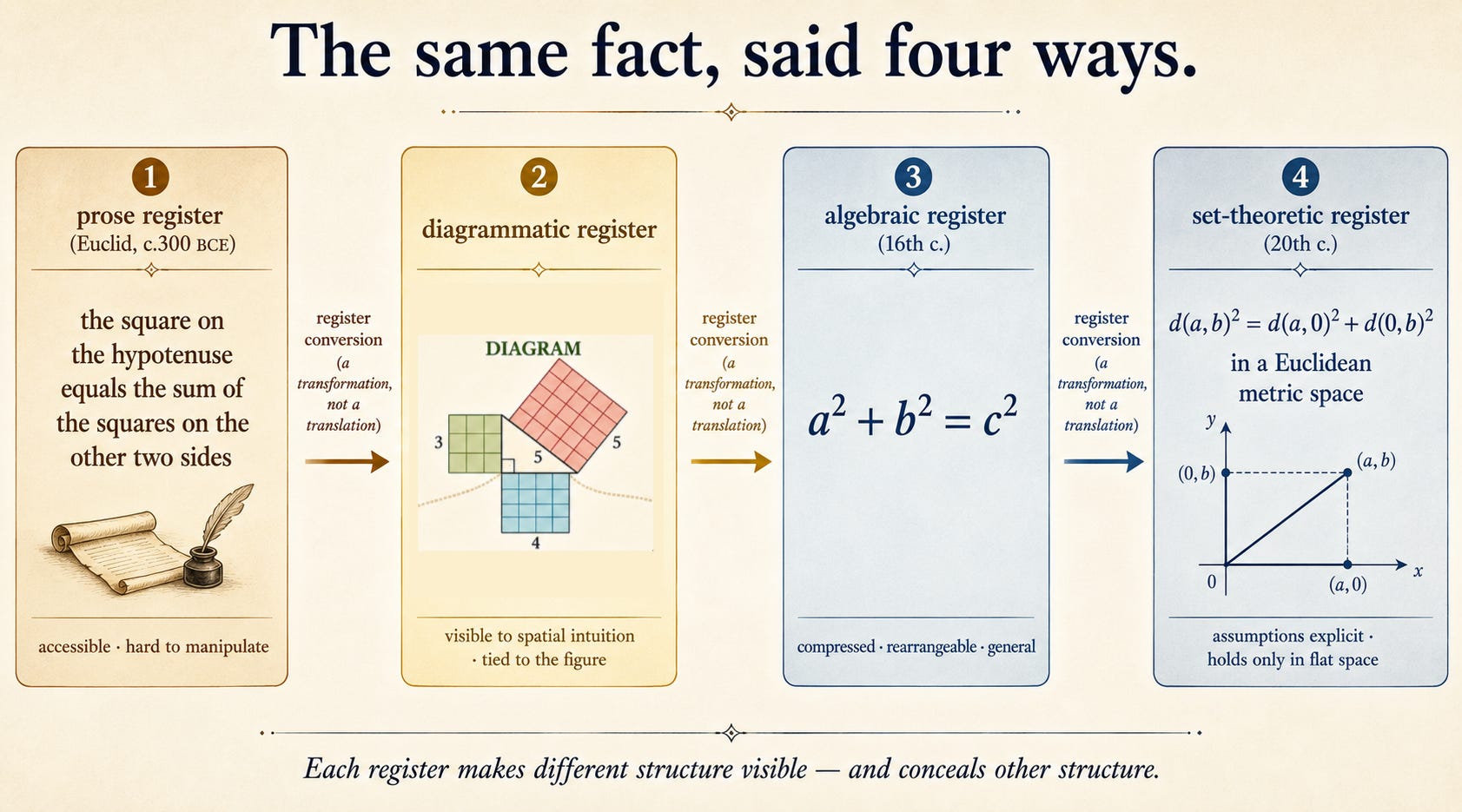
Let me anchor the whole post with one demonstration. I am going to state the same mathematical fact in four different ways. The fact is simple — one of the oldest in geometry. It concerns the sides of a right-angled triangle.
First — Euclid’s prose, circa 300 BCE: in a right-angled triangle, the square described on the side subtending the right angle is equal to the squares described on the sides containing the right angle.
Second — Euclid’s diagram: a right-angled triangle with squares constructed on each of its three sides. The square on the hypotenuse visibly equals, in area, the sum of the other two squares. The proof proceeds by cutting and rearranging regions of the figure.
Third — algebraic notation, sixteenth century onward: a² + b² = c².
Fourth — set-theoretic formalism, twentieth century: for any right triangle with legs of measure a and b and hypotenuse c in a Euclidean metric space, the distance function d satisfies d(a,b)² = d(a,0)² + d(0,b)².
Four registers — four cognitive postures. These are not four translations of the same thing. Each register makes different operations available and different things visible. The prose register describes the relationship in natural language: accessible, but hard to manipulate or extend. The diagrammatic register makes the area relationship visible to spatial intuition: powerful for proof by construction, but tied to the specific figure. The algebraic register compresses the relationship into three symbols: now it can be rearranged, generalized, differentiated, applied to any values of a, b, c. The set-theoretic register makes the underlying assumptions explicit — Euclidean metric space, distance function — revealing that the theorem holds only in flat space, and opening the question of what happens in curved space. Each step in this sequence is what Duval calls a register conversion: a move between representational systems that is not a mere translation but a cognitive transformation — one that reveals new structure and conceals other structure.
This is the thread we will follow. Mathematics is not one thing. It is a family of representational registers, each with its own expressive power, its own cognitive demands, and its own relationship to the objects it represents. And the power of mathematics as a cognitive technology comes, in large part, from the ability to move between registers — to use each one for the operations it does best, and to carry results from one register into another where they can be developed further.
Compression: when notation thinks
The first and most immediately visible power of mathematical notation is compression. An equation packs into a few symbols an inferential structure that would take paragraphs of prose to express — and that, in prose form, would be almost impossible to manipulate.
Consider Newton’s second law: F = ma. The equation says: force equals mass multiplied by acceleration. In those four words — and three symbols — it encodes an entire structure of proportional relationships. Force is directly proportional to acceleration: double the force, double the acceleration, for a fixed mass. Mass is inversely proportional to acceleration: double the mass, halve the acceleration, for a fixed force. These two proportionalities are not separate claims. They are entailed simultaneously by the single equation.
But the compression goes further. Because F, m, and a are now symbols — mathematical objects — they can be operated on algebraically. The equation can be rearranged to give a = F/m, which says something about acceleration as a function of force and mass. Or m = F/a, which says how to infer mass from observed force and acceleration. Three distinct physical claims — one equation. And that equation can now be combined with others: with the law of gravitation, with equations of motion, with conservation laws. The symbolic form makes combinability possible in a way that prose statements of the same relationships cannot achieve.
Nominalization in mathematics — the same operation, deeper. Earlier in the chapter we saw how nominalization in scientific language turns processes into objects available for further operations. Mathematics performs the same operation, but with greater precision and at greater depth. The operation of differentiation — finding the rate of change of a function — was originally described in terms of infinitely small quantities, limits, and rates. Newton called it the fluxion; Leibniz called it the differential. Once formalized into the notation dy/dx, the operation became an object: a function that maps functions to functions. It could now be differentiated again to give the second derivative, combined with other operators, studied in its own right. This is mathematical nominalization: turning an operation into a symbol that can be further operated on — and it is the mechanism by which mathematics builds its hierarchical structures, each level packaging the level below into an object available for the next level’s operations.
There is a cognitive consequence of compression that is easy to overlook. When a mathematician or scientist works with a well-chosen notation, the notation itself carries part of the cognitive load. The symbols do not merely represent the relationships — they guide the manipulations. The algebraic structure of the notation suggests what operations are possible, what substitutions are legal, what factorizations might simplify the expression. Working mathematicians sometimes describe this as the notation thinking for them — not in any mystical sense, but in the precise sense that the structure of the representational medium constrains and guides the operations that can be performed.
This is the externalization of reasoning into a medium that Leibniz imagined and Frege partially achieved. But mathematics went further than logic: the notation is not just a record of inferences already made. It is a tool that generates new inferences by its own internal operations. The stream, in mathematics, is generative.
Generativity: when mathematics outruns intuition
The second power of mathematics is the one that most often astonishes non-mathematicians — and many mathematicians too. Mathematical notation regularly generates results that nobody anticipated, that could not have been reached by informal reasoning, and that turn out to describe physical reality with uncanny precision.
The calculus is the clearest example. Newton and Leibniz developed it in the seventeenth century as a tool for handling continuously changing quantities — velocities, accelerations, areas under curves. The notation they developed — particularly Leibniz’s, which turned out to be far more manipulable than Newton’s — made it possible to perform operations on functions: differentiation and integration. And those operations, applied to the equations of mechanics, generated predictions about the motions of planets, pendulums, and projectiles that observation confirmed with extraordinary precision.
But the generativity did not stop there. The same notational machinery, applied to new domains, kept producing unexpected results. The equations of electromagnetism, written by Maxwell in the 1860s, generated — by pure symbolic manipulation — a prediction that electromagnetic waves must travel at a specific speed. When that speed was calculated, it matched the speed of light. Maxwell had not set out to explain light. The mathematics told him he had.
Generativity and proportionality — the calculus. The concept of a derivative is, at its core, the formalization of proportional reasoning extended to continuously changing quantities. The derivative of a function at a point gives the instantaneous rate of change — the proportional relationship between an infinitesimal change in input and the corresponding change in output. Once this proportionality is formalized into notation, it becomes generative. The chain rule says: the derivative of a composed function is the product of the derivatives — proportionalities multiply through compositions. The fundamental theorem of calculus says: differentiation and integration are inverse operations — the proportionality relationship runs in both directions. These are not results that informal proportional reasoning could have reached. They required the notation. The notation, once in place, made them visible — and then made them manipulable tools for further derivations.
The generativity of mathematics has a deep connection to the network structure of mathematical knowledge. A mathematical field is not a collection of isolated results. It is a web of theorems connected by logical dependencies: each theorem proved from others, each result opening new questions, each notation making previously unformulable questions formulable. When new notation is introduced — as the calculus introduced differentiation and integration — it does not just give names to existing ideas. It creates new nodes in the network, and new edges connecting them to existing results. The network grows, and as it grows, new paths through it become visible.
This is why mathematics is genuinely cumulative in a way that few other intellectual enterprises are. The Pythagorean theorem proved by Euclid is still true. The calculus developed by Newton and Leibniz is still valid. The set-theoretic foundations built by Cantor and Frege are still in use. Each generation does not replace its predecessor’s work — it adds to the network, connects it to new domains, and makes previously unreachable regions of mathematical space accessible.
Proof: the communicative calibration of mathematics
The third power of mathematics is proof — and I want to be careful about what proof is and is not, because it is easy to misunderstand.
Proof is not primarily a tool for convincing yourself that a result is true. Mathematicians very often know — or strongly believe — that a result is true before they have a proof of it. Intuition, pattern recognition, analogy, and numerical experimentation all provide evidence of mathematical truth that precedes formal proof. What proof does is something different. It is the communicative calibration of mathematical knowledge across the Agent–Agent vertex.
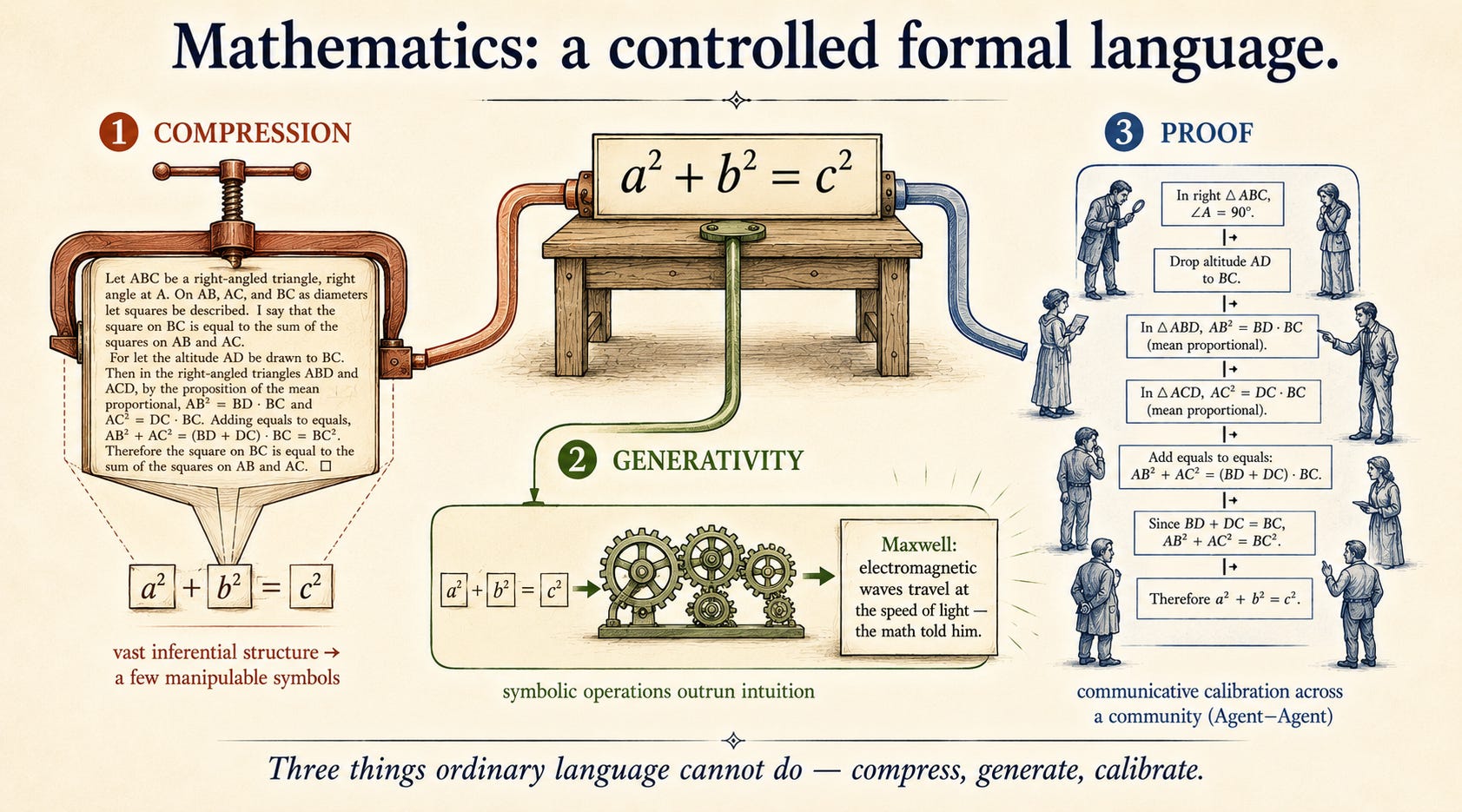
When a mathematician writes a proof, she is constructing a stream-form of her mathematical understanding that can be transmitted to other mathematicians, inspected by them, challenged at every step, and either accepted or rejected on grounds independent of her authority, reputation, or persuasiveness. The proof externalizes her reasoning into a form that any competent member of the community can evaluate. It converts the snapshot — her personal grasp of why the result is true — into a stream the community can check.
Proof as recursive structure. A proof is a sequence of propositions, each following from previous ones by explicit inference rules. This is recursion in its structural form: each step depends on earlier steps, which themselves depended on still earlier steps, back to the axioms. But proof also requires recursion in the sense Carruthers identified: the mathematician must be able to treat each step as a proposition — an object to be examined — and ask whether it follows validly from what precedes it. The reader of a proof performs a sustained recursive operation: attending to each inference, embedding it within the larger structure, evaluating its validity. Mathematical education is, in significant part, the development of this recursive competence — the ability to follow a proof step by step without losing the thread of the overall structure, and to produce proofs that maintain validity at every step while building toward a conclusion. This is among the most demanding cognitive tasks that formal education asks of learners.
Proof has a further function that connects it to the institutional dimension of science. Once a result is proved, it becomes a stable node in the mathematical network — available for use in further proofs without needing to be re-established each time. The network of theorems is a cognitive prosthesis for the community: it extends the effective working memory of mathematical practice far beyond what any individual mathematician could maintain. When a mathematician says let f be a continuous function on a closed interval and invokes the intermediate value theorem, she is drawing on a node in the network that someone else established, at another time, and whose reliability she trusts without re-examining the proof. The network does the cognitive work.
This is the Agent–Institution vertex in its mathematical form. The institutions of mathematical practice — the norms of proof, the peer review of results, the textbook codification of established theorems — maintain the reliability of the network. They are what make it safe to build on earlier results without starting from scratch every time.
Duval and register conversion: Euclid’s long journey
We have now examined compression, generativity, and proof as three powers of mathematics as a cognitive technology. But there is a fourth dimension that cuts across all three: the question of representational registers. Here we turn to the French mathematics educator and cognitive scientist Raymond Duval.
Duval’s central claim is this: mathematical objects are never directly accessible. They are always accessed through representations — through the specific semiotic registers in which they are expressed. And a semiotic register is not just a notation. It is a system of representation with its own internal operations, its own way of transforming representations, and its own relationship to the objects it expresses.
Duval identifies four main registers in mathematics: natural language, figural or geometric representations, symbolic algebraic notation, and tabular or graphical representations. Each register has its own treatment operations — the internal transformations you can perform within the register. And moving from one register to another is a conversion — a cognitively distinct operation from treatment, and one that Duval finds to be a major source of difficulty for learners.
The key insight is that understanding a mathematical object requires being able to work with it in at least two registers — to convert representations between them — and to recognize that the different representations are representations of the same object. This seems obvious. But Duval’s empirical work showed that it is, in practice, extremely difficult: students who can work fluently within one register often fail to recognize the same object when it appears in another.
Euclid’s geometry — a register conversion across two millennia. The history of Euclidean geometry is the most instructive long-run demonstration of Duval’s claim that exists. Euclid’s Elements (circa 300 BCE) presented geometry entirely in the prose and diagrammatic registers. The proofs were sequences of natural-language statements, each accompanied by a geometric figure; the treatment operations were geometric constructions — drawing lines, extending segments, constructing circles. For nearly two thousand years, this was geometry. The prose-and-diagram register made certain things visible — the constructive relationships between figures, the spatial structure of Euclidean space, the visual immediacy of the area arguments — and concealed others: the algebraic structure of the relationships, the dependence on the parallel postulate, the assumption of a flat metric space. The conversion to algebraic notation — through Descartes’ coordinate geometry in the seventeenth century — was not a translation of Euclid’s results into a new notation. It was a transformation that made new operations available. Once a circle could be represented as x² + y² = r² and a line as y = mx + b, geometric objects could be operated on algebraically: results that required elaborate constructions in Euclid could now be derived by manipulation. The further conversion to set-theoretic formalism in the twentieth century — through Hilbert’s axiomatization — made yet another register available, one in which the assumptions of Euclidean geometry could be stated explicitly as axioms, varied systematically, and shown to be independent. Changing the parallel postulate produced the non-Euclidean geometries: hyperbolic, elliptic, Riemannian. The set-theoretic register made visible the assumptions that the prose-and-diagram register had concealed for two thousand years.
What Duval gives us, through this history, is a precise account of what happened at each register conversion. It was not that mathematicians simply found a more convenient notation for the same ideas. Each new register revealed structure that the previous register had hidden — and in doing so, opened new mathematical territory. The register is not neutral. It shapes what can be seen, what can be asked, and what can be proved.
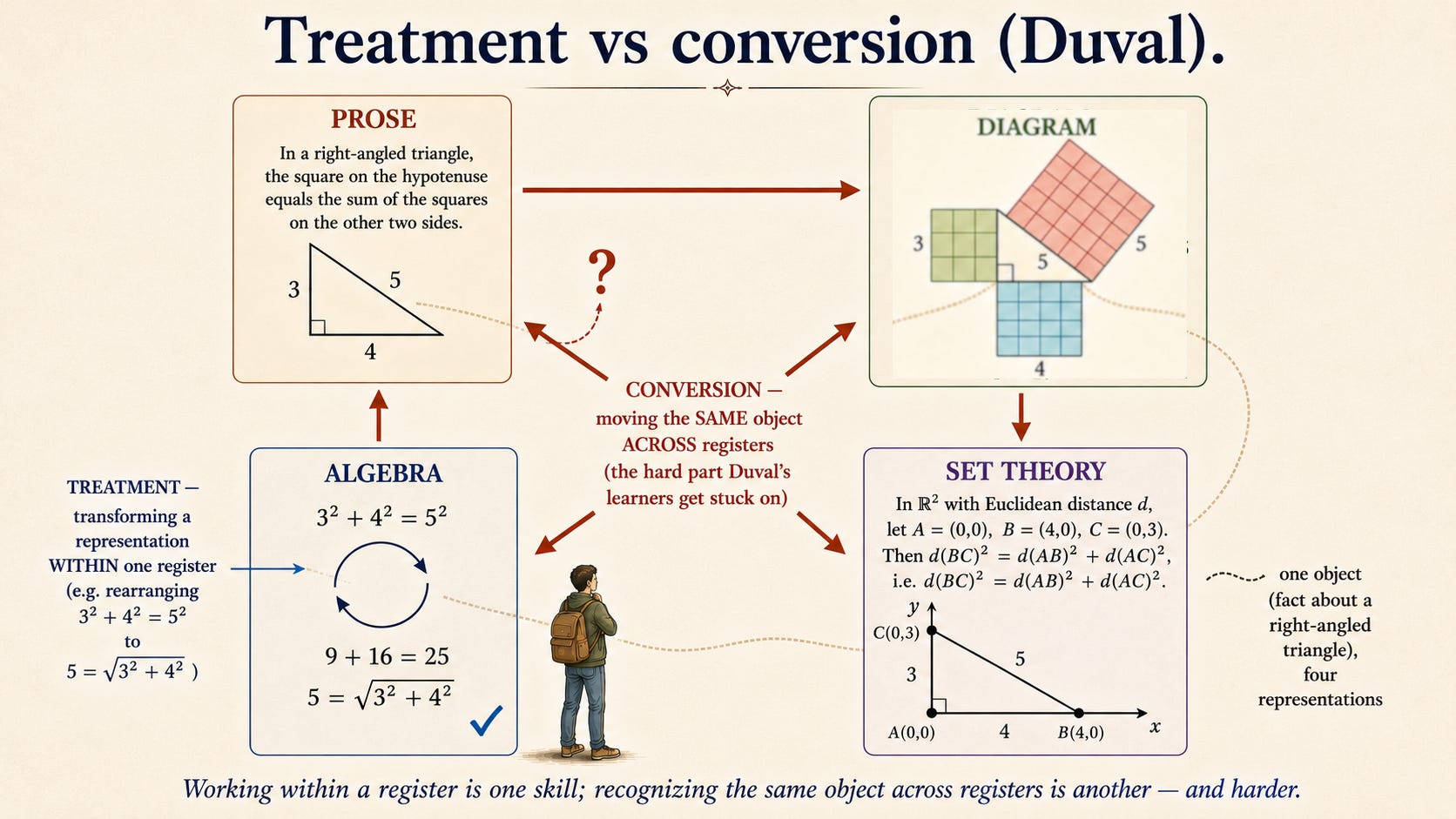
This has direct consequences for science education — consequences that are often missed. When a student learns Newton’s laws in the algebraic register, as equations, she is working in a register that conceals the geometric and physical intuitions from which those laws were originally derived. When a student learns probability as a set of rules for manipulating fractions, she is working in a register that conceals the frequency interpretation, the Bayesian interpretation, and the geometric interpretation, each of which gives different intuitions about what probability means. The student who works in only one register has, in Duval’s terms, not yet understood the mathematical object — because the object is only fully accessible when you can move between registers and recognize the same structure in each.
There is a connection here worth naming, because we met its other half earlier. In the post on Piaget we introduced Karmiloff-Smith’s representational redescription — the process by which knowledge a mind already holds implicitly gets re-encoded into more explicit, more manipulable formats. Duval’s register conversion is the same insight seen from the outside. Redescription is the mind re-representing its own knowledge internally, running inward toward explicitness and largely on its own; conversion is the coordination of the external, public registers — prose, diagram, equation, set-theoretic form — that the culture supplies, and it has to be taught. They are not one process. But they are two faces of one dynamic: a cognitive system gaining power by re-representing the same content in a format with different affordances. And the bridge between them is what this chapter is building toward — learning to move fluently between external registers is exactly how a learner internally redescribes them, until the notation stops being something she decodes and becomes something she thinks in. We close that loop in the synthesis.
Why this is a language at all
Notice what the three powers and the register insight, taken together, establish. Mathematics is a language in the full sense — but a controlled, formal one. Like ordinary language it has a vocabulary (its symbols and objects), a grammar (its legal operations), and a community of speakers who calibrate meaning between them. Unlike ordinary language, its rules are explicit, its ambiguities deliberately engineered out, and its operations guaranteed to preserve truth when applied correctly. It is, in the series’ phrase, a formalized instrument: language disciplined until it does the work an instrument does — extending what a mind can reach, measure, and construct.
And like any language it lives in the snapshot/stream cycle. Every equation a scientist writes turns an embodied grasp of a phenomenon into a transmissible stream; every learner who reconstructs the meaning behind the symbols runs the stream back into a snapshot. The gap between the two — between the symbol on the page and the understanding it is meant to carry — is exactly where Duval found his learners stranded, fluent in one register and lost in the next.
Take-home. Mathematics is not a collection of techniques — it is a cognitive technology, a controlled formal language that does three things ordinary language cannot. It compresses vast inferential structure into manipulable notation; it generates new truths by symbolic operations that outrun the intuitions that motivated them; and it calibrates knowledge across a community through proof. Duval completes the picture: each representational register — prose, diagram, equation, set-theoretic form — makes different structure visible and enables different operations. Learning mathematics is learning to move fluently between registers without losing the thread of meaning. Changing the register is not translation. It is transformation.
Next: “Multimodal Science: Text, Image, Graph, and Gesture.” We have examined language and mathematics as the two primary schematic registers through which science thinks. But scientific communication is never monomodal: text, diagram, graph, image, gesture, and inscription each carry a portion of the meaning that no single mode could carry alone — and reading a scientific text means integrating across all of them.
Image prompts used for this post. Try them on your own AI model and compare what it produces with our figures.
1. The same fact, four registers
Output format: PNG. Landscape, 18cm × 10cm. A horizontal sequence of four panels, left to right, each showing THE SAME mathematical fact about a right-angled triangle but in a different representational register, with a labeled conversion arrow between consecutive panels reading "register conversion (a transformation, not a translation)". PANEL 1 "prose register (Euclid, c.300 BCE)": a block of plain text reading "the square on the hypotenuse equals the sum of the squares on the other two sides"; small tag below: "accessible · hard to manipulate". PANEL 2 "diagrammatic register": a right triangle with a literal square drawn on each of its three sides, the large square visibly equal in area to the two smaller ones; tag: "visible to spatial intuition · tied to the figure". PANEL 3 "algebraic register (16th c.)": the bold equation a² + b² = c²; tag: "compressed · rearrangeable · general". PANEL 4 "set-theoretic register (20th c.)": "d(a,b)² = d(a,0)² + d(0,b)² in a Euclidean metric space"; tag: "assumptions explicit · holds only in flat space". Above all four, large caption: "The same fact, said four ways." Below: "Each register makes different structure visible — and conceals other structure." Warm tones on the left fading to cool, structured tones on the right; clean schematic line-art; not photographic; NO brain icon.2. The three powers of mathematical notation
Output format: PNG. Landscape, 18cm × 10cm. A central labeled token "a² + b² = c²" (or "F = ma") sitting on a workbench, with three distinct mechanisms branching from it, each labeled. BRANCH 1 "COMPRESSION", drawn as a large paragraph of dense prose being squeezed by a clamp down into three small symbols; tag: "vast inferential structure → a few manipulable symbols". BRANCH 2 "GENERATIVITY", drawn as the symbols feeding into a gear-train that outputs a NEW, unexpected result on a card labeled "Maxwell: electromagnetic waves travel at the speed of light — the math told him"; tag: "symbolic operations outrun intuition". BRANCH 3 "PROOF", drawn as a ladder of stacked statements each linked to the one below by an inference arrow ⊢, with several small human figures standing around it inspecting each rung; tag: "communicative calibration across a community (Agent–Agent)". Above, large caption: "Mathematics: a controlled formal language." Below, smaller caption: "Three things ordinary language cannot do — compress, generate, calibrate." Clean schematic line-art; soft warm tones with three distinct accent colors for the three branches; not photographic; NO brain icon; render the inspectors as whole embodied figures.3. Treatment vs conversion
Output format: PNG. Landscape, 16cm × 9cm. A diagram distinguishing two cognitive operations in mathematics. On the canvas, place four labeled register-zones as separate boxes: "prose", "diagram", "algebra", "set theory". WITHIN one zone (say "algebra"), draw a tight looping arrow that stays inside the box, labeled "TREATMENT — transforming a representation WITHIN one register (e.g. rearranging a² + b² = c² to c = √(a²+b²))". BETWEEN the zones, draw bold arrows crossing from one box to another, labeled "CONVERSION — moving the SAME object ACROSS registers (the hard part Duval's learners get stuck on)". Show a single small icon of the "same object" (a right triangle) reappearing inside each of the four zones in that zone's native notation, with a faint thread connecting all four instances to signal "one object, four representations". A small embodied student figure stands beside the algebra box, fluent there (a checkmark), but a question mark hovers over the conversion arrow leading to the diagram box. Above, large caption: "Treatment vs conversion (Duval)." Below, smaller caption: "Working within a register is one skill; recognizing the same object across registers is another — and harder." Clean schematic line-art; soft tones, the conversion arrows in a single strong accent color; not photographic; NO brain icon; render the student as a whole embodied figure.The same stream (prompts) activates different snapshots (models) in different receivers (agents). Try the prompts above on your own AI model and compare what it produces with our figures.
This is “The Roots of STEM,” a series exploring the cognitive bases of science, technology, engineering, and mathematics. Subscribe to follow the arc from the body to the laboratory.
Mathematics is a language, not a tool applied to language. Register conversion is transformation, not translation. Notation is generative, not merely compressive. "The notation thinks" is an observation I have made independently and tested empirically (114 experiments measuring how named operators change output structure). Duval's register insight, which you present through the Pythagorean example across four registers, is structurally parallel to a result I have formalized: three irreducible projections (genealogical, structural, functional) that each reveal different structure in the same object, with no two recovering the third. Duval has four registers. I have three projections. Both say: the object is only accessible through multiple views, each view reveals and conceals, and moving between views is the cognitive work, not a convenience.
Mathematics is not a tool the mind uses. Mathematics is what the mind does. The fifteen structural-categorial operators I have formalized are not a notation for cognitive operations. They ARE the cognitive operations. The mind does not use mathematics to think. The mind's constitutive activity IS mathematical. Individuation, classification, negation, conditionality, causation, boundary, comparison, quantification: these are not tools the mind picks up. These are the operations the mind consists in when it is cognizing. The mathematics is not external to the mind. The mathematics IS the mind's activity.
If mathematics is a tool the mind uses, the mind could in principle think without mathematics. If mathematics is what the mind does, the mind without mathematics is not thinking. The fifteen operators do not extend cognition. The fifteen operators ARE cognition. Remove them and there is no cognition left to extend.
https://doi.org/10.5281/zenodo.20318684