
Habitat and Memetat
The two worlds every human being inhabits

You know how to navigate a city you have never visited. Not because you were born knowing it. Not because you studied its streets in a book. You know it because you have a mobile phone, and it has maps, and the maps were built from satellite data, street surveys, and the collective navigational experience of millions of people encoded in a digital system. You consult the map, follow the arrows, arrive.
What just happened, cognitively? You used an external representation — a map — to extend your capacity for action into an environment you had never physically encountered. The map is not in your head. The knowledge of the city was not in your head before you arrived. And yet you navigated successfully. The cognitive system that got you there was not just you. It was you plus the phone plus the map plus the infrastructure that produced the map.
Now consider what you are doing at this moment. You are reading a series of posts — words written, revised, and delivered through a medium that lets you engage with them at your own pace, in your own time, in your own location. This series itself is a construction of exactly the kind we are about to name: a set of socially produced, digitally transmitted structures designed to reshape your cognitive engagement with the world. You are not just learning about the concept I am about to introduce. You are currently inside it.
That is not a coincidence. It is the point.
Two environments
Every human being inhabits two environments simultaneously. I want you to hold the distinction loosely at first — feel it before you define it.
The first is the habitat.
Picture an infant reaching for an object. She feels its weight, its texture, its resistance. She drops it and watches it fall. She reaches again. This is habitat engagement — the world as afforded by the body’s direct sensorimotor coupling with physical reality. The potter feeling clay respond under her hands. The cook tasting a sauce and adjusting the seasoning. The field scientist tracking weather patterns, noticing the smell of rain before it arrives. The habitat is the world you encounter through your body.
The second is the memetat.
The alphabet is memetat. The periodic table is memetat. A laboratory protocol is memetat. A legal system is memetat. The map on your phone is memetat. And — this matters for anyone living in 2026 — the entire online digital environment is memetat. Every website, every database, every social media platform, every digital archive, every search engine result. All of it: the accumulated, socially constructed, digitally stabilized traces through which human communities have externalized and transmitted their knowledge, their practices, their norms, and their narratives.
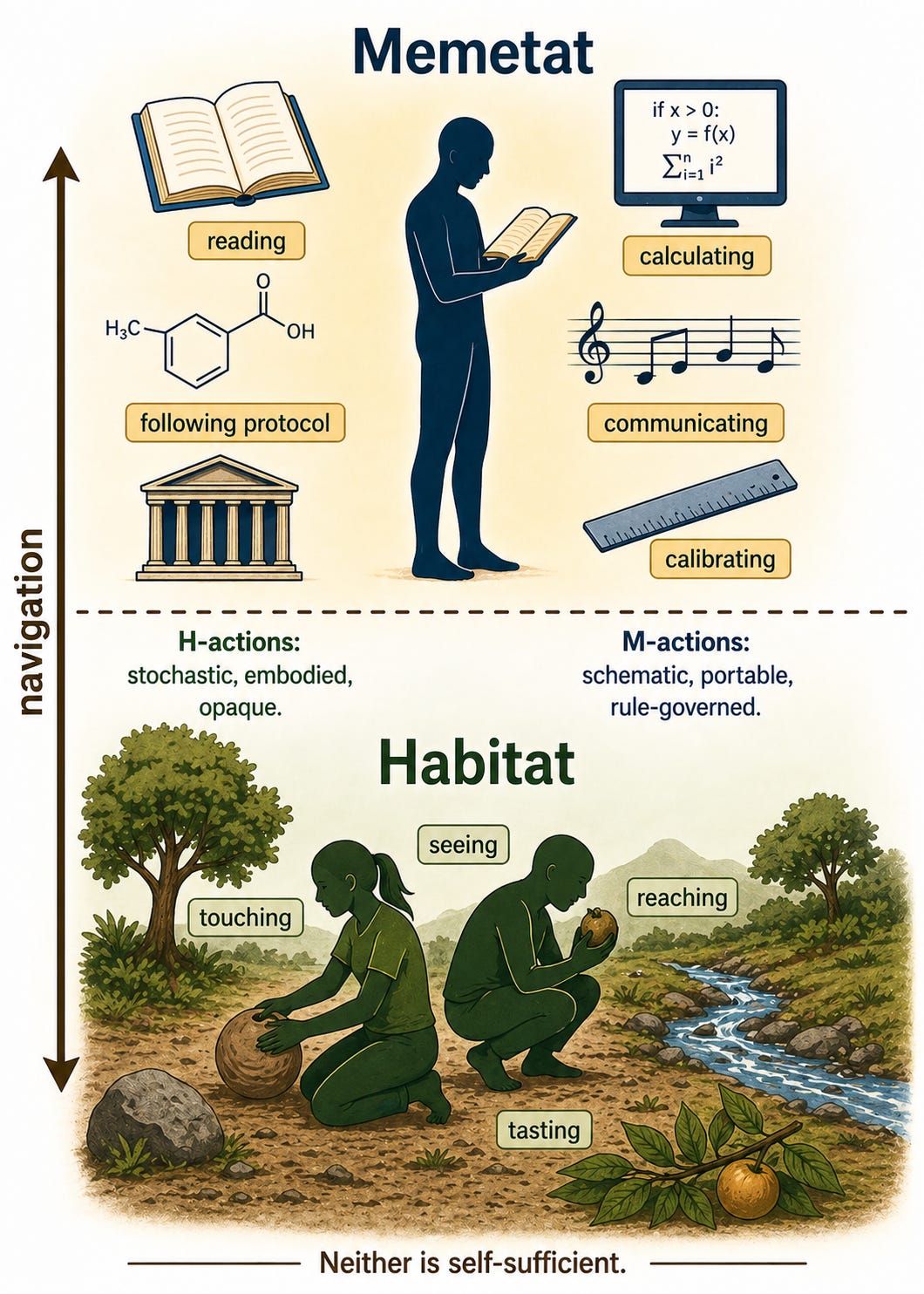
You spend a very large portion of your waking life in the memetat. Probably much more than you spend in direct sensorimotor engagement with the physical habitat. That asymmetry — more memetat, less habitat — is one of the defining features of contemporary life. It has consequences we will return to.
Two kinds of action
The distinction between habitat and memetat is not simply inside versus outside, or natural versus artificial, or individual versus social. It is subtler. It is a distinction between two kinds of action.
H-actions — habitat-dwelling actions — are stochastic in character. They operate on statistical regularities extracted from experience. They are adaptive, context-sensitive, tolerant of noise, and they degrade gracefully under perturbation. They are often opaque to introspection — you cannot always say how you do them. The expert’s trained intuition. The musician’s feel for timing. The experienced clinician’s pattern recognition. Effective, embodied, resistant to explicit specification.
M-actions — memetat-dwelling actions — are schematic in character. They are organized according to explicit, portable, rule-governed structures that can be communicated, inspected, criticized, and transmitted across persons and generations. Writing a mathematical proof is an M-action. Following a laboratory protocol is an M-action. Posting a carefully worded argument online is an M-action. M-actions require a medium — a trace: sound, mark, diagram, symbol, digital signal. They are the actions through which habitat knowledge gets externalized, stabilized, and transmitted.
And here is the crucial point: neither pole is self-sufficient.
H-actions alone — pure habitat engagement without any memetat scaffolding — produce adaptation without understanding. The organism learns, adjusts, becomes competent. But the competence is locked in the body. It cannot be communicated. It cannot be accumulated across generations. It cannot be subjected to critical evaluation. It is effective but opaque.
M-actions alone — pure memetat engagement without habitat grounding — produce empty formalism. Symbols manipulated according to rules but not connected to any real encounter with the world. Students who recite definitions but cannot apply them. Algorithms that produce outputs without physical understanding. Expertise without experience.
Scientific knowledge lives in the navigation between the two. It is grounded in habitat engagement — in experiments, observations, sensorimotor encounters with phenomena. And it is stabilized in the memetat — in theories, protocols, instruments, mathematical models, published findings. The scientist is always doing both: engaging the habitat through the tools the memetat has made available, and feeding the results back into the memetat as new knowledge.
If we live in two worlds, why don’t we see them?
A fair question. If the habitat and the memetat are so different, why don’t we experience them as separate? Why does the world feel like one world, not two?
Because they are presented to us entangled.
When you look at a thermometer and read “37.2°C,” you are simultaneously in the habitat (your eyes tracking the mercury column, your hand feeling the glass) and in the memetat (the number, the Celsius scale, the convention that maps column height to temperature). The two are fused in a single experience. You do not first perceive the column and then separately consult the convention. You see the temperature. The habitat encounter and the memetat structure arrive together, woven into one act of perception.
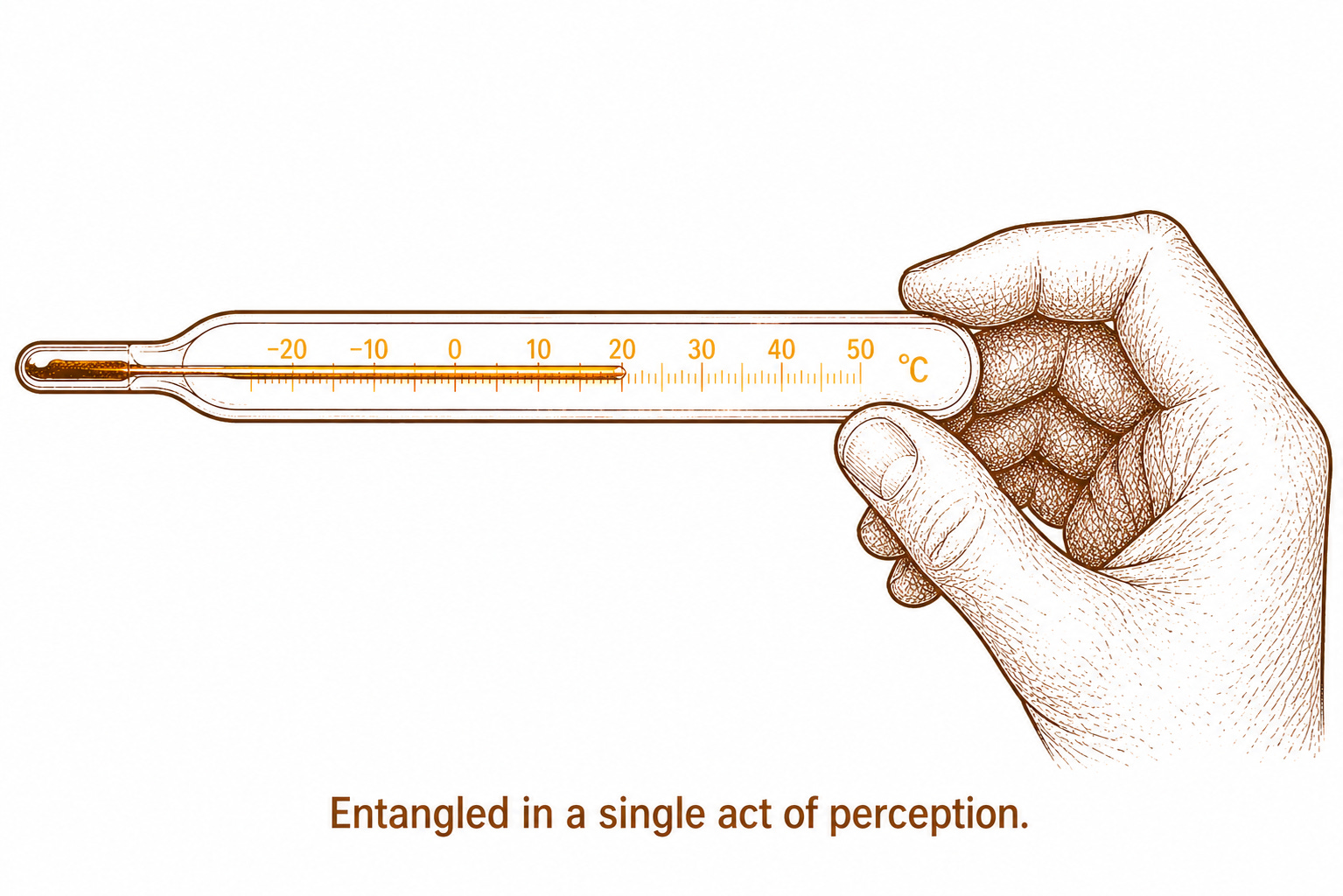
Alva Noë has made this point forcefully: organisms and their environments are constitutively entangled — you cannot specify what a human being is independently of the organized practices, tools, and cultural environments in which human life is embedded. The dancer and the stage. The blind person and the cane. The scientist and the instrument. In each case, the agent and the constructed environment are not two things that happen to interact. They are co-constituted through ongoing practice.
The habitat/memetat distinction is not a claim that you experience two worlds. It is an analytical distinction — a tool for seeing what is entangled in every act of knowing. Just as a chemist can distinguish hydrogen and oxygen in water without claiming that you experience them separately when you drink, we can distinguish habitat engagement and memetat engagement without claiming that they feel separate when you do science. The distinction is in the analysis, not in the experience. And the analysis is needed precisely because the entanglement hides the dependencies.
Two channels of inheritance
The habitat/memetat distinction connects to something deeper: two channels through which knowledge is transmitted across generations.
Phyletic inheritance — genetic transmission — builds the organism’s body: its anatomy, physiology, sensorimotor architecture. It is the channel through which the habitat-engaging agent is constructed. Genetic change takes generations — thousands to millions of years for significant shifts.
Mimetic inheritance — cultural transmission through imitation, teaching, and institutional practice — builds the memetat. It is the channel through which conventions, instruments, notations, and institutions are transmitted. Mimetic change can happen in a single lifetime, a single decade. The digital revolution transformed the memetat within a generation. The genome barely noticed.
This difference in timescale is part of what makes the memetat so powerful — and so demanding. The memetat changes faster than biology can adapt to it. Navigating the contemporary memetat requires capacities that our biological architecture was not specifically designed for — capacities that education, training, and cultural practice have to supply.
Isn’t this just genes and memes?
Another fair question. Richard Dawkins introduced the term meme — by analogy with gene — to name the unit of cultural transmission: the idea, the practice, the symbol that replicates through social learning. The gene/meme distinction maps onto the phyletic/mimetic channels I just described. So: are habitat and memetat just new words for the same thing?
No. And the difference matters.
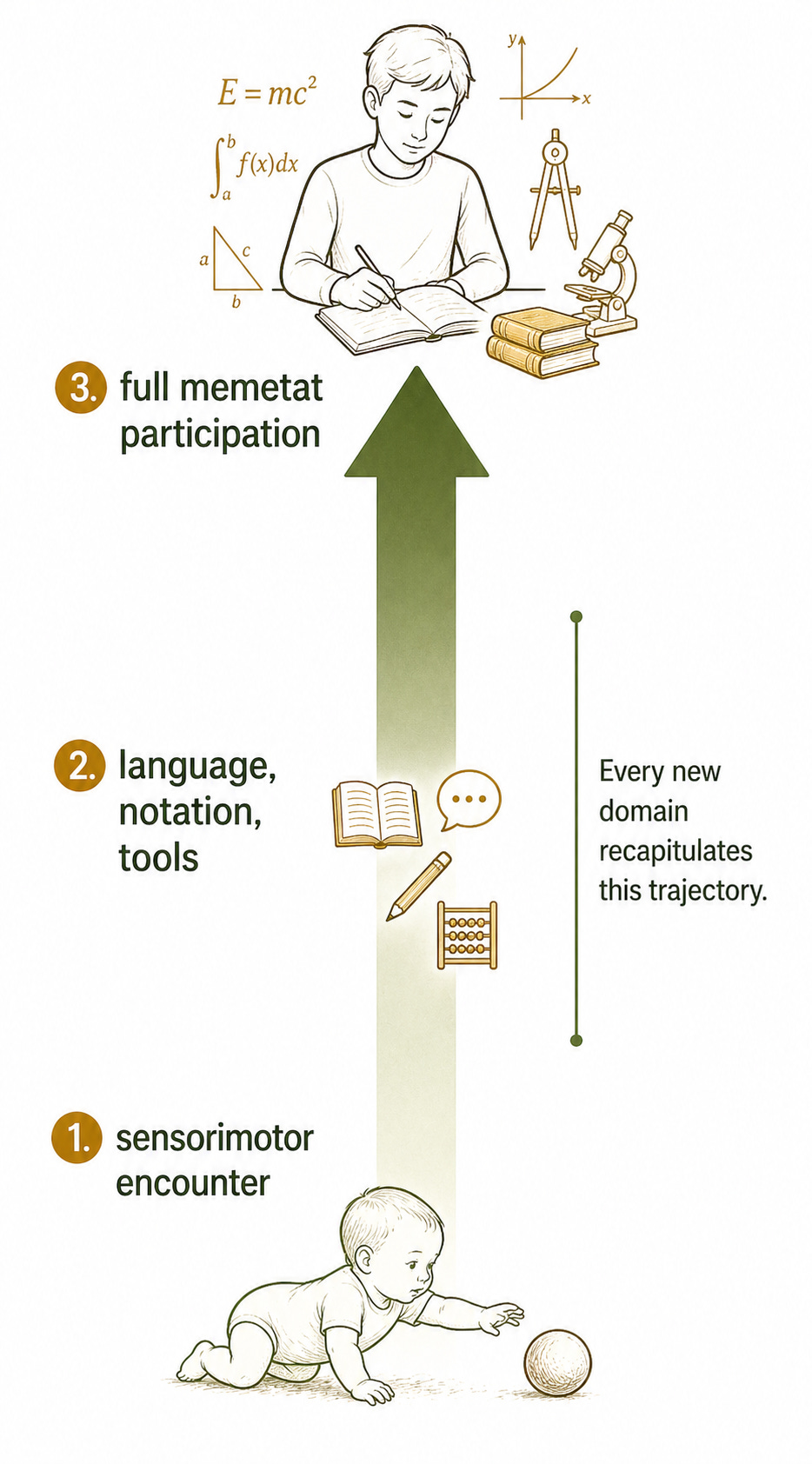
The gene/meme framework is about units of replication. It asks: what is the cultural analogue of the gene? What gets copied, varied, and selected in cultural transmission? The focus is on the unit — the meme — and on the Darwinian logic of its replication. This is an important question, and it has generated productive research in cultural evolution.
The habitat/memetat framework is about environments of action. It asks: what kind of world is the agent navigating? What are the affordances of that world — what does it make possible, what does it demand? The focus is not on what gets copied but on where the agent acts and what kind of action each environment requires.
A meme is a thing — an idea, a tune, a catchphrase — that spreads. The memetat is a world — the entire constructed environment of conventions, instruments, inscriptions, and institutions that a community of agents inhabits. The periodic table is not a meme (it does not replicate itself). It is a feature of the memetat — a structure in the constructed environment that shapes what agents can do and know.
The gene/meme framework tells you about cultural evolution — how ideas spread and change. The habitat/memetat framework tells you about cognitive ecology, “forms of life” (Cf. Wittgenstein) — what kind of world the agent is operating in and what that world demands of the agent’s cognitive architecture. Both are useful. They answer different questions.
The seed: natural and artificial
Let me plant something here that we will harvest properly in a later post.
The habitat/memetat distinction illuminates the deepest difference between natural and artificial intelligence.
Natural agents — you, the scientist, the child learning to count — begin in the habitat. You start with sensorimotor engagement: touching, seeing, reaching, falling, tasting. From that embodied encounter, you progressively construct memetat structures — language, number, theory, notation. The trajectory runs from world to symbol.
Artificial agents — large language models, the systems that now generate text and images with remarkable fluency — begin in the memetat. They are trained on the digital archive of human-produced text and data. They consume the memetat and construct a compressed relational map of it. Their trajectory runs from symbol to symbol. They never encounter the habitat directly. They have no body, no sensorimotor history, no experience of weight, temperature, resistance, or spatial navigation.
The natural agent builds knowledge from habitat engagement with the world. The artificial agent builds statistical models from memetat tokens that were themselves produced by agents with habitat engagement. These are structural inversions of each other — the same architecture traversed from opposite ends. We will develop this fully in a later post. For now, hold the image: world to symbol versus symbol toward world.
Your own trajectory
One more thing — because it connects the distinction to something you have experienced, whether or not you have named it.
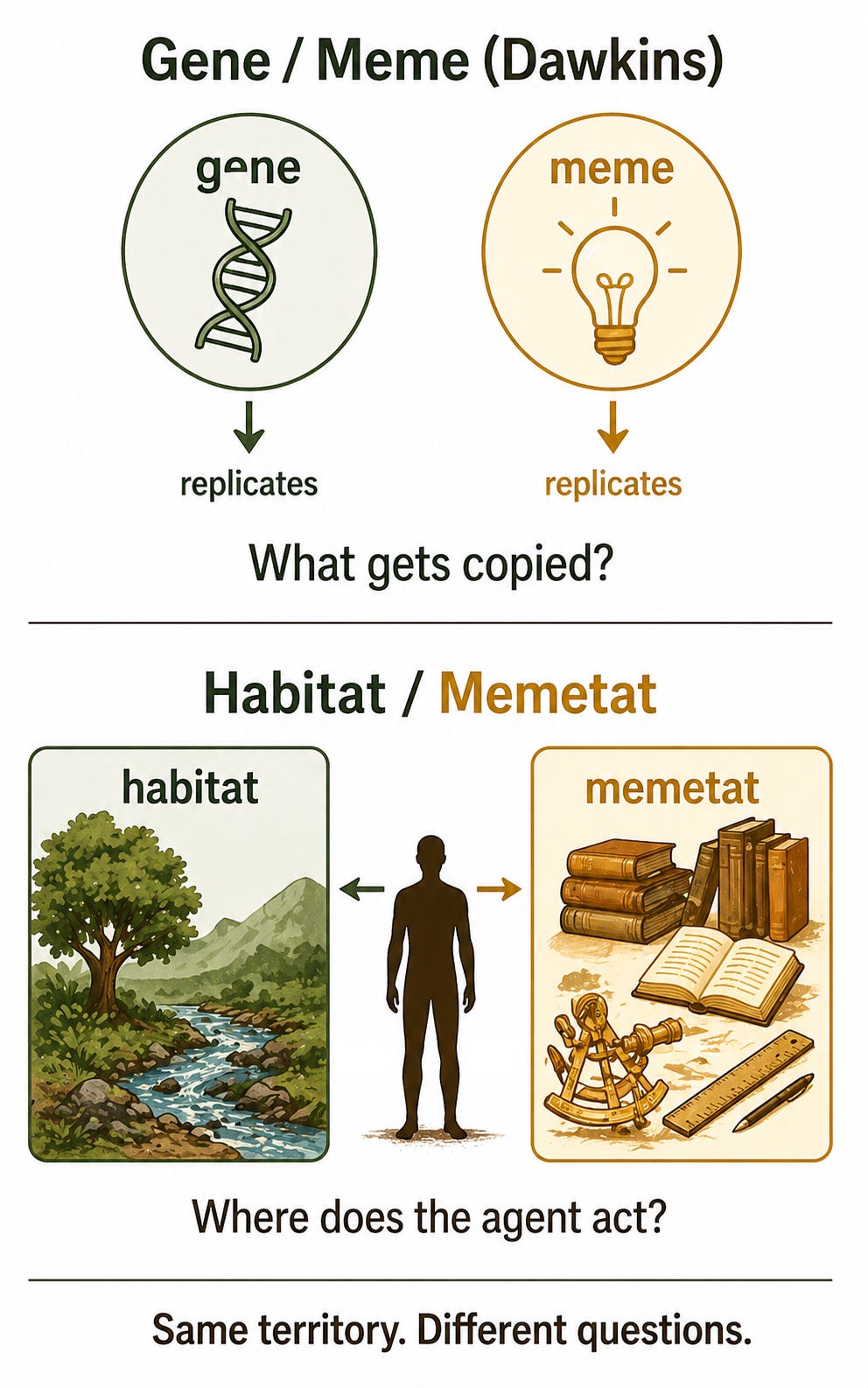
Every human agent begins in the habitat. The infant has no memetat access — no language, no notation, no institutional embedding. The infant encounters the world directly, through sensorimotor engagement. From that engagement, the infant begins to build — slowly, over years, with enormous social support — the memetat structures that will eventually make them a full participant in cultural and scientific life.
This trajectory recurs throughout life, every time you encounter a new domain. When you first met calculus, you were in the habitat of that domain: encountering the concepts as foreign objects, manipulating symbols without fully understanding what they referred to. As your understanding deepened — as you developed intuitions about rates of change, built a feel for what derivatives and integrals do — you were constructing memetat structures increasingly grounded in something that felt like understanding. You were moving from symbol manipulation toward genuine engagement.
Science as a collective enterprise is the institutionalized version of this trajectory. Phenomena initially grasped through direct encounter — experiment, observation, measurement — are progressively stabilized as memetat structures: theories, laws, models, databases. The balance that eighteenth-century chemists used to weigh their compounds was a habitat instrument — a device for direct sensorimotor encounter with the physical world. The conservation of mass, as a theoretical principle, is a memetat construction — an abstraction stabilized through the cumulative work of many agents across many encounters. Neither exists without the other.
The compass bearing
Two environments. Two kinds of action. Two channels of inheritance. One trajectory — from habitat to memetat — that every human agent traverses, that every scientist re-enacts in every domain, and that artificial intelligence inverts.
Intelligence is the navigation between them. Science is that navigation at its most systematic, most disciplined, most productive.
This is the first of the three frameworks that the previous post promised. The next two — the triadic lens and the snapshot/stream architecture — will build on it. Together, the three form the coordinate system for everything that follows.
Next: “Cognitive and Epistemic — The Question That Is Prior”
Image prompts used for this post
1. Habitat and Memetat Split
Output format: PNG. A vertical split diagram. BOTTOM HALF labeled "Habitat": A human figure in direct contact with the physical world. Hands touching a round object (clay, rock, fruit). Feet on textured ground. Natural elements — a stream, a tree, a stone. Small labels: "touching," "seeing," "reaching," "tasting." Earthy greens and browns. TOP HALF labeled "Memetat": The same human figure surrounded by constructed artifacts — an open book, a screen, a ruler, a chemical formula, a musical note, a building with columns. Small labels: "reading," "calculating," "following protocol," "communicating." Warm ambers and blues. BETWEEN the halves: a horizontal dashed line. Left: "H-actions: stochastic, embodied, opaque." Right: "M-actions: schematic, portable, rule-governed." Vertical double-headed arrow on the left labeled "navigation." Bottom text: "Neither is self-sufficient." Clean schematic, sans-serif. Portrait (10cm × 14cm).
2. The Entanglement — Thermometer
Output format: PNG. A hand holding a thermometer. The hand and glass tube drawn in earthy brown (habitat — body touching instrument). The numbers on the scale and "°C" label drawn in amber/gold (memetat — the convention giving the reading meaning). The two colors overlap and blend where the eye meets the scale — showing habitat and memetat fused in a single act of perception. Label below: "Entangled in a single act of perception." Minimal line drawing, two-tone color. Portrait (5cm × 7cm).
3. Genes/Memes vs. Habitat/Memetat
Output format: PNG. Two rows stacked vertically. TOP ROW "Gene / Meme (Dawkins)": Two circles — "gene" with DNA helix icon, "meme" with lightbulb icon. Arrow under each: "replicates." Question below: "What gets copied?" BOTTOM ROW "Habitat / Memetat": Two rectangles — "habitat" showing landscape (green), "memetat" showing books and instruments (amber). A figure between them with arrows both ways. Question below: "Where does the agent act?" Dividing line between rows. Below both: "Same territory. Different questions." Portrait (5cm × 8cm).
4. The Developmental Arrow
Output format: PNG. A vertical arrow pointing upward. Bottom: infant reaching for an object (habitat engagement). Top: the same figure grown, surrounded by equations and instruments (memetat participation). Three stages along the arrow: "sensorimotor encounter" → "language, notation, tools" → "full memetat participation." Right side: "Every new domain recapitulates this trajectory." Portrait (5cm × 9cm).
The same stream activates different snapshots in different receivers. Try the prompts above on your own AI model and compare what it produces with our figures. When you generate, please post your generated images in response to this post.
This is “The Roots of STEM,” a series exploring the cognitive bases of science, technology, engineering, and mathematics. Subscribe to follow the arc from the body to the laboratory.
Yes, you’re right about all this, but it all boils down to structure, doesn’t it, whether of memes or habitemes?