
From Behavior to Biology
Opening Chapter 2 — why the body comes first

Stand up. Take a single step forward.
Now answer a question. Before the step, how did you keep from falling? You shifted your weight onto one foot. You braced through the supporting leg. You let the swinging leg release. The trunk adjusted. The arm moved a little to balance the trunk. The eyes held the horizon steady against the rocking of the head. None of this was something you decided. None of it was something you knew, in any explicit sense, how to do. The body did. You came along.
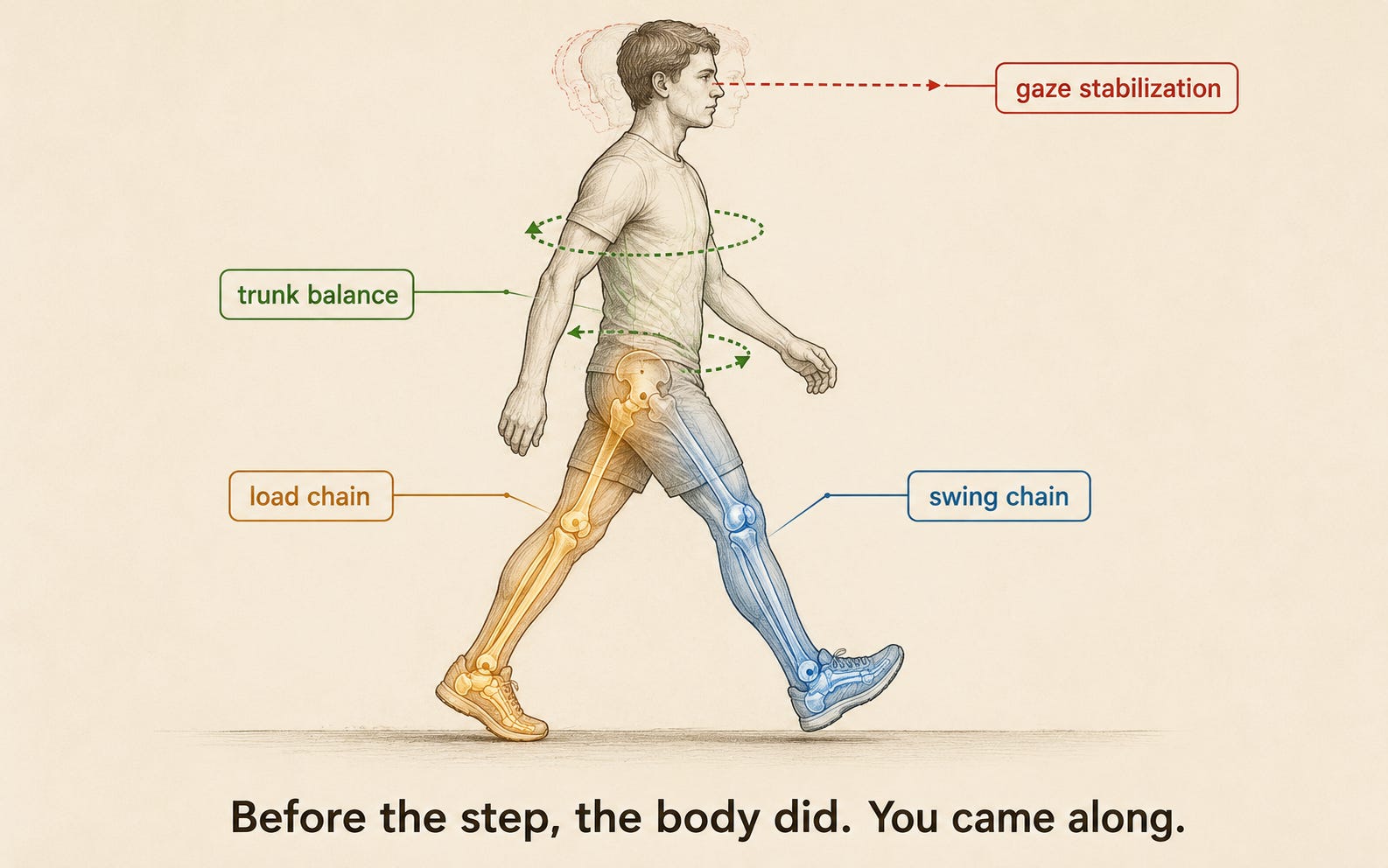
This is the territory Chapter 2 enters. The cognitive agent is, first and before anything else, a body — a particular kind of body, with a particular evolutionary history, organized in particular ways that the rest of cognition then builds on. If we want to understand what makes science possible, we have to understand what kind of agents we are. And what kind of agents we are starts at the level of an organism that does what your body just did when you took that step.
That is the promise of Chapter 2: to take seriously the claim, which Chapter 1 only gestured at, that the body is not the implementation detail of cognition but its constitutive ground. The eight chapters of this series are arranged so that the body comes first — before language, before instruments, before institutions, before science. Not because the body is more important than these. Because none of them work, or even mean what they mean, without it.
The compass we just built
Chapter 1 closed with a compass: three layers (the habitat/memetat dialectic, the triadic lens, the snapshot/stream architecture) and five demarcations. The compass tells you which direction is which. The map is the territory ahead.
Chapter 2 is the first stretch of that map. The terrain it covers is the biological and embodied turn in cognitive science — the long, mostly twentieth-century work of recovering the body as the ground of mind. Phenomenology, genetic epistemology, autopoiesis, the sensorimotor account of perception: each of these is a tradition that, in its own way, refused to let the body be peripheral. We will walk through them in turn.
But before we step into that terrain, we have to look back at what cognitive science was responding to. Because the biological turn was a turn away from something specific — and that something was not a mistake. It was a discipline. And it left behind a structure that we cannot ignore.
The bracket
Cast your mind back to the late nineteenth century. Psychology was a young discipline, struggling to be taken seriously as a science. Its primary method was introspection: trained observers would examine their own mental states and report what they found. The trouble was that different observers, trained in different laboratories, reported different things. There was no public adjudication. No reproducibility. No shared observational basis.
In 1913, John Watson stated the response plainly. If psychology is to be a science, it must confine itself to what can be publicly observed. The action patterns of organisms — what they do in response to what — are measurable, reproducible, quantifiable. Everything else — intentions, images, feelings, the contents of consciousness — is to be set aside. Not denied. Bracketed. Treated as methodologically inaccessible and therefore, for the purposes of the science, outside the scope of inquiry.
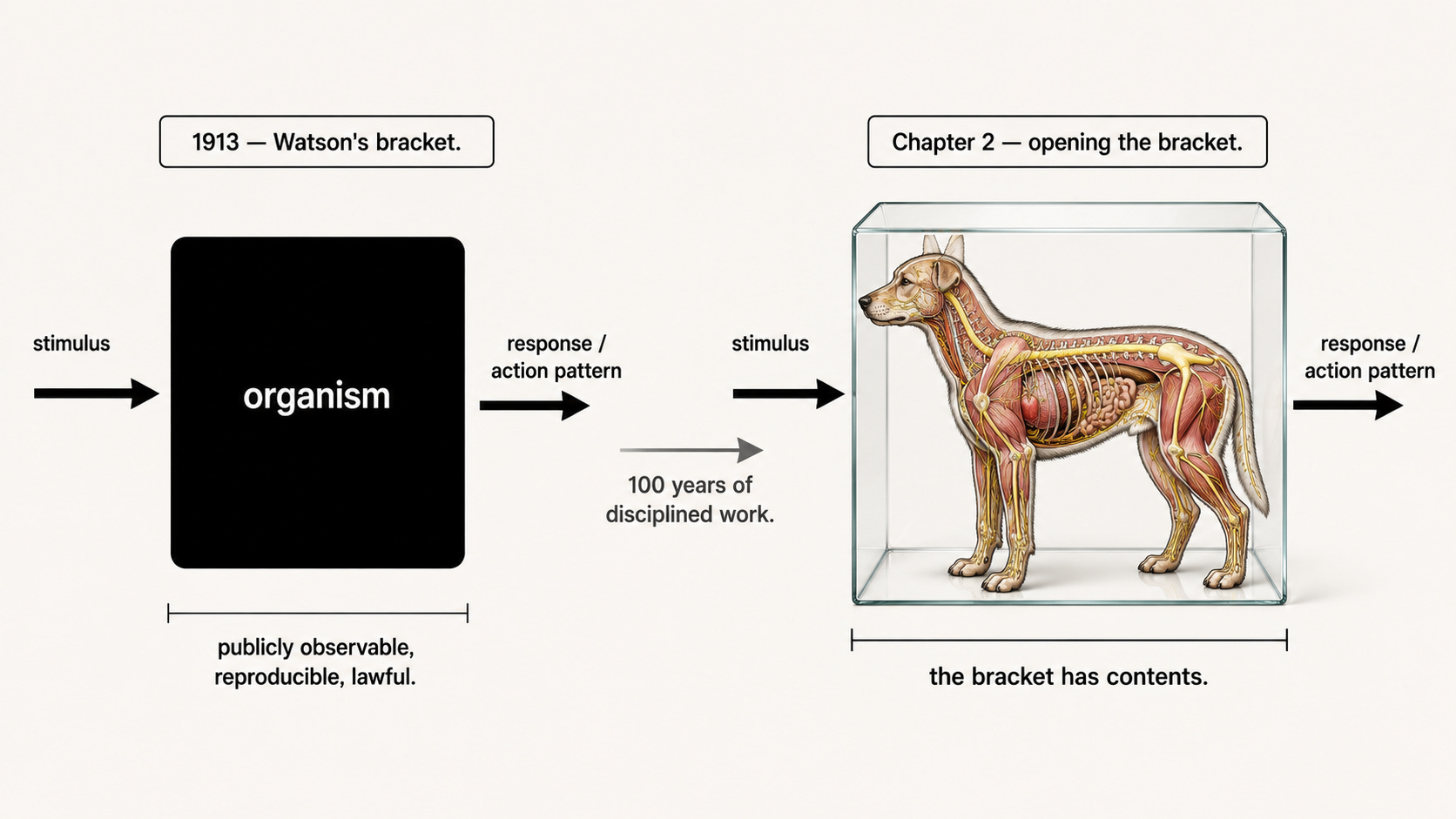
This is what behaviorism did. And what I want to be clear about, before going any further, is that this was not a mistake. It was a principled methodological choice that, in the terms of its own project, was enormously productive.
What behaviorism achieved
Ivan Pavlov showed that a dog could be conditioned to salivate at a bell. Classical conditioning: the systematic transfer of a response from an unconditioned to a conditioned stimulus through repeated pairing. The point is not the salivation. The point is the learning. The organism’s repertoire of action is being modified by its history of encounters with the environment. The agent, through exposure, reorganizes what it does and when.
Edward Thorndike contributed the law of effect: action patterns followed by satisfying consequences are repeated; action patterns followed by unsatisfying consequences are suppressed. The environment, through its consequences, shapes the repertoire of the agent. Already, in embryo, this is a picture of an organism in a loop with its world.
B. F. Skinner took these ideas further than anyone. Operant conditioning — the systematic shaping of action patterns by reinforcement schedules — became one of the most powerful applied paradigms psychology has ever produced. Extraordinarily complex behavioral sequences, precisely timed performances, intricate problem-solving routines: all of these can be built up through the selective reinforcement of successive approximations. The timing, frequency, and predictability of reinforcement affect what the agent does, in lawful and quantifiable ways.
Here is the part of the story that gets lost in standard textbook narratives: behaviorism never went away. It was not refuted. It was not displaced. Reinforcement remains one of the most widely applied paradigms in clinical psychology, in animal training, in education, in artificial intelligence. Reinforcement learning — the computational framework that drives game-playing systems, robotic controllers, and the alignment of large language models — is behaviorism formalized and scaled. The law of effect, in mathematical dress, drives systems that outperform the best human players at chess, Go, and StarCraft.
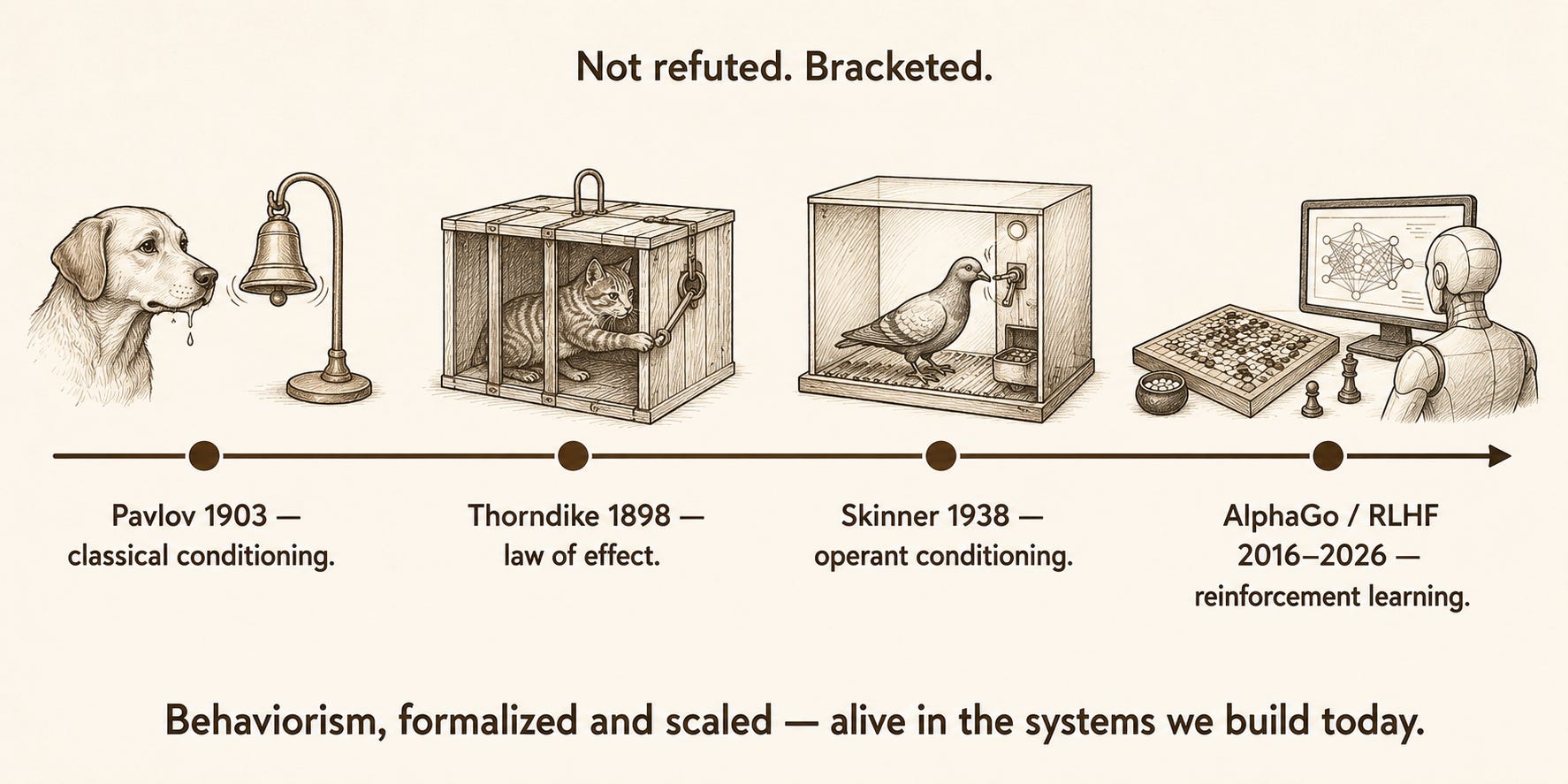
So when I say cognitive science moved from behavior to biology, I am not saying behaviorism failed. I am saying it was designed to do a specific job. And it did that job brilliantly. The question is what it was designed to leave out.
What the bracket excluded
The behaviorist methodological decision was to bracket the organism’s internal organization. The organism is, for purposes of the science, a black box: stimulus in, response out. The relationship between them is the object of study. What happens inside is, by methodological fiat, outside the inquiry.
This was not ignorance. Skinner knew, of course, that organisms had internal states. He chose not to investigate them — because to invoke unobservable internals would reintroduce the very problem behaviorism had been designed to overcome. If you postulate internal representations, mental images, cognitive schemas, you are back to arguing about entities that no experiment can decisively adjudicate.
The bracket was a discipline. And for the questions behaviorism was asking — what environmental contingencies produce what action patterns, and how reliably — the discipline was appropriate, and the answers were real.
But the bracket has contents. And at some point the questions inside the bracket become unavoidable. Not because behaviorism asked the wrong questions, but because the agent inside the black box is not arbitrary. It is a body. A particular kind of body. Organized in particular ways. And those ways turn out to matter — not as implementation details, but as conditions of possibility for the very behavior the science was trying to explain.
Why “first,” not “also”
Here is the move that defines Chapter 2. Cognitive science of science does not add the body to its picture alongside mental states, language, reasoning, and institutional structure. It puts the body underneath them — as the ground without which none of the others is what it is.
Three reasons, briefly, to be developed across the chapter.
One. Higher cognition is not free-standing. The mathematical reasoning of a physicist, the diagrammatic thinking of a chemist, the conceptual analysis of a philosopher — each of these is performed by an embodied agent whose perceptual, attentional, and motor architecture shapes the very form of the thinking. Drop the body, and you do not get cleaner cognition. You get a description of cognition that no longer attaches to anyone in particular.
Two. The body is what binds cognition to a world. The thermometer puzzle that opened this series — two readings, two cities, agreement to within a degree — is a puzzle because there is a body holding the instrument, and another body across the world also holding one, and the agreement between them is not an agreement of inner experiences but of coupled bodies engaged with calibrated material in shared protocols. Take the body out, and the agreement becomes mysterious all over again.
Three. Understanding the body teaches us what cognition is for. Cognition is not, in its origin, the construction of inner pictures of an outer world. It is the navigation of an environment by an agent whose survival depends on getting that navigation right. The body is where that navigation happens. It is where the pressures of selection do their shaping work. It is where the structures we call cognitive — attention, anticipation, memory, learning — first acquire their function.
None of these three claims is something we can simply assert. Each one has to be earned by walking through the traditions that established it. That is what the remaining episodes of Chapter 2 will do.
The terrain ahead
Six stops, in roughly chronological order of when each tradition entered the conversation.
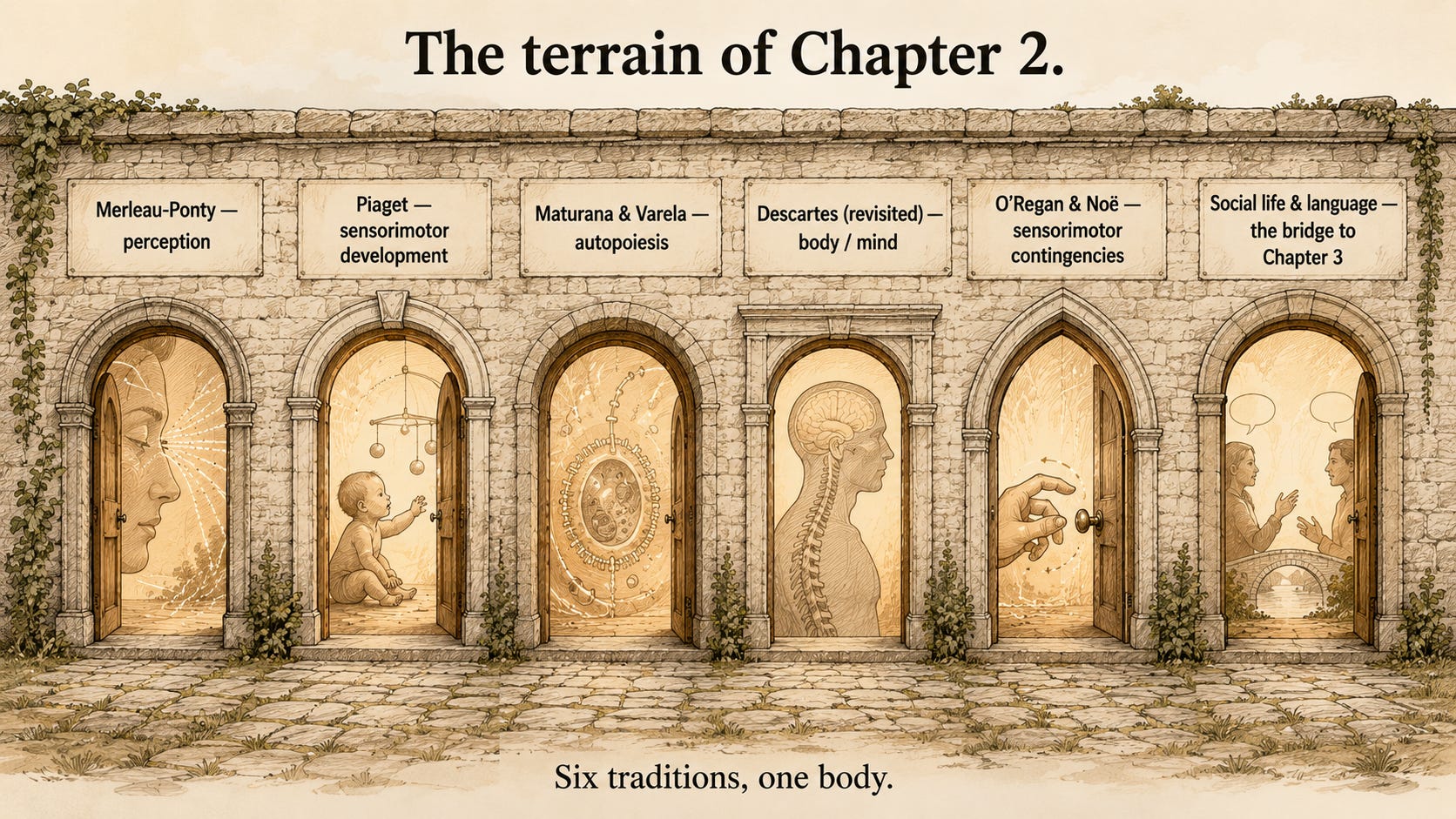
Merleau-Ponty on perception — the body as the subject of perceiving, not the object that gets perceived. The Cartesian split, opened from the body’s side.
Piaget on the biology of intelligence — cognition as the developmental elaboration of sensorimotor schemas. The infant’s reaching as the beginning of knowing.
Maturana and Varela on autopoiesis — life as a circular organization that produces itself, and cognition as what such an organization does when it engages with an environment.
A recurring revisit of Descartes — because the body/mind problem he bequeathed to modern philosophy is the problem each of these traditions is, in its own way, working to dissolve.
O’Regan and Noë on sensorimotor contingencies — perception as the practical mastery of how sensory inputs change as the body moves. Seeing as a way of acting.
And finally social life and language as the bridge — because no body navigates alone, and the social dimension of cognition is already implicit in the bodies that practice it. Chapter 2 ends where Chapter 3 will pick up.
What this chapter is, and is not
What Chapter 2 is: a guided tour through the traditions that, between them, recovered the body as the constitutive ground of cognition. Not as a complete history. Not as a definitive synthesis. As a working set of resources for the larger project of grounding science in what kind of agents we are.
What Chapter 2 is not: a refutation of behaviorism. Behaviorism handled what it could handle, and what it handled remains real. The bracket it placed was disciplined and productive. Chapter 2 is what comes after the bracket — not against it.
What this means for you, the reader. By the end of Chapter 2 you should have, not a finished theory of embodied cognition, but a working sense of why the body cannot be left out, and what kind of theoretical resources are available for putting it in. The map will not be complete. But it will, for the first time, have terrain on it.
Take-home point. Behaviorism’s bracket was a principled discipline that gave psychology a public, reproducible method — and it never went away (reinforcement learning is its mathematical descendant). But the bracket has contents. Inside it is a body: organized, evolved, situated, doing the work of navigation by which cognition first acquires its function. Chapter 2 opens that bracket — not to refute behaviorism, but to put the body back where the rest of the science can build on it.
Next: “Merleau-Ponty and the body that perceives” — we begin the patient work of opening the bracket with the twentieth-century thinker who, more than any other, made the body’s standpoint legible to philosophy.
Image prompts used for this post (click to expand — try them on your own AI model and compare results)
1. The Body Took the Step
Output format: PNG. A single human figure mid-stride, seen from the side in soft anatomical line-art style — not a stick figure, but a real body with weight and balance. Translucent overlays mark the participating systems: the supporting leg's load-bearing chain (foot, ankle, knee, hip) in warm amber; the swinging leg in cool blue; the trunk's counter-rotation in dotted green; the eye line held steady against the rocking head in red. Each system labeled with a small tag: "load chain," "swing chain," "trunk balance," "gaze stabilization." Caption below: "Before the step, the body did. You came along." Subtle, anatomical, not cartoony. Warm neutral background. Landscape (16cm × 10cm).
2. The Bracket
Output format: PNG. A schematic in two halves. LEFT: the behaviorist diagram — an arrow labeled "stimulus" enters a solid black box labeled "organism"; an arrow labeled "response / action pattern" exits. The box is opaque. Above the box, a small label reads: "1913 — Watson's bracket." Below: "publicly observable, reproducible, lawful." RIGHT: the same diagram, but the box is now transparent glass, and inside it is a recognizable mammalian body in cross-section — muscles in opposing pairs, a spinal cord, a beating heart, a peripheral nerve plexus, no isolated brain icon. Above the glass box: "Chapter 2 — opening the bracket." Below: "the bracket has contents." A small arrow between the two halves labeled "100 years of disciplined work." Clean schematic, sans-serif, neutral palette. Landscape (16cm × 9cm).
3. Reinforcement Did Not Go Away
Output format: PNG. A horizontal timeline running left to right, with four nodes evenly spaced. Each node has a small illustrative icon above it and a label below. LEFT node — a dog and a bell, labeled "Pavlov 1903 — classical conditioning." Second node — a cat in a puzzle box, labeled "Thorndike 1898 — law of effect." Third node — a pigeon pecking a key in a Skinner box, labeled "Skinner 1938 — operant conditioning." RIGHT node — a game board (Go or chess) with a humanoid silhouette in front of a screen, labeled "AlphaGo / RLHF 2016–2026 — reinforcement learning." A continuous line connects all four. Caption below the timeline (large): "Behaviorism, formalized and scaled — alive in the systems we build today." Caption above (smaller): "Not refuted. Bracketed." Sketch-line style, warm earthy palette. Landscape (16cm × 8cm).
4. Six Doorways into the Body
Output format: PNG. A wide stone wall with six doorways cut into it, each doorway slightly different in proportion or arch style, but all opening onto a softly lit interior — a hint of bodily organization (a curved spine, a hand, a heart, a moving figure) glimpsed through each. Each doorway labeled at the top with a tradition: (1) "Merleau-Ponty — perception," (2) "Piaget — sensorimotor development," (3) "Maturana & Varela — autopoiesis," (4) "Descartes (revisited) — body / mind," (5) "O'Regan & Noë — sensorimotor contingencies," (6) "Social life & language — the bridge to Chapter 3." Above the wall, large caption: "The terrain of Chapter 2." Below the wall, smaller caption: "Six traditions, one body." Stone-and-warm-light aesthetic, sketched architectural style. Landscape (16cm × 9cm).
The same stream (prompts) activates different snapshots (models) in different receivers (agents). Try the prompts above on your own AI model and compare what it produces with our figures.
This is “The Roots of STEM,” a series exploring the cognitive bases of science, technology, engineering, and mathematics. Subscribe to follow the arc from the body to the laboratory.